Intercom Fin
AI-native messaging, outcome-based pricing, fastest path to autonomous resolution
Vergleich
AI Resolution, Pricing, and Helpdesk Fit Compared
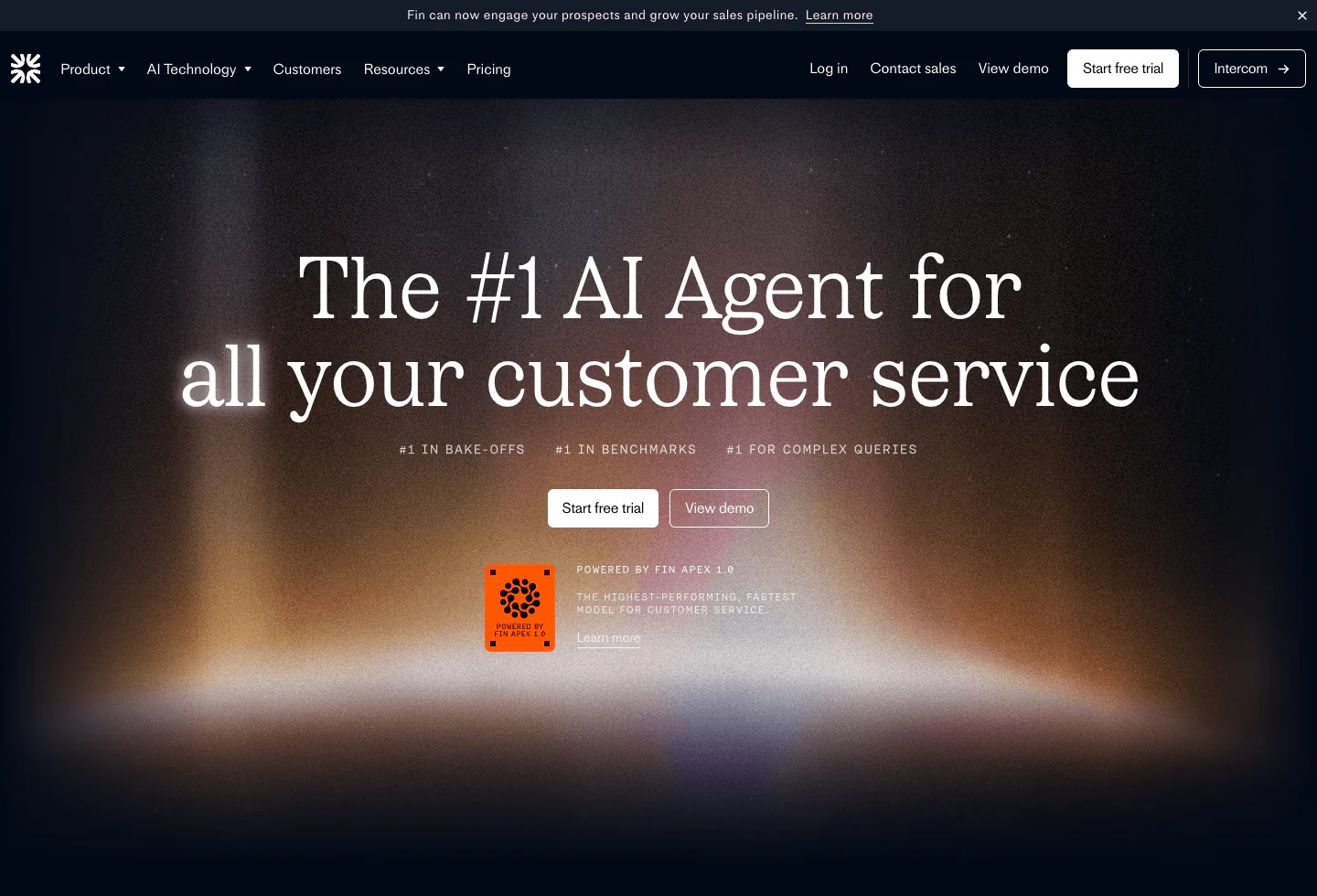
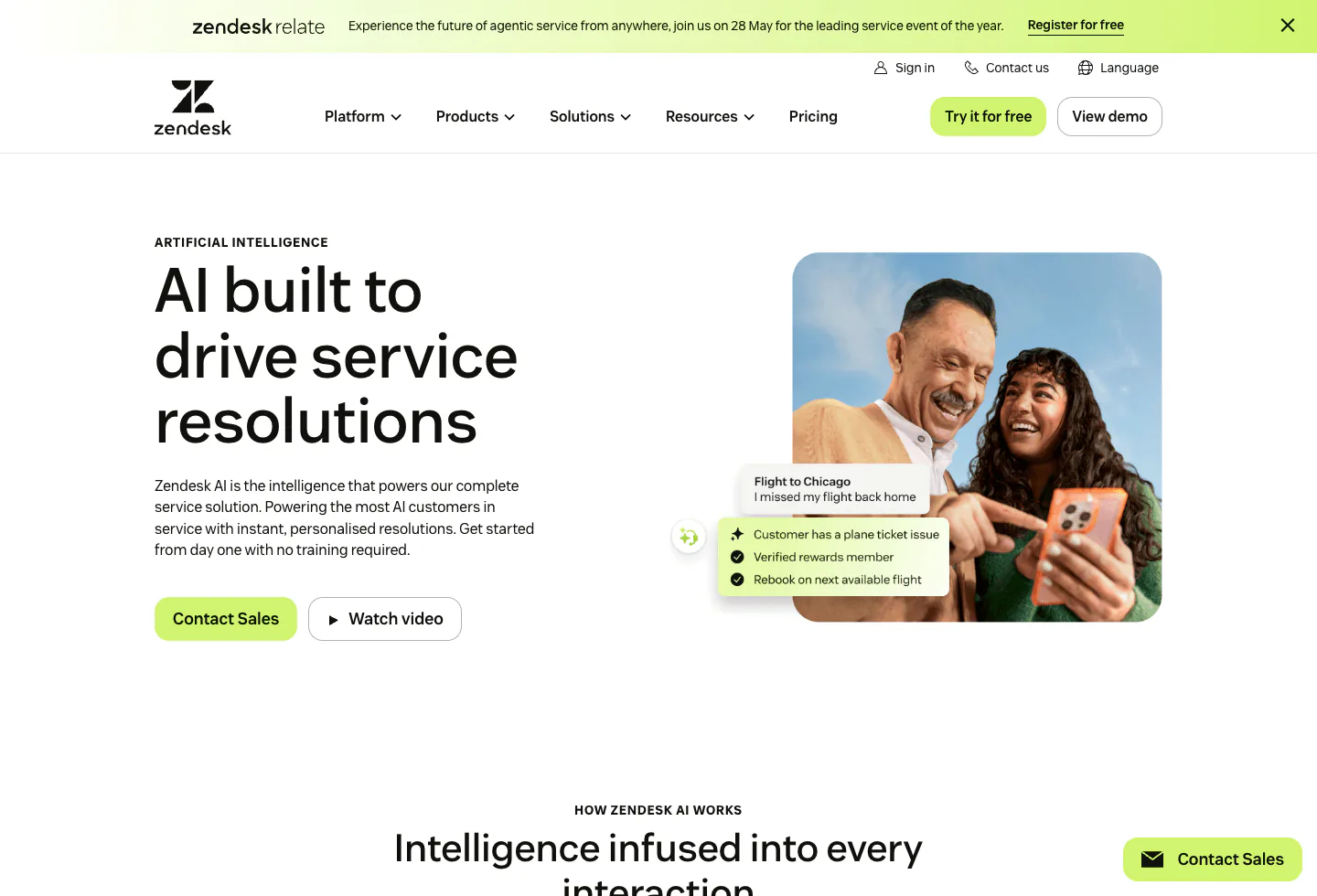
Intercom Fin and Zendesk AI are the two most common AI support platforms in enterprise shortlists, but they were built for different operating models. Intercom is messaging-first and AI-native. Zendesk is ticketing-first and governance-heavy. The right choice depends on how you define a resolution, how costs scale with volume, and whether support, sales, and product teams need to share one workspace.

AI-native messaging, outcome-based pricing, fastest path to autonomous resolution
Enterprise ticketing, SLA governance, layered AI on a mature helpdesk
Aktualisiert Beste KI-Agent-Tools
Wählen Sie Intercom Fin, wenn
Wählen Sie Zendesk AI, wenn
Evaluation methodology
We compared Intercom Fin and Zendesk AI as buyer-fit choices, not as a simple feature checklist. The scoring weights real resolution evidence, pricing transparency, operating-model fit, implementation effort, governance depth, channel coverage, and the quality of human handoff.
Official product pages and help-center documentation from Intercom and Zendesk as of August 2026; third-party production benchmarks and pricing teardowns from CloneDesk, Yaplet, Layer3 Labs, Automation Atlas, Coworker AI, and GetMacha; and the editorial buyer-fit framework published on this site.
We did not run a private head-to-head benchmark, quote customer case studies we cannot verify, or state fixed prices where vendors require custom quotes. All dollar figures outside official pages are labeled as reported or estimated.
Treat every number as a starting point for your own demo and pilot. The most important validation is running the same workflow, with your own knowledge base and ticket taxonomy, on both platforms.
Proof point
Resolution rate is the most consequential AI metric, but every vendor defines it differently. A resolution can mean the customer confirmed satisfaction, the conversation ended without escalation, or the AI simply provided the last answer. Before comparing claims, ask each vendor to define the denominator and to exclude abandoned sessions and follow-up tickets opened within 72 hours.
| Plattform | Vendor claim | Production evidence | Quelle |
|---|---|---|---|
| Intercom Fin | 76% average resolution across 8,000+ customers | 45–53% in production analysis of SaaS and ecommerce helpdesks | Intercom blog, Mar 2026; CloneDesk benchmark, 2026 |
| Zendesk AI | 50–80% in marketing and case-study ranges | 30–50% real-world; one documented deployment logged 44% | Intercom learning center comparison, 2026; CloneDesk Vagaro analysis, 2026 |
| Generic RAG baseline | — | 18–24% on complex multi-step enterprise tasks | Independent benchmark, Jan 2026 |
Why the gap matters: Vendor dashboards often count no human touch as success, which includes customers who gave up or opened a second ticket through another channel. An honest baseline for most teams is 15–25% before AI, and a validated 60–70% is strong. Any claim above 70% should be pressure-tested against your actual ticket mix.
Cost modeling
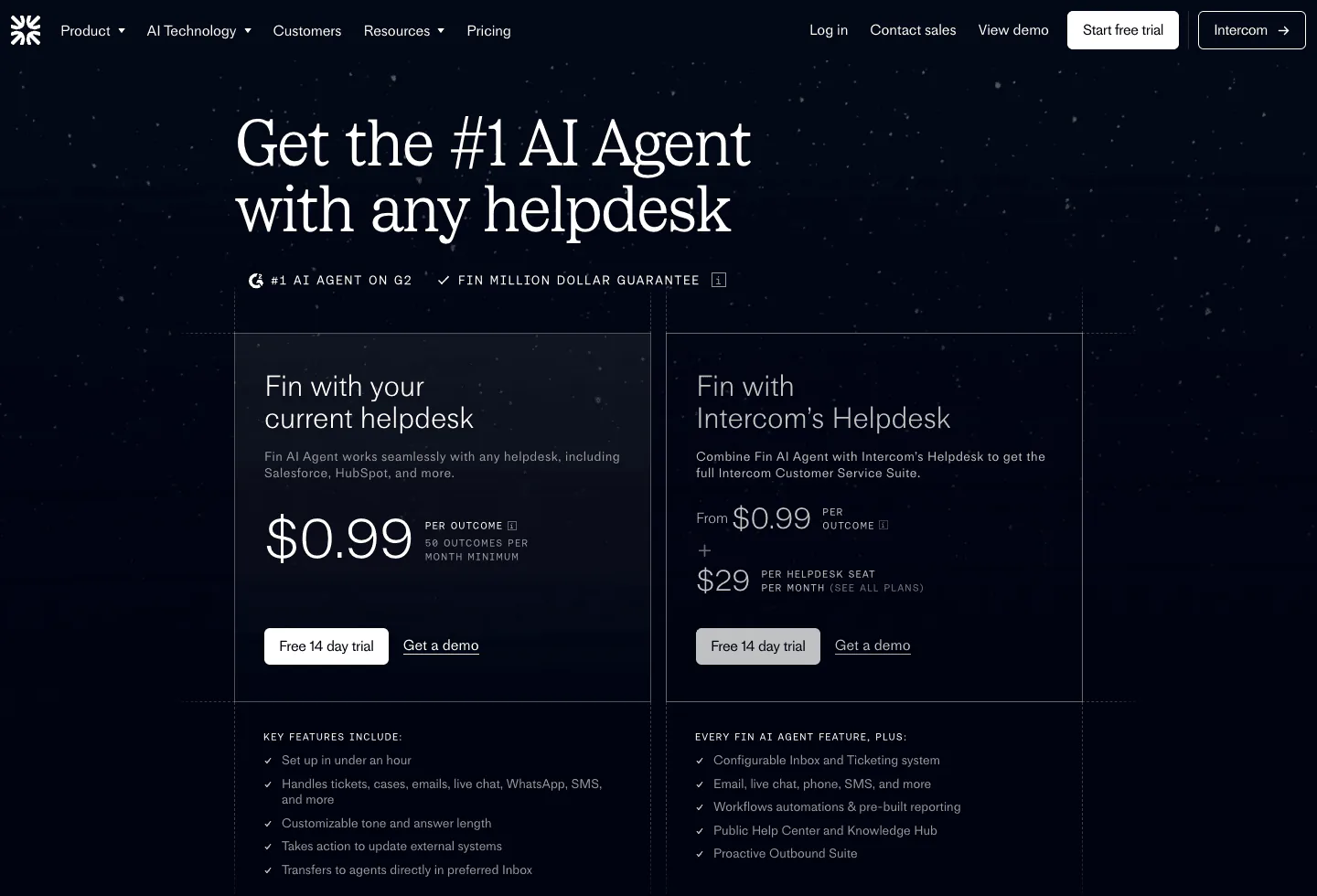
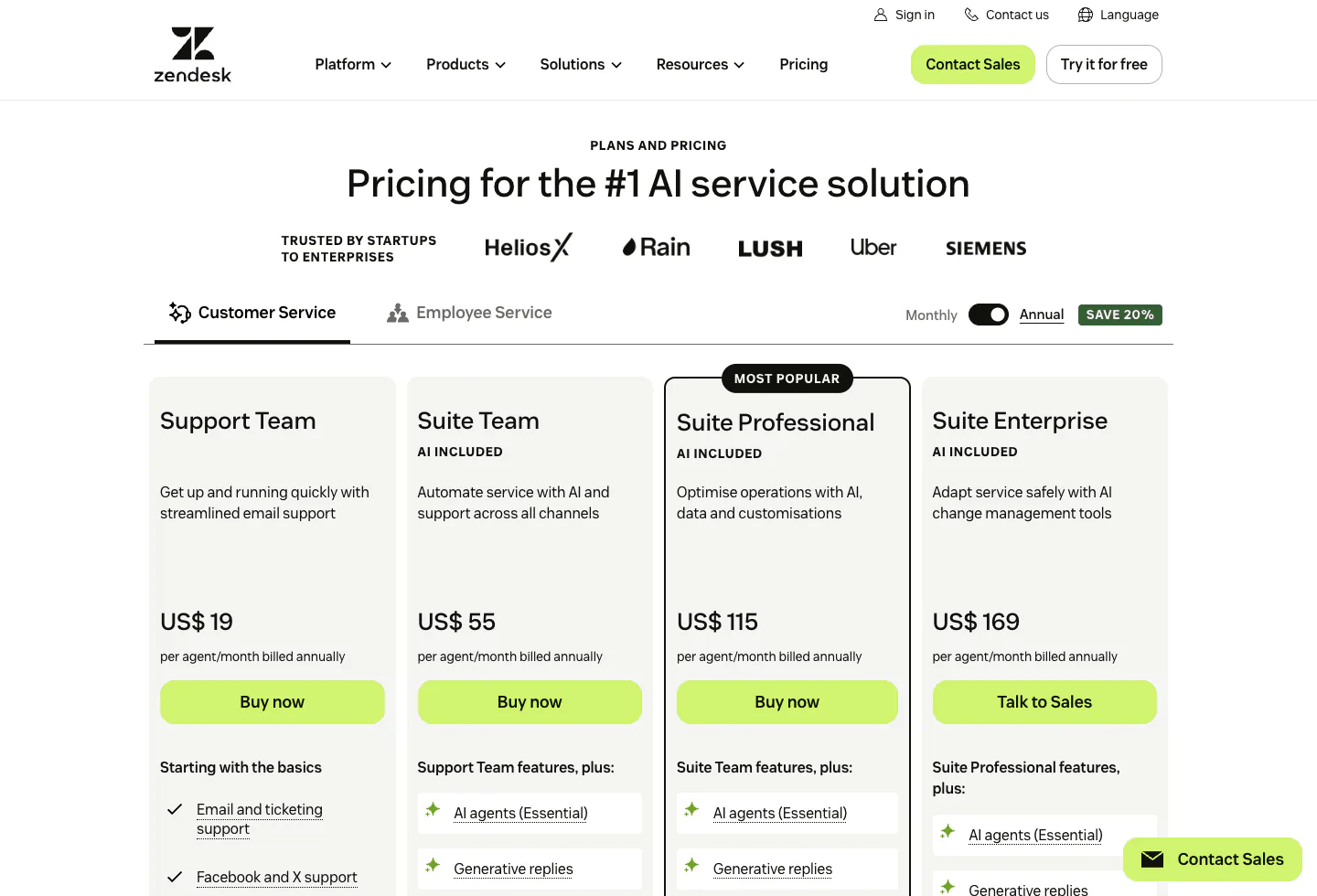
Both vendors moved toward outcome-based AI pricing in 2026, but their cost curves differ. Intercom publishes a single per-outcome rate. Zendesk layers seat fees, a Copilot add-on, included automated-resolution allowances, and overage charges. The cheaper option depends on your seat count, resolution volume, and how many add-ons you need.
| Kostenschicht | Intercom Fin | Zendesk AI |
|---|---|---|
| Base seat | Essential ~$29/mo, Advanced ~$85–$99/mo, Expert ~$132–$139/mo (reported) | Suite Team $55, Growth ~$89 (not public), Professional $115, Enterprise $169 per agent/mo (official) |
| AI agent pricing | $0.99 per outcome (resolution, procedure handoff, disqualification); $9.99 per sales qualification; 50 outcomes/mo minimum for standalone Fin (official) | 5–15 automated resolutions included per agent/mo; overage reported at ~$1.50 committed / ~$2.00 pay-as-you-go (third-party estimate) |
| Agent-assist add-on | Copilot $35 per user/mo (official) | Copilot $50 per agent/mo on Professional+ (official) |
| Other common add-ons | Pro $99/mo, Proactive Support Plus $99/mo, usage-based messaging channels | Workforce Engagement $50, Contact Center $83, QA and WFM add-ons ~$25–$35 each |
| Preistransparenz | Outcome rate published; seat pricing not always visible | Seat tiers published; per-resolution overage rate not published |
These numbers are illustrative; get a current quote before budgeting. They assume annual billing and include agent-assist Copilot on both sides.
| Line item | Intercom Fin (Advanced + Copilot) | Zendesk AI (Professional + Copilot) |
|---|---|---|
| Seats | 20 × $85 = $1,700 | 20 × $115 = $2,300 |
| Agent-assist | 20 × $35 = $700 | 20 × $50 = $1,000 |
| AI resolutions | 1,000 × $0.99 = $990 | 200 included, 800 overage × ~$1.50 = ~$1,200 |
| Estimated AI + seat total | ~$3,390/mo | ~$4,500/mo |
At low resolution volume, Intercom published per-outcome rate usually wins. At very high volume with many included Zendesk allowances, the gap narrows, but Zendesk uncapped overage meter can still surprise you. Model your own volume, not the marketing sticker.
Workflow design
Intercom treats support as a continuous conversation inside a shared inbox. The AI agent can answer, ask clarifying questions, run Procedures, and hand off to a human while preserving the full transcript. It is faster to deploy but offers lighter ticket-field discipline and SLA enforcement.
Zendesk treats every issue as a ticket with a lifecycle: new, open, pending, solved, closed. Macros, triggers, automations, SLAs, and custom fields govern how work moves. This adds setup overhead but gives large teams precise control over queue ownership, compliance, and reporting.
The choice usually comes down to whether your team thinks in chats or tickets. If agents already use macros, views, and SLA dashboards, Zendesk feels natural. If they expect a modern messenger experience, Intercom fits better.
Under the hood
| Dimension | Intercom Fin | Zendesk AI |
|---|---|---|
| Core model | Patented Fin AI Engine with proprietary fin-cx-retrieval and fin-cx-reranker models trained for support | General-purpose LLMs layered with Ultimate.ai (2024) and Forethought (2026) technology for triage and autonomous agents |
| Knowledge grounding | Help center articles, past conversations, custom data connectors, Shopify, Stripe, Salesforce, Linear | Help center, ticket history, macros, and customer data inside Zendesk; external actions via Action Builder and integrations |
| Autonomous actions | Procedures: multi-step workflows that can read/write external systems and hand off to humans | AI agents with Flow Builder, macros, triggers, and API actions; advanced agentic features folded into Suite plans in 2026 |
| Resolution verification | Outcome counted when customer confirms or exits without further help; frustration escalations are not billed | Three tiers: Assisted Escalation free, Contained Resolution free, Verified Resolution billable after independent LLM check |
| Continuous improvement | Train, Test, Deploy, Analyze flywheel with Simulations, Regression Tests, CX Score | Intelligent triage, quality assurance from Klaus, workforce management from Tymeshift, and analytics dashboards |
Practical implication: Fin is architected as a customer-service AI agent first and a helpdesk second; it can also run standalone on top of Zendesk or Salesforce. Zendesk is a mature helpdesk first and is layering AI on top through multiple acquisitions, which can create configuration seams.
Omnichannel coverage
Messenger, email, SMS, WhatsApp, Instagram, Facebook, Slack, Discord, and in-app messaging are available. Fin Voice offers AI-powered voice. Channel usage is generally pay-as-you-go beyond core plans.
Email, messaging, help center, native voice through Zendesk Talk, and social channels via Sunshine Conversations or integrations. The contact-center add-on adds AWS-backed telephony. Social-native channels often require an extra connector and separate billing.
If your customers live on Slack, Discord, or in-product messaging, Intercom has the broader native map. If voice and formal contact-center operations are central, Zendesk is the stronger starting point.
Time to value
Standalone Fin can be connected to an existing helpdesk in under an hour, per Intercom own documentation. A full Intercom helpdesk rollout with workflows and knowledge tuning typically takes days to a few weeks. Intercom reports self-managed teams reach about 59% resolution in 33 days and professional-services customers reach about 68% in 20 days.
A Zendesk implementation commonly runs 2–4 months for mid-market teams and longer for enterprise. Triggers, macros, custom fields, SLA policies, routing rules, and AI add-ons all need to be configured and tested. Teams of 50+ agents often hire a Zendesk consultant or partner.
Migration watch-out: Moving from one platform to the other typically takes 3+ weeks for tickets, help center articles, macros, and user data. Rebuilding automations is usually manual.
Control and compliance
| Requirement | Intercom Fin | Zendesk AI |
|---|---|---|
| Ticketing governance | Unified inbox with roles and permissions; lighter ticket-field and SLA control | Deep: SLAs, skills-based routing, custom fields, macros, approval workflows, sandbox |
| Audit and reporting | Pre-built reports, custom reports on Advanced+, CX Score, AI Topics | Advanced analytics, custom dashboards, quality assurance, workforce management add-ons |
| Compliance certifications | SOC 2 Type II, ISO 27001, ISO 42001, HIPAA on Expert, GDPR | SOC 2 Type II, ISO 27001, HIPAA, PCI DSS, GDPR, data residency options |
| Data and AI governance | Spend caps, usage limits, ISO 42001 for responsible AI | Custom agent roles, sandbox, data residency, but per-resolution meter is auto-billed and uncapped unless negotiated |
Regulated industries and large operations usually prefer Zendesk control surface. Teams that value speed and AI-native UX over ticket-field discipline usually prefer Intercom.
Buyer personas
Intercom wins when product, support, and sales teams share a messaging-first workspace and want AI to resolve a high share of repetitive questions quickly.
Both can work, but Intercom Shopify and Stripe connectors plus Fin for Ecommerce give it an edge for storefront-aware automation. Zendesk can handle high-volume order-driven queues if paired with vertical integrations.
Zendesk is the safer default when SLA enforcement, native voice, PCI or HIPAA, and multi-tier routing are required. Fin can be added on top if you want its AI resolution layer without migrating.
Fin can run standalone on Zendesk, Salesforce, Freshdesk, HubSpot, and others at $0.99 per outcome. This is a lower-risk way to test autonomous resolution before replacing your helpdesk.
Risk check
Intercom Fin
Zendesk AI
Proof points
Verwenden Sie für beide Plattformen die gleichen Beweisanfragen, damit der Vergleich fair und funktionsfähig bleibt.
| Bereich | Fragen Sie nach | Warum es wichtig ist |
|---|---|---|
| Resolution definition | Show exactly what counts as resolved, including how abandoned sessions and follow-up tickets are handled. | Dashboard vanity metrics can be 20–35 points higher than real production resolution. |
| Wissensqualität | Eine Demo mit Ihren Hilfedokumenten, Richtlinien, Produktseiten und echten Randfällen. | Generische Demos verbergen veraltete Inhalte, schwache Abrufmöglichkeiten und schlechte Antwortgrenzen. |
| Übergabe | Eine Live-Eskalation von der KI zum Menschen, wobei Transkript, Absicht und Kontext erhalten bleiben. | Die Qualität des Supports sinkt, wenn sich Kunden nach einem Fehler bei der Automatisierung wiederholen. |
| Workflow-Aktionen | Ein Sandbox-Workflow, der zeigt, was der Agent lesen, schreiben, genehmigen oder weiterleiten kann. | Dies trennt die einfache Beantwortung von Fragen von der echten Agentenautomatisierung. |
| Preisexposition | Plan requirements, usage limits, AI add-ons, included allowances, and overage terms at your expected volume. | Ein Plan mit niedrigem Einstieg kann teuer werden, wenn Gespräche, Sitzplätze oder Vorsätze zunehmen. |
| 72-hour follow-up | A report of AI-resolved conversations that generated a follow-up ticket within 72 hours. | This exposes the gap between no human touch and issue actually solved. |
Widen the shortlist
Neither platform is the right default for every workflow. Evaluate adjacent tools when the operating model, channel mix, or budget points elsewhere.
Beweisspur
These are the primary pages we used for claims and pricing. Visit them directly before procurement because packaging changes frequently.
FAQ
There is no universal answer. Intercom publishes a $0.99 per-outcome AI rate and generally has lower seat fees for small teams. Zendesk has higher seat fees and a $50/agent Copilot add-on, but includes a small number of automated resolutions per agent. The cheaper option depends on your seat count and how many AI resolutions you consume. Model both at your expected volume.
Intercom publishes the highest average resolution rate at 76% across 8,000+ customers, while independent production analysis puts real-world Fin performance closer to 45–53%. Zendesk markets 50–80% but production analysis commonly sees 30–50%. The most important factor is how resolution is defined and whether it is validated against your own ticket mix.
Yes. Fin can run as a standalone AI agent on top of Zendesk, Salesforce, Freshdesk, HubSpot, and other helpdesks at $0.99 per outcome. This lets you test autonomous resolution without a full platform migration.
Intercom Fin can be deployed in hours to days; a full Intercom helpdesk rollout usually takes days to a few weeks. Zendesk commonly takes 2–4 months for mid-market teams and longer for enterprise, especially when configuring triggers, macros, SLAs, and AI add-ons.
Intercom is strong for storefront-aware automation through Shopify and Stripe connectors and Fin for Ecommerce. Zendesk can handle high-volume order-driven queues but may need vertical integrations or Gorgias for deep store context.
For Intercom, set spend caps and usage reminders in the workspace, and audit assumed resolutions against follow-up tickets. For Zendesk, monitor the Automated Resolutions dashboard, negotiate an overage cap, and confirm whether your contract uses Verified, Contained, or Assisted resolution tiers.
Zendesk is the safer default for strict SLAs, PCI DSS, custom roles, sandbox environments, and data residency. Intercom offers HIPAA on the Expert plan and ISO 42001 AI governance certification, but its ticketing governance is lighter.
Yes, but plan for several weeks. Tickets, help center articles, macros, user data, and automations must be migrated, and automations usually need to be rebuilt manually.
Nächster Schritt
Nutzen Sie die Methodik, um Kanäle, Automatisierungstiefe, Übergabe, Integrationen und Implementierungspassung zu bewerten, bevor Sie eine Plattform in die engere Auswahl nehmen.
Lesen Sie weiter
Fahren Sie mit den Seiten fort, die die Auswahlliste, den Demoplan oder den Anbietervergleich am wahrscheinlichsten verbessern.