

Quick verdict
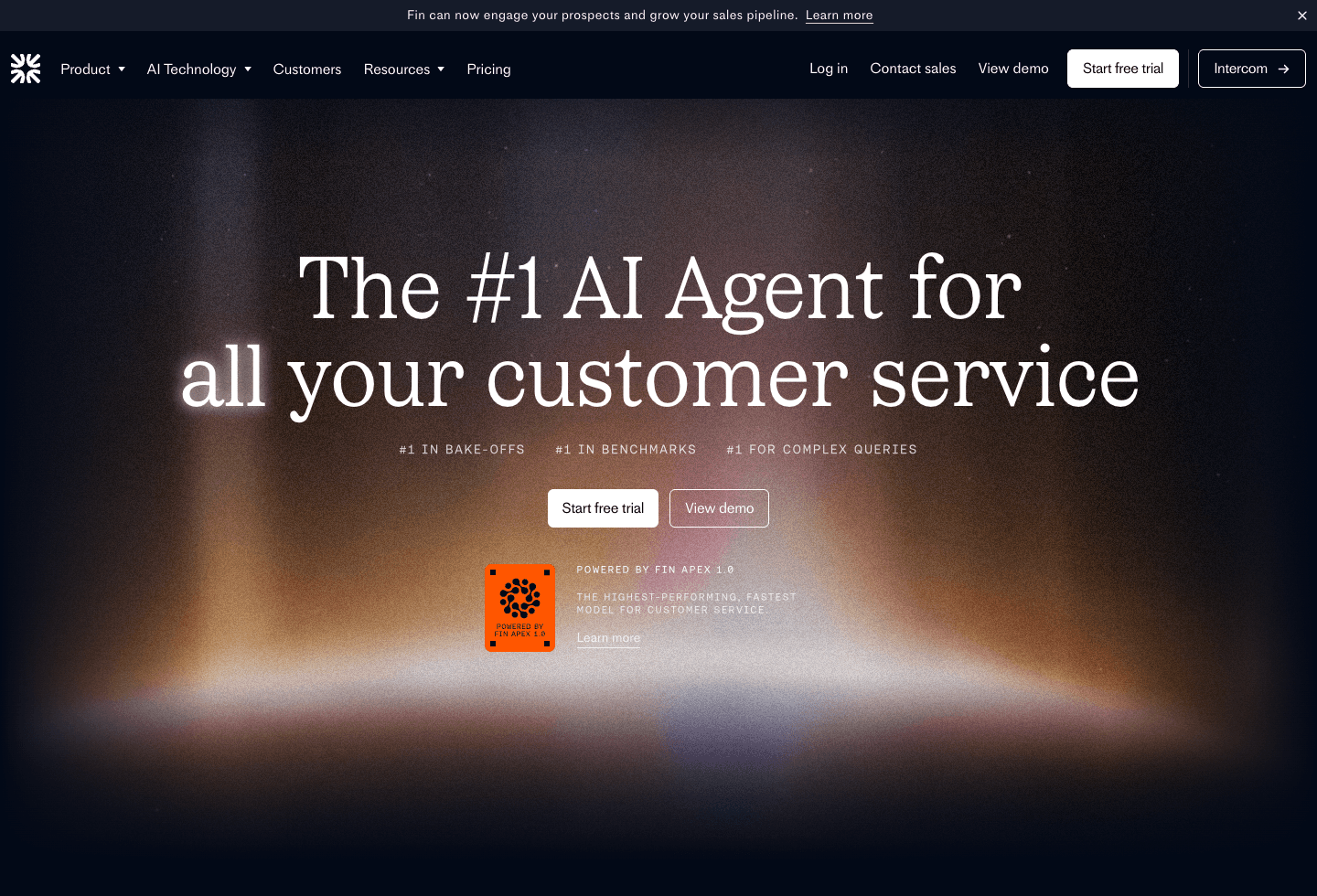
Intercom Fin is the right AI agent if your team already uses Intercom and you want a tightly integrated support bot trained on your helpdesk articles and conversation history. It is not a standalone omnichannel platform.
Editorial support fit signal
Evaluate firstRelevant for teams evaluating Fin with Intercom's suite or supported helpdesk setups. Verify helpdesk support, channel coverage, outcome pricing, add-ons, and inbox ownership before rollout. This is an editorial fit signal, not a user review average, benchmark result, vendor-provided rating, or measured performance claim.
How we evaluated this
We evaluated Fin around ecosystem fit and billing clarity. The practical test is not whether Fin can answer an FAQ in a demo; it is whether your help center, workflows, customer attributes, and handoff rules produce clean outcomes without surprising finance when volume spikes.
Setup observation
Outcome pricing needs a reopen policy
Fin's pricing has evolved from a simple resolution story toward broader outcome-based value. Buyers should ask exactly how reopenings, partial answers, multi-step procedures, and human transfers are counted in their contract.
- Define what counts as an AI outcome before the pilot begins.
- Track reopened conversations separately from first-contact AI answers.
- Set usage reminders or hard limits during launch week so a successful bot does not create an uncontrolled bill.
Pricing notes and cost model
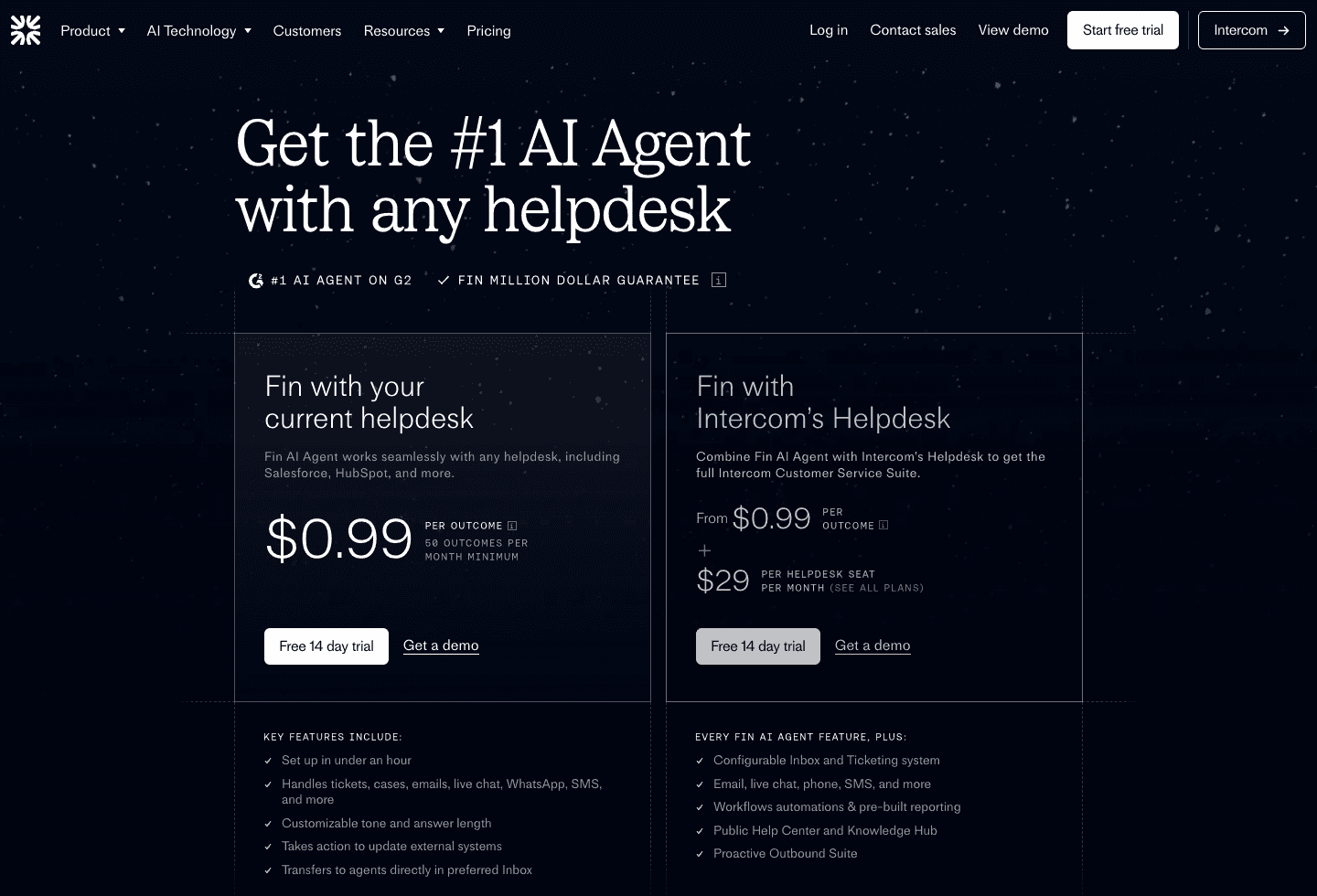
Fin has publicly described per-resolution pricing and, in 2026, a broader Outcomes metric for workflow value. Treat the billing unit as a contract definition, not a slogan. Factor in the Fin or Intercom base subscription, seats, included monthly outcomes or resolutions, usage limits, and any Copilot or proactive-support modules you need.
Who Intercom Fin fits best
Strengths
- Teams already invested in Intercom for messaging, helpdesk, and customer data
- Customer service teams that want AI trained on existing help center content
- Businesses evaluating outcome-based pricing (per resolution) versus seat-based pricing
Limitations to verify
- Teams that do not use Intercom or plan to migrate away from it
- Buyers who need native WhatsApp Business API or deep social messaging without middleware
- Organizations that require heavy ticketing governance, SLAs, and compliance audit trails
Workflow automation and handoff to test
Intercom Fin escalates to the Intercom inbox when confidence is low, a sensitive topic is detected, or the customer explicitly asks for a human. Agents see the AI's draft, the full conversation thread, and any custom data collected during the automated phase. Set up escalation rules for billing disputes, account cancellations, and VIP customer segments.
- Deflect repetitive support questions with AI-generated answers
- Qualify and route conversations before human agents see them
- Collect customer context (order number, account status) automatically
- Trigger follow-up messages based on resolution status
AI capability questions
- Natural-language answers synthesized from help center content
- Conversation escalation based on confidence scores and topic filters
- Agent assist with draft replies and internal note summaries
- Continuous learning from resolved conversations and agent corrections
Analytics and operating visibility
Fin provides resolution rate, source quality, conversation deflection metrics, and agent-assist adoption. We recommend asking how Fin distinguishes between 'resolved by AI' and 'handed off and then resolved' to avoid inflated deflection numbers.
Channel coverage to verify
- Intercom Messenger (website and in-app)
- Email via Intercom inbox
- Supported third-party messaging channels (SMS, WhatsApp via integrations)
- Help center search and conversational answers
Feature areas to verify
- AI support agent trained on Intercom help center articles and conversation history
- Fin AI Copilot for agent assistance and reply suggestions
- Automated conversation routing and qualification
- Resolution-based pricing with human-review controls
- Seamless inbox escalation with full transcript context
- Custom answers and tone-of-voice configuration
Questions to ask before buying
- Which Intercom plan tier and Fin add-on are required for our expected conversation volume?
- How does Fin define a 'resolved' conversation, and what happens if the customer reopens the ticket?
- Can Fin access our custom objects, user attributes, and past conversation history for personalized answers?
- Which channels are natively supported versus requiring a third-party integration or middleware?
- How do unresolved questions, answer edits, and handoff outcomes feed back into Fin's training loop?
- What is the total cost at our expected monthly resolution volume, including Intercom base plan and seat fees?
Red flags to control
- Fin is marketed as a standalone AI product but requires an Intercom plan and ecosystem commitment to function fully.
- Resolution-based pricing can spike during seasonal volume peaks or product launches if the bot's deflection rate is lower than projected.
- Deep helpdesk governance (SLAs, custom ticket fields, compliance audit trails) is not Intercom's primary strength.
- The vendor cannot show Fin answering accurately from your actual help center articles during a pilot.
Alternatives
- Zendesk AIChoose Zendesk AI when ticketing governance, SLA enforcement, and enterprise helpdesk operations are non-negotiable.
- YourGPT AIChoose YourGPT AI when you need native WhatsApp, Instagram, and email channels without committing to the Intercom ecosystem.
- ChatbaseChoose Chatbase for a simpler, cheaper website-first support bot if you do not need Intercom's broader customer communication suite.
Official sources to verify
Claim and source ledger
What this profile is based on
Public Intercom Fin product documentation, pricing pages, and integration guides published as of May 2026. We referenced Intercom's help center and public API documentation for channel and handoff details.
What we did not verify
We did not measure actual resolution rates, test response accuracy against a labeled dataset, or audit Fin's data-processing agreements. Buyers should run a pilot with real conversation history before scaling.
How we scored fit
Our editorial fit signal weights ecosystem lock-in, resolution-pricing transparency, and help center integration depth. It is not a performance benchmark.
Final verdict
Choose Intercom Fin when you want AI support to live inside Intercom and you are comfortable modeling cost around outcomes or resolutions rather than only seats. Choose Zendesk AI if your primary risk is SLA and ticket governance, YourGPT AI if native omnichannel reach matters more, and Chatbase if you need a lighter website-only agent.
FAQ
Common questions
What is Intercom Fin best used for?
Intercom Fin is best used for teams already on Intercom who want an AI support agent trained directly on their help center. It excels at deflecting repetitive questions and assisting human agents with draft replies inside the Intercom inbox.
Does Intercom Fin work without Intercom?
No. Intercom Fin requires an active Intercom subscription. It is designed as an add-on AI layer within the Intercom ecosystem, not as a standalone support platform.
How does Intercom Fin pricing work?
Fin has publicly used resolution-based pricing and, in 2026, moved its core pricing language toward Outcomes. Ask what counts as an outcome in your contract, which monthly subscription is required, how included allowances work, and whether usage reminders or hard limits are available.
Can Intercom Fin handle complex support workflows?
Fin handles standard deflection and routing well. Complex workflows involving custom objects, conditional branching, or multi-system integrations may require Intercom's workflow builder or third-party tools. Test your specific use case in a pilot.
Is Intercom Fin secure for sensitive customer data?
Review Intercom's current trust center, data-processing agreement, retention settings, and model-training commitments before routing sensitive customer conversations through Fin.
Intercom Fin vs Zendesk AI: which should I choose?
Choose Fin if your team is already on Intercom and values messaging-first support with outcome pricing. Choose Zendesk AI if you need robust ticketing, SLA management, and enterprise governance.
What are the main drawbacks of Intercom Fin?
Fin is ecosystem-dependent: it does not work without Intercom. Resolution pricing can be unpredictable at scale. It lacks deep WhatsApp and social-native channel support compared to omnichannel platforms like YourGPT AI.
How accurate is Intercom Fin compared to a human agent?
Accuracy depends heavily on help center quality and conversation complexity. Fin performs well on factual, article-based questions. It struggles with ambiguous requests, policy exceptions, and emotionally charged interactions that require human judgment.
Buyer tools
Compare by workflow, not by hype.
Use the methodology to evaluate channels, automation depth, handoff, integrations, and implementation fit before shortlisting a platform.