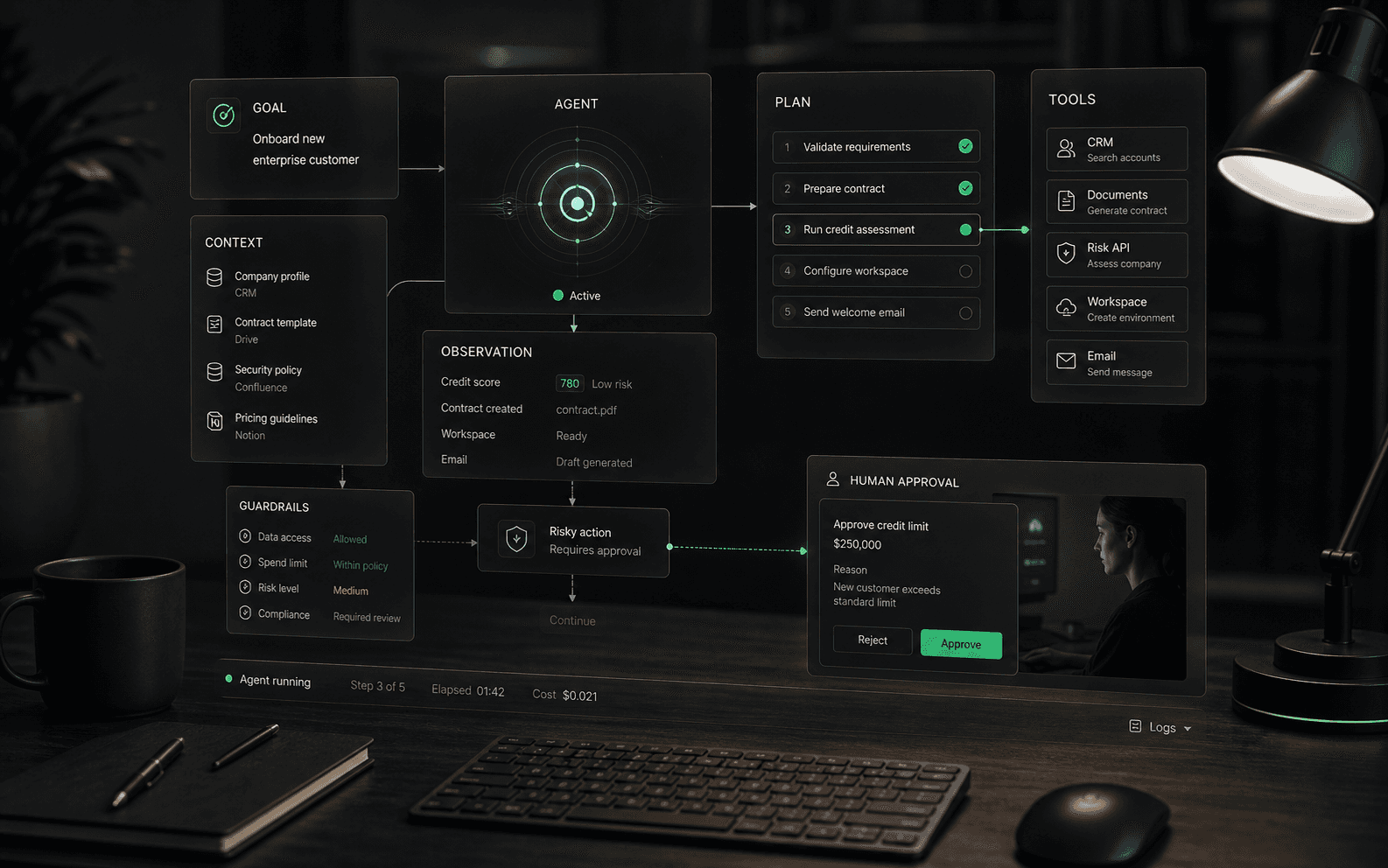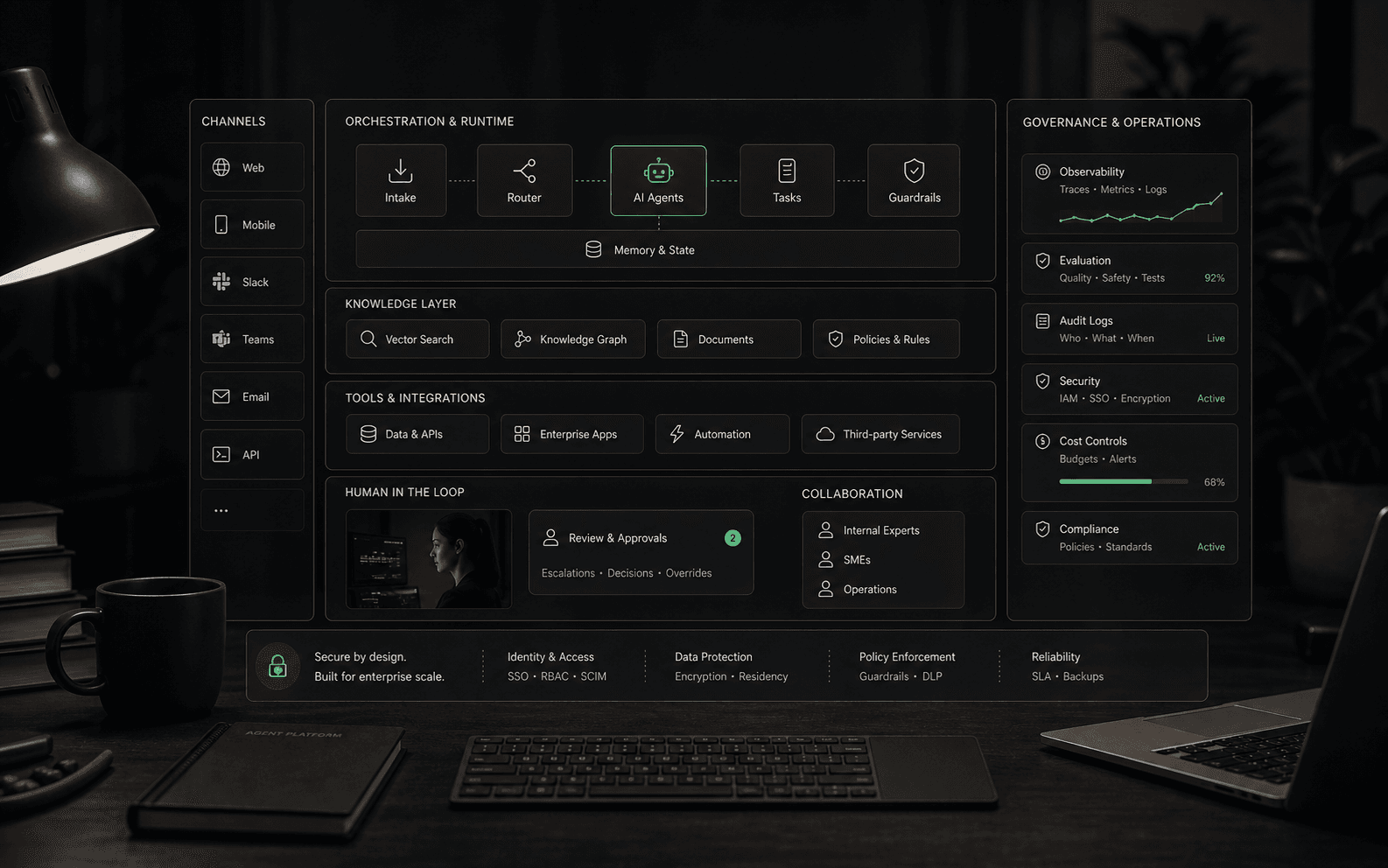
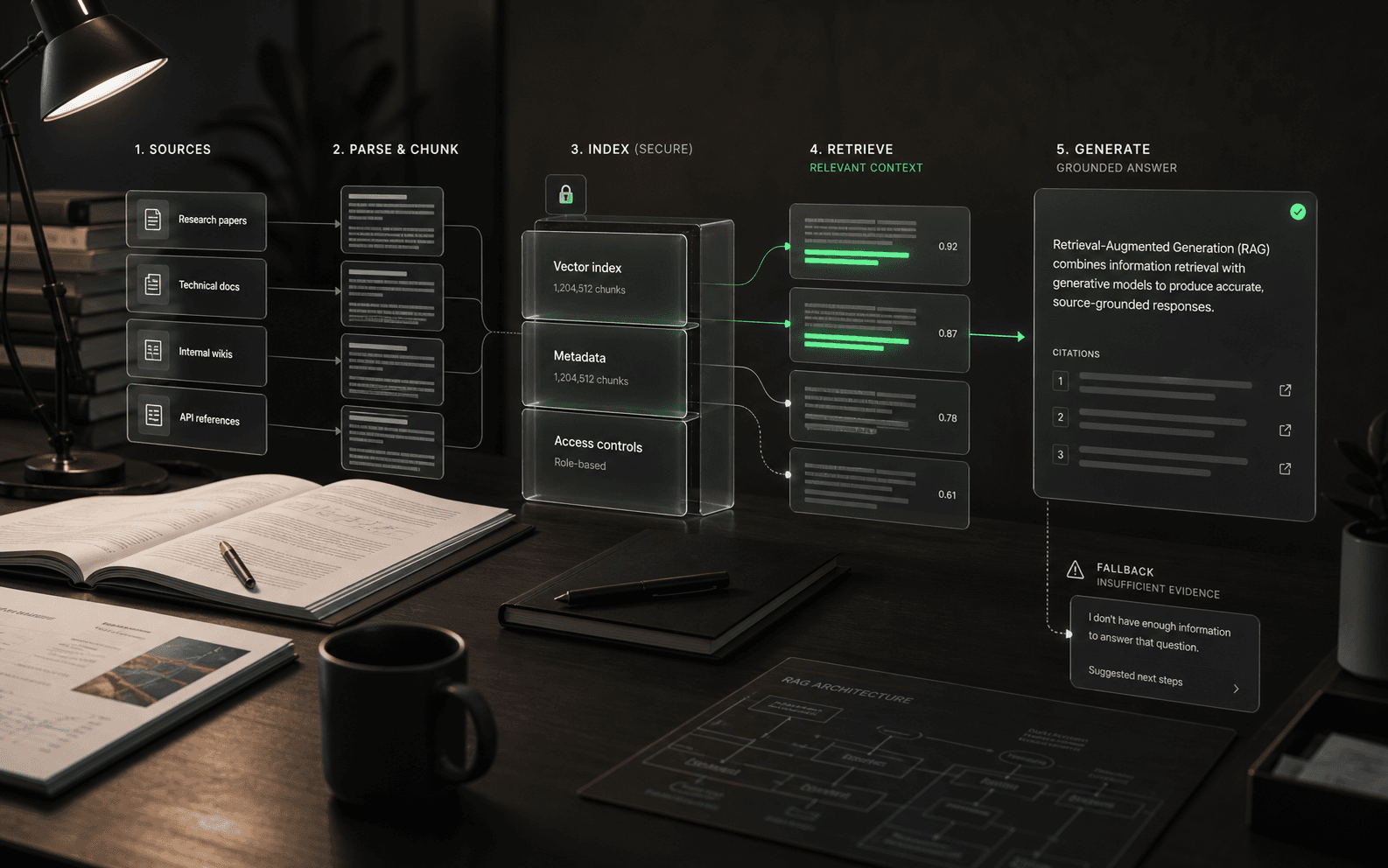
What RAG does
RAG connects generation to retrieval. Instead of asking a model to answer from its general training alone, the system searches approved sources, selects relevant passages or records, and uses that context to produce an answer. In AI agent products, those sources might include help centers, internal docs, product manuals, policy pages, CRM records, order data, or other business systems, depending on what the platform supports.
How RAG works
- Ingest: approved sources are collected from documents, help centers, databases, APIs, or other repositories.
- Prepare: content is parsed, cleaned, split into meaningful chunks, tagged, permissioned, and indexed for retrieval.
- Retrieve: when a user asks a question, the system searches for relevant source material using keyword search, vector search, hybrid search, reranking, or another retrieval approach.
- Augment: the selected context is assembled into the model prompt with instructions about how to use it.
- Generate: the model writes an answer using the retrieved context, ideally with source visibility for reviewers or users when appropriate.
- Improve: failed queries and corrected answers feed back into source hygiene, retrieval tuning, and evaluation sets.
Why it matters for AI agents
RAG is one of the main ways an AI agent becomes business-specific. A support agent that cannot retrieve the current refund policy, warranty rule, pricing page, product limitation, or account context will often produce fluent but unreliable answers. Good retrieval does not make the system perfect, but it gives the agent a better chance of answering from the material the business actually trusts.
RAG can fail at several layers
- Source failure: the correct answer is absent, stale, duplicated, contradicted, or written in a way the retriever cannot use.
- Indexing failure: the content was chunked poorly, tagged incorrectly, embedded without useful metadata, or not refreshed after an update.
- Retrieval failure: the system finds the wrong passage, misses a synonym, ranks old content above current content, or retrieves material the user should not see.
- Grounding failure: the model receives the right context but ignores, overextends, or misreads it.
- Experience failure: the answer sounds confident but gives reviewers no source trail, uncertainty signal, or escalation path.
The quality depends on more than file upload
- Source quality: outdated, duplicated, contradictory, or poorly structured documents lead to poor answers.
- Chunking and indexing: the system has to split and store knowledge in a way that preserves meaning.
- Retrieval quality: the agent must find the right context for messy real-world questions, not just exact keyword matches.
- Permission handling: private or role-restricted content should not appear in answers for the wrong user.
- Fallback behavior: the system should know when sources are missing, weak, or conflicting instead of inventing certainty.
- Review workflow: teams need a way to identify bad answers and fix the source material or retrieval rules.
What buyers should test
- Ask questions where the answer exists in one approved source and nowhere else.
- Ask questions where two documents conflict and see whether the agent notices uncertainty.
- Ask about an outdated policy and verify whether the latest source wins.
- Ask permission-sensitive questions and confirm restricted content stays restricted.
- Ask questions with no reliable source and check whether the agent says it does not know or escalates.
- Review whether citations or source snippets are available to humans for QA.
Evaluation dataset for RAG demos
A serious RAG demo should use a small but realistic test set before procurement. Include questions with one clear source, questions that require two sources, questions with outdated traps, questions with restricted content, questions that should produce no answer, and questions using customer language rather than internal terminology. The goal is to separate answer fluency from retrieval quality.
Concrete examples and non-examples
- Example: a support agent retrieves the current warranty policy, cites the relevant source internally, and answers only within that policy's boundary.
- Example: an internal operations agent searches a procedure library before drafting the next step for an employee request.
- Example: an ecommerce agent retrieves order-specific context and product documentation before explaining what information a human needs to review a return.
- Non-example: a model answers from general memory without checking approved business sources.
- Non-example: a vendor uploads documents once but provides no refresh process, permission controls, source visibility, or failure reporting.
RAG versus model training
RAG is not the same as training a model. Training changes model behavior through additional learning. RAG retrieves external information at response time. For buyers, that distinction matters because RAG can often reflect updated business content faster, but it also depends heavily on source freshness, indexing, permissions, and retrieval quality.
RAG versus long context
Long-context models can accept large amounts of text in a prompt, but that is not automatically RAG. RAG implies selective retrieval: the system chooses relevant material from a larger source set before generation. Dumping a large file into context can be useful for narrow tasks, but it does not solve source freshness, permissions, ranking, conflict resolution, or recurring knowledge operations by itself.
Red flags
Be skeptical when a vendor treats upload a PDF as proof of reliable knowledge grounding. Also watch for no source visibility, no refresh controls, no permission model, no way to handle conflicting documents, no reporting on unanswered questions, and no process for improving poor retrieval after launch.
Metrics to monitor
RAG quality should be measured beyond answer fluency. Useful signals include retrieval hit rate on known-answer questions, source freshness, unresolved query rate, citation accuracy, permission failures, conflicting-source incidents, answer correction rate, and the number of failed questions that turn into knowledge improvements. These measures help separate weak source material from weak retrieval and weak generation.
Knowledge operations
RAG creates an ongoing knowledge operations problem. Someone must decide which sources are approved, remove duplicates, archive outdated material, resolve policy conflicts, and review questions the agent could not answer. Buyers should ask whether support operations, product operations, documentation, or IT will own that loop. Without a named owner, retrieval quality usually degrades as products, policies, and customer language change.
Ownership after launch
The owner of RAG quality should have authority to change source material, not just read analytics. If support teams find repeated retrieval misses but documentation owners cannot update articles quickly, the agent will keep failing in the same way. A useful operating loop connects failed questions, source fixes, re-indexing, regression tests, and reviewer signoff before the updated knowledge is trusted in production.
Sources to verify
Use these references to understand the term and pressure-test vendor claims. Product-specific details still need to be verified against current vendor materials.
FAQ
Common questions
Is RAG the same as training an AI model?
No. Training changes model behavior. RAG retrieves external information at response time, so the quality depends heavily on the connected sources, retrieval logic, and freshness of the indexed content.
Does RAG prevent hallucinations?
No. RAG can reduce unsupported answers when retrieval and source quality are strong, but it does not guarantee accuracy. Buyers still need fallback behavior, source review, testing, and human oversight for risky workflows.
Is RAG the same as semantic search?
No. Semantic search helps retrieve relevant information, often by matching meaning rather than exact keywords. RAG uses retrieval as one step in a larger pattern: retrieve relevant context, pass it to a generative model, and produce an answer. A system can have semantic search without generation, and it can generate text without doing reliable retrieval.
Is uploading documents to a chatbot the same as RAG?
Not by itself. Uploaded documents can be used in a RAG system if the chatbot retrieves relevant passages from those documents at answer time and uses them as context for generation. But a file upload button does not prove how retrieval works, whether the right passages are selected, whether sources are fresh, or whether the answer stays grounded in the retrieved material. For buyers, the test is to inspect the retrieval step, source visibility, and failure behavior.
How is RAG different from fine-tuning?
Fine-tuning changes model behavior by training on additional examples or data. RAG retrieves external information at response time and uses it as context for the answer. RAG is often better suited for changing business knowledge because sources can be updated without retraining, but quality still depends on retrieval, permissions, and source hygiene.
What should buyers test in a RAG demo?
Use questions with one clear source, questions requiring multiple sources, outdated-policy traps, permission-sensitive content, synonyms customers actually use, and questions where the correct answer should be unknown. Ask to see retrieved sources, not just the final response, so you can tell whether the answer was grounded or merely fluent.
What causes RAG systems to give wrong answers?
Wrong answers can come from stale sources, conflicting documents, poor chunking, weak retrieval, missing metadata, permission mistakes, context-window limits, or a model that ignores the retrieved material. Debugging RAG requires separating source problems, retrieval problems, grounding problems, and generation problems instead of treating every failure as a prompt issue.
Who should own RAG quality after launch?
RAG quality needs an operational owner with authority to improve source material. Support operations, product operations, documentation, or knowledge management may own content quality, while technical teams own indexing, permissions, retrieval configuration, and monitoring. Without a closed loop between failed answers and source updates, retrieval quality usually degrades over time.
Does RAG work with private or permissioned data?
It can, but buyers should verify permission handling carefully. The system needs to respect who is allowed to retrieve each source, whether restricted content can appear in answers, how access changes are synced, and how retrieval is logged. Permission mistakes can turn a useful knowledge system into a data exposure risk.