
The Difference Between AI Agents and Automation
Four-question test for AI agents vs RPA automation, with hybrid pattern: agents propose, scripts execute irreversible actions.
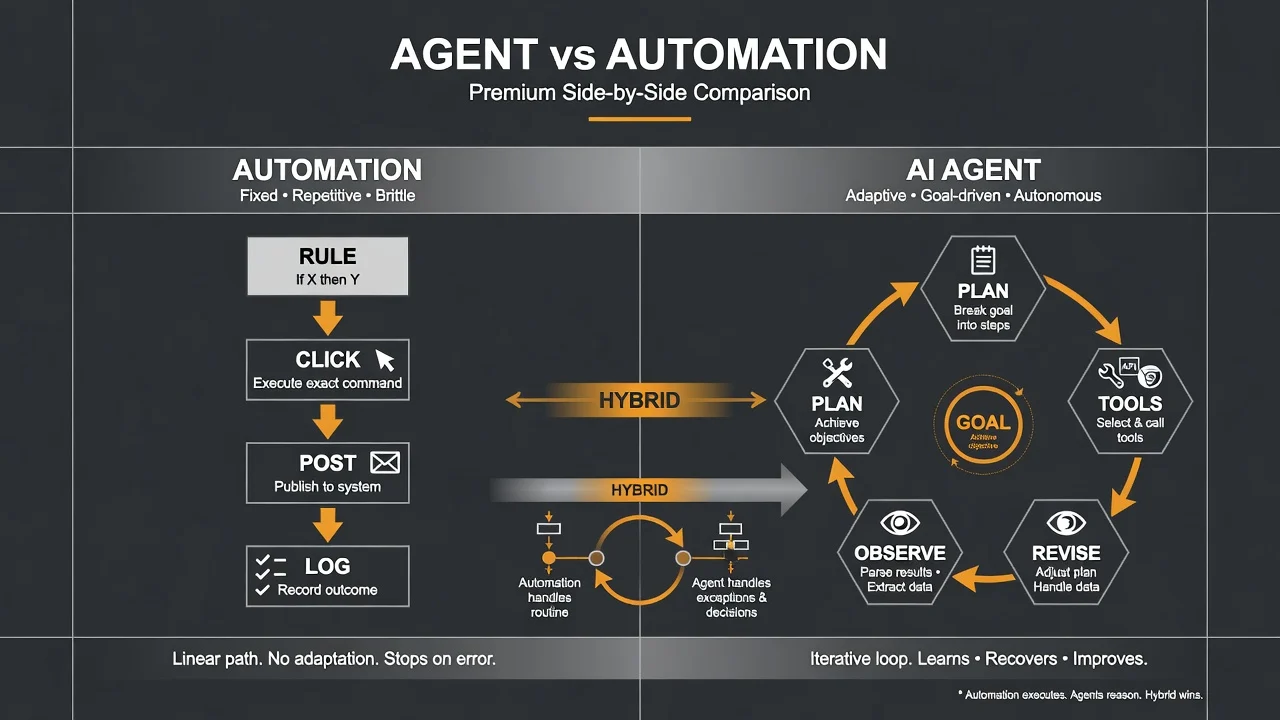
Four-question test for AI agents vs RPA automation, with hybrid pattern: agents propose, scripts execute irreversible actions.
| Pregunta | Automation | AI agent |
|---|---|---|
| What drives control flow? | Predefined rules | Goal + planning |
| What inputs work best? | Structured and expected | Unstructured and variable |
| What fails first? | Brittle when the UI or rule changes | Confident wrong actions without gates |
| Best combined how? | Executes the approved action | Interprets, drafts, routes exceptions |
How to use this page: run the four-question test on your process, pick automation / agent / hybrid, then only open vendor demos that match that pattern. Related: multi-agent systems explained, AI workflow automation agents, best AI agents for finance and accounting.
Buying agents for a pure rules process overpays for uncertainty. Buying pure RPA for messy document work underpays for judgment and creates exception piles. The useful part of this page is the decision test and hybrid pattern, not another glossary definition.
Automation is software that runs a known process. Classic robotic process automation (RPA) clicks through applications, moves files, copies fields, and triggers workflows based on rules. Given the same inputs and a stable UI or API, it produces the same path.
An AI agent is software that accepts an objective, decides which tools or substeps to use, observes results, and continues until it hits a success condition, a failure condition, or a human gate. Large language models often provide the planning and language understanding layer. Tools provide the ability to act.
Intelligent automation sits between them. It combines RPA-style execution with AI capabilities such as document extraction, classification, or prediction. The process is still largely designed by people. AI fills specific cognitive gaps inside that process.
These definitions match how practitioners in RPA communities and enterprise automation vendors describe the shift from scripted bots to agentic systems. The labels vary. The behavioral difference does not.
Ask four questions about any system:
If the answers are fixed path, structured inputs only, no plan revision, and a predetermined last step, you have automation.
If the answers are path selection, unstructured or novel inputs, plan revision, and a goal condition with optional human approval, you have an agent.
Many products blend both. A system can use an agent to interpret an email and then call a deterministic payment workflow. That hybrid is often the right design.
| Dimension | Automation | AI agent |
|---|---|---|
| Control logic | Rules and scripts | Goals plus planning |
| Input style | Structured and expected | Unstructured and variable |
| Behavior when blocked | Fails or follows exception branch | Tries alternatives or asks for help |
| Explainability | Step logs are usually clear | Needs traces of plans tool calls and drafts |
| Best work | Stable high-volume processes | Variable multi-step knowledge work |
| Main risk | Brittleness when UIs or rules change | Confident wrong actions without gates |
| Cost profile | Predictable per transaction | Variable model and tool spend |
| Change speed | Requires workflow redesign | Can adapt prompts tools and policies |
Neither column is morally superior. They optimize for different environments.
Automation remains the correct default when:
Examples include posting a standard journal from a validated template, moving approved invoices into a payment batch, provisioning accounts from an HRIS event, or syncing closed-won deals into a billing system.
History backs this. Businesses spent a decade on RPA because many back-office tasks were rule-heavy and repetitive. That value does not vanish because agent demos look smarter. A deterministic bot that posts the same way every night is often safer and cheaper than an agent inventing a path each time.
Agents earn their keep when:
Examples include reading a contract and proposing redlines against a playbook, investigating a variance across three systems, triaging a support ticket with policy retrieval, or coordinating research and draft steps for a report.
Cognitive science offers a useful analogy. Habits are automation. Deliberate problem solving is agentic. You do not deliberate about every keystroke when typing a password. You do deliberate when diagnosing a production outage. Software should follow the same split.
Most enterprises will not jump from pure RPA to fully autonomous agents. They will extend automation with AI perception, then add limited planning, then add multi-agent orchestration where needed.
A common progression:
Deloitte and other advisory firms have argued that orchestration quality determines whether multi-agent investments create value or cancel out in complexity. That claim matches engineering experience. Coordination overhead is real.
Automation path. Vendor ID is known. PO matches. Amount is within tolerance. Bot posts and routes payment.
Agent path. Invoice is non-PO. Line items are ambiguous. Contract PDF and email thread must be read. Agent proposes coding and an approver with evidence links. Human approves. Deterministic payment workflow runs.
Automation path. Password reset through a fixed identity flow.
Agent path. Angry customer describes a multi-product billing conflict. Agent retrieves policy, checks invoices, drafts a resolution, and escalates refunds above threshold.
Automation path. After offer acceptance create accounts and schedule day-one tasks.
Agent path. Candidate texts questions about shift flexibility and benefits. Conversational agent answers FAQs screens for requirements and books interviews. Recruiter handles exceptions.
Automation path. On alert threshold page on-call and open a ticket template.
Agent path. Investigate logs across services draft a root-cause hypothesis propose a fix and open a pull request for human review.
In each pair the irreversible money identity or production action should stay deterministic or heavily gated. The interpretive work can be agentic.
Automation fails loudly when a selector breaks or a field is missing. That is annoying and visible.
Agents can fail politely. They produce fluent wrong answers, take an unnecessary tool path, or skip a verification step while sounding complete. That is why agent systems need:
RPA programs historically underinvested in change management when applications changed. Agent programs underinvest in evaluation and permissions. Different failure mode. Same leadership lesson: design for the failure you will actually get.
Automation ROI is usually about labor minutes removed from a stable process times volume minus bot maintenance.
Agent ROI includes those minutes but also model tokens, tool calls, review time on drafts, and error remediation. An agent that saves twenty minutes of drafting and creates five minutes of careful review can still win. An agent that saves twenty minutes and creates thirty minutes of cleanup does not.
Measure:
If a vendor will not help you instrument those metrics, you are buying narrative not operations improvement.
| Situation | Prefer automation | Prefer agent | Prefer hybrid |
|---|---|---|---|
| Stable ERP posting rules | si | No | Optional AI capture only |
| Unstructured document interpretation | No | si | Agent proposes automation posts |
| Strict deterministic audit needs | si | Only with heavy gates | Common pattern |
| Novel multi-tool research | No | si | Agent then human |
| High-volume identical tickets | si | Overkill | Rules first |
| Policy-heavy customer decisions | Risky alone | Good with limits | Agent draft plus approval |
Use the matrix in procurement meetings. Force the vendor to show which cells their product occupies with live workflows not slideware.
Multi-agent systems are a form of agentic design where roles specialize. They are not the opposite of automation. In fact mature multi-agent systems often call automation tools as hands.
An orchestrator agent may decide that a refund is allowed then invoke a deterministic payment API that cannot freestyle amounts outside policy. That is good architecture. Cognition chooses. Determinism executes.
If you want the architecture deep dive, read multi-agent systems explained. The short version: specialization and orchestration help only when handoffs and evaluation are explicit.
That last point matters. Agents can discover a reliable path. Once the path is stable you can codify it as automation and save cost.
Automation often lives with a center of excellence that manages bots and licenses. Agents pull in data science product engineering security and domain owners. Without a clear owner you get shadow agents in individual ChatGPT accounts with no audit trail.
Assign:
This is ordinary operating design. Agent projects fail when companies pretend software removes the need for it.
Automation runs fixed steps for known processes. An AI agent pursues a goal by choosing steps using tools and adjusting based on intermediate results. Automation is script-driven. Agents are goal-driven within constraints.
No. RPA is a form of automation that mimics structured user actions or API sequences. It does not independently plan novel multi-step strategies the way agentic systems do.
Intelligent automation combines traditional automation with AI capabilities such as document understanding or machine learning decisions inside a largely predefined process.
Use an agent when inputs are unstructured paths vary by context and the work product needs interpretation or multi-tool synthesis. Keep automation for stable high-volume deterministic work.
Yes. The strongest designs use agents for interpretation and planning then call deterministic workflows for execution especially for payments account changes and other high-impact actions.
They are more flexible not automatically better. Flexibility increases both capability and risk. Advanced operations choose the simplest system that meets the reliability bar.
No. Start with one agent and clear tools. Add multiple agents when specialization and verification steps justify the coordination cost.
Stop arguing about labels in the abstract. Map the work. If the path is known and stable automate it. If the goal is clear but the path depends on messy context use an agent with budgets logs and human gates. If both appear in one process build a hybrid and make the handoff explicit.
For product shortlists after you know which pattern you need browse the tools directory and domain guides such as best AI agents for finance and accounting, best AI legal agents 2026, y AI workflow automation agents. Category clarity first. Vendor selection second.
Further reading
4 next jobs from this page. Named destinations, not a pile of related guides.
04