
Best AI Agents for HR and Recruiting
Hiring-motion matrix for recruiting AI agents: hourly conversational hiring, skills matching, interviews, and inclusive job language.
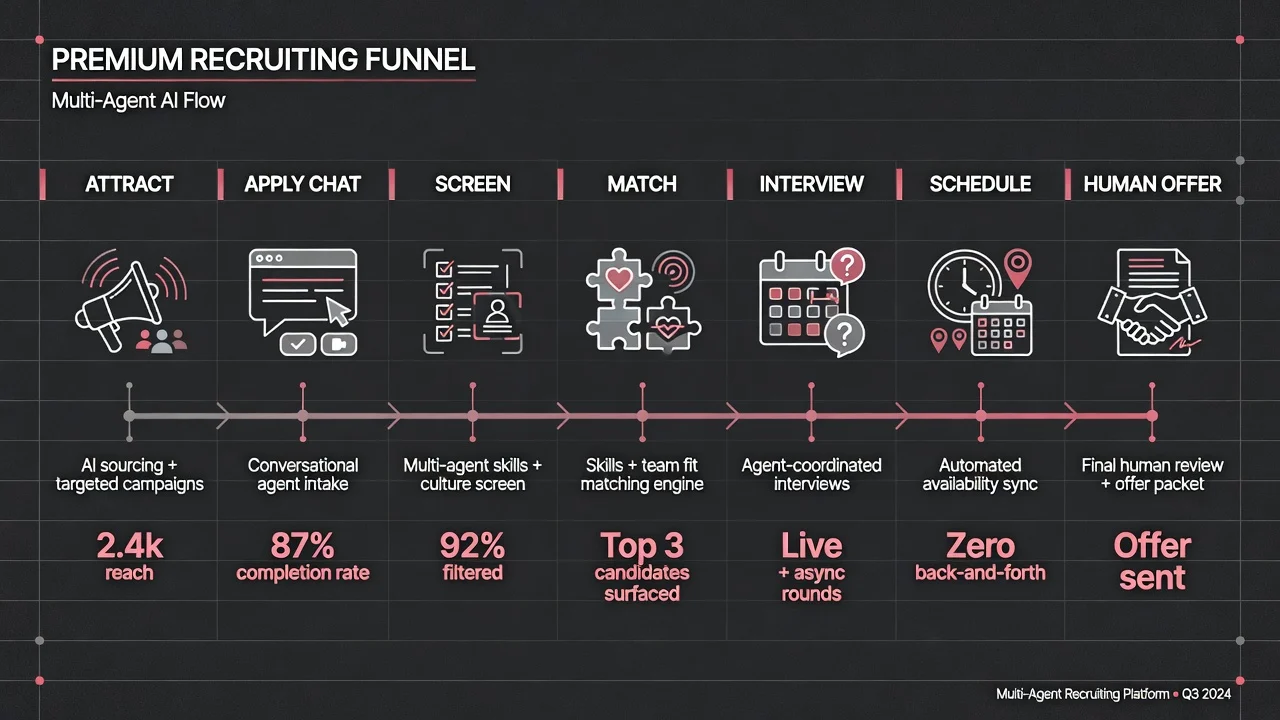
Hiring-motion matrix for recruiting AI agents: hourly conversational hiring, skills matching, interviews, and inclusive job language.
| Hiring motion | Best first agent type | Ejemplo |
|---|---|---|
| High-volume hourly / frontline | Conversational apply + scheduling | Paradox |
| Skills-based enterprise TA | Matching + interview agents | Eightfold |
| Large early-round screens | Structured async interview | HireVue |
| Fragmented career-site journey | Talent experience platform | Phenom |
| Inclusive language cleanup | Job-language AI | Textio |
How to use this page: identify your dominant req type (not “all hiring”), map it to one funnel stage, pilot that stage for two weeks with human override on, then expand. Related: multi-agent systems explained, AI workflow automation agents.
Recruiters do not buy “AI.” They hire software to complete specific jobs in the funnel. Most competitor pages rank products alphabetically. This page ranks jobs → stages → human ownership.
That job map is what makes shortlists faster for TA leaders and more citable when someone asks for the best AI recruiting tool for hourly hiring versus the best AI for skills-based enterprise talent matching. Those are different products.
Talent teams face two pressures at once. Hiring managers want speed and quality. Candidates want fast replies and clear next steps. When volume spikes, human recruiters cannot answer every SMS, reschedule every shift interview, or screen every application with equal care.
Labor economics makes the stakes concrete. Unfilled frontline roles create overtime and lost revenue. Slow professional hiring creates project delay and manager workarounds. Recruiting agents matter when they protect candidate experience and recruiter focus at the same time.
Selection psychology adds another layer. Structured interviews and consistent scoring reduce noise in human judgment. AI can enforce structure. It can also encode bias if trained or configured poorly. Buyers should demand explainability on ranking factors, audit logs, and options for human override.
| Job | What “done” looks like | Agent type |
|---|---|---|
| Answer candidates instantly | FAQs resolved without a recruiter queue | Conversational apply agent |
| Screen consistently | Structured answers scored the same way every time | Screening and interview agents |
| Find the right people | Shortlists match skills and role potential | Matching / talent intelligence |
| Fill calendars without chaos | Interviews booked and rescheduled automatically | Scheduling agent |
| Write fair job posts | Clear inclusive language before the funnel starts | Language guidance tools |
If you buy a single “AI recruiter” label without mapping volume type and workflow, you will either under-automate hourly hiring or over-automate professional search.
In practice, recruiting agents fall into a few job families:
Josh Bersin’s 2026 coverage of multi-agent talent acquisition describes this shift clearly: vendors are shipping suites of cooperating agents rather than one chatbot. Eightfold, Paradox, Maki, Phenom, SmartRecruiters, and others all push combinations of candidate engagement, assessment, and matching. The buyer question is how those agents work together and what industry knowledge sits underneath them.
Primary job: Engage and schedule hourly or frontline candidates at scale.
Paradox (often associated with its Olivia assistant) is a leading conversational AI platform for high-volume recruiting. It is widely used in frontline and hourly hiring where texting, FAQs, and scheduling dominate.
Best fit: Retail, hospitality, healthcare staffing, logistics, and other high-volume environments where speed-to-apply and interview booking matter more than deep executive search.
Fortalezas: Conversational apply flows, candidate Q&A, screening questions, and scheduling at scale. It is built for high-volume frontline hiring where text and scheduling dominate. Validate any time-to-hire claims against your own baseline.
Limits: Professional search teams may need stronger talent intelligence elsewhere.
How to pilot: Run one high-volume requisition type end to end by text. Measure completion rate, time-to-schedule, no-show rate, and recruiter interventions per hire.
Primary job: Match people to roles with skills depth and consistent evaluation.
Eightfold is a talent intelligence platform that matches people to roles using deep skills models across internal and external talent. In 2026 it has expanded agentic products such as candidate agents and interview agents that work with its matching core.
Best fit: Enterprises that care about skills-based hiring, internal mobility, and consistent evaluation across high volume and professional roles.
Fortalezas: Skills graph matching, talent rediscovery, AI interview patterns, and multi-agent talent workflows. Interview and Candidate agent capabilities are designed to keep evaluation consistent at scale.
Limits: Implementation is enterprise-grade. Success depends on clean role definitions and recruiter change management.
How to pilot: Compare shortlists for five open roles against your current process. Score match relevance with hiring managers and measure time from apply to interview-ready slate.
Primary job: Run consistent early-round interviews without burning interviewer hours.
HireVue is known for on-demand video interviewing and assessments. It helps enterprises run structured async interviews and evaluation workflows at scale.
Best fit: Companies that need consistent early-round interviews and assessment structure across large applicant pools.
Fortalezas: Async video interviews, structured evaluation support, and assessment packaging that reduces calendar chaos for first-round screens. It often pairs with an ATS rather than replacing the whole stack.
Limits: Candidate experience depends on thoughtful question design. Use human interview stages for final judgment and relationship building.
How to pilot: Convert one high-volume early screen to structured async interviews. Measure completion rates, interviewer time saved, and hiring manager satisfaction with signal quality.
Primary job: Modernize the full candidate journey rather than one screening bot.
Phenom provides a broader talent experience platform spanning career sites, CRM, chat, and AI matching features used by large employers.
Best fit: Enterprises modernizing the full candidate and employee talent experience rather than only one screening bot.
Fortalezas: Career site personalization, candidate engagement, and platform breadth across the talent lifecycle. Useful when fragmented point tools create inconsistent candidate journeys.
Limits: Breadth can mean a longer implementation. Teams with one narrow pain may prefer a focused agent first.
How to pilot: Instrument one career site journey from visit to scheduled screen. Measure drop-off and response latency before and after agent features.
Primary job: Run hiring operations on a modern system of record with AI assistance.
SmartRecruiters is a recruiting platform with AI features across sourcing and hiring workflows. It appears regularly in 2026 roundups of AI recruiting stacks for enterprises that want ATS-adjacent process control with modern automation.
Best fit: Organizations standardizing recruiting operations on a modern hiring platform with AI assistance layered into the process.
Fortalezas: Hiring process orchestration, collaboration with hiring managers, and AI features that support screening and workflow speed inside a recruiting system of record.
Limits: Exact AI agent depth varies by package and roadmap. Integrate carefully if you already own a separate CRM or assessment stack.
How to pilot: Measure requisition cycle time and hiring manager response latency on a pilot department before wider rollout.
Primary job: Improve the top of the funnel before agents start screening.
Textio is not a full recruiting agent suite. It is still a high-value AI layer for inclusive job descriptions and talent communication language. Many teams pair it with agents that source and screen.
Best fit: Companies that want better job post language and more inclusive candidate communication.
Fortalezas: Language guidance that helps reduce biased phrasing and improve clarity in postings and outreach.
Limits: It does not replace conversational apply or interview agents.
How to pilot: Rewrite ten live postings. Track apply rate and demographic mix shifts carefully and ethically under your legal guidance.
| Product | Strongest job fit | Agent emphasis | Pricing posture |
|---|---|---|---|
| Paradox | High-volume hourly hiring | Conversational apply and scheduling | Enterprise sales. Confirm with vendor |
| Eightfold | Skills matching and enterprise TA | Matching plus interview and candidate agents | Enterprise sales. Confirm with vendor |
| HireVue | Structured async interviews | Interview and assessment agents | Enterprise / assessment models. Confirm with vendor |
| Phenom | Full talent experience | Engagement and matching across the journey | Enterprise sales. Confirm with vendor |
| SmartRecruiters | Recruiting operations platform | AI-assisted hiring workflows | Enterprise packages. Confirm with vendor |
| Textio | Inclusive language | Writing guidance for jobs and outreach | Package-based. Confirm with vendor |
High-volume frontline hiring and enterprise skills-based hiring are different jobs. Buy for the one that dominates your req mix.
In 2026, mature teams assemble agents the way they assemble recruiting process stages:
The orchestration question is whether one vendor covers multiple stages cleanly or whether you integrate best-of-breed tools through your ATS. For architecture context, see multi-agent systems explained.
| Product | Product page |
|---|---|
| Paradox | paradox.ai · video library |
| Eightfold | eightfold.ai · Candidate Agent |
| HireVue | hirevue.com |
| Phenom | phenom.com |
| SmartRecruiters | smartrecruiters.com |
| Textio | textio.com |
Josh Bersin’s 2026 write-up on cooperating talent-acquisition agents is a useful industry briefing: Multi-agent AI for talent acquisition.
AI in hiring sits under employment law and anti-discrimination expectations that vary by jurisdiction. This is not legal advice. It is a buyer checklist:
Trust is also product design. Candidates abandon processes that feel opaque or endless. Fast replies help. Unclear black-box rejections do not.
| Métrica | Por qué es importante | How agents should help |
|---|---|---|
| Time to first response | Candidate experience and drop-off | Instant conversational replies |
| Time to schedule | Recruiter load | Automated booking and reschedules |
| Screen completion rate | Funnel health | Mobile-friendly structured questions |
| Interviewer hours per hire | Capacity | Async structured early rounds |
| Quality of hire proxies | Downstream success | Better matching and structured scores |
| Candidate satisfaction | Brand and offer acceptance | Clear status and human escalation paths |
Measure a baseline before the pilot. Vendor averages are not your baseline.
Days 1-2. Choose one persona and req type. Hourly store associate or campus software engineer, not both.
Days 3-5. Configure questions, FAQs, and scoring rubrics with hiring managers.
Days 6-10. Run the agent on live traffic with human oversight. Keep a parallel path for exceptions.
Days 11-12. Review score distributions, drop-offs, and recruiter interventions.
Days 13-14. Decide expand, reconfigure, or stop. Write the human escalation policy before wider release.
Paradox leads many high-volume conversational hiring use cases. Eightfold leads many enterprise talent intelligence and skills-matching use cases. HireVue is strong for structured video and assessments. Phenom and SmartRecruiters fit broader enterprise talent platforms. Textio helps with inclusive job language. Fit depends on volume type and process stage.
No. They automate engagement, scheduling, and structured screening. Recruiters still own relationship strategy, complex selling of roles, exception handling, and final process design with hiring managers.
Any selection system can produce biased outcomes if poorly designed or unmonitored. Demand auditability, human override, structured criteria, and ongoing adverse-impact review with qualified partners.
Automate high-volume first response, FAQs, scheduling, and structured early screens. Keep final interviews, offer strategy, and sensitive candidate communications under clear human ownership.
Most enterprise platforms use custom pricing. Confirm current pricing with the vendor and include implementation, ATS integration, and change management in total cost.
Specialized agents handle apply chat, screening, interviewing, matching, and scheduling. An orchestration layer or ATS passes candidates between stages with logs and human checkpoints.
Buy for your dominant hiring job first. High-volume frontline teams should prioritize conversational apply and scheduling. Enterprise skills-based organizations should prioritize matching quality and structured evaluation. In every case, write the human escalation path before you celebrate automation rates.
For architecture context beyond HR products, read Multi-Agent Systems Explained y AI workflow automation agents.
Further reading
4 next jobs from this page. Named destinations, not a pile of related guides.
04