
Best AI Agents for Finance and Accounting
Bottleneck-first matrix for finance AI agents: AP, close, spend, bookkeeping. Control ladder from read-only to execute-with-approval.
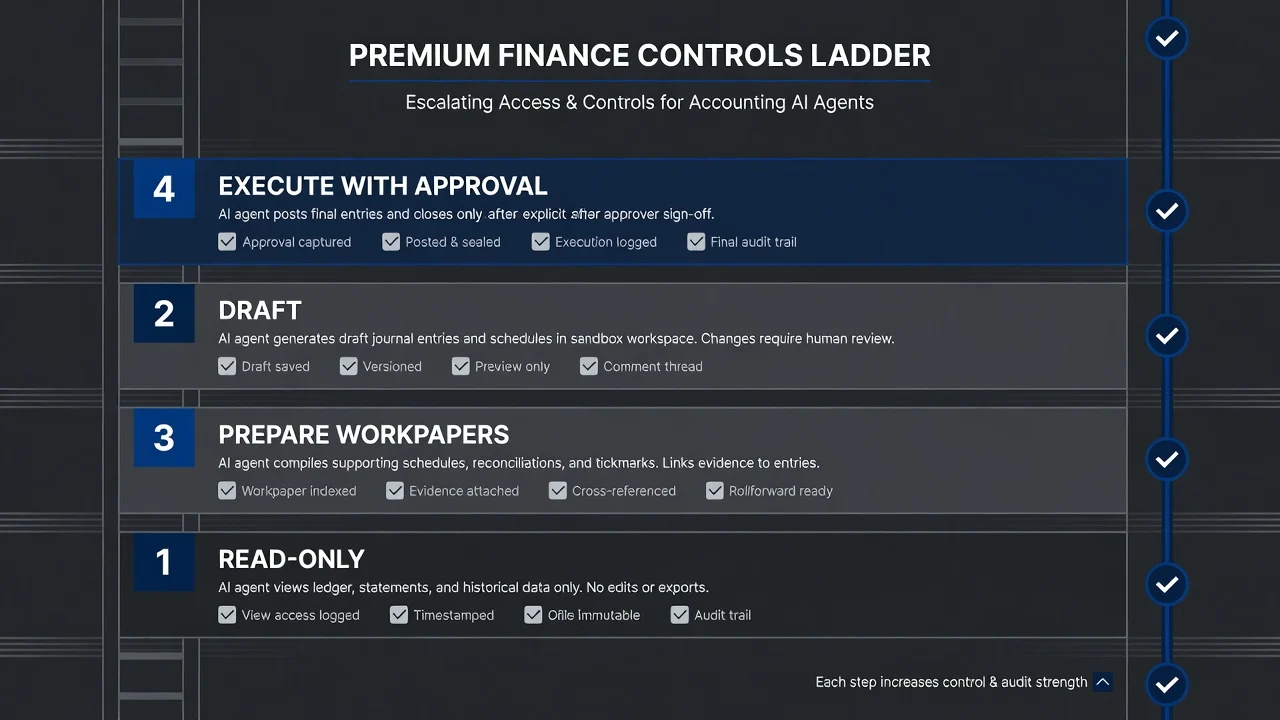
Bottleneck-first matrix for finance AI agents: AP, close, spend, bookkeeping. Control ladder from read-only to execute-with-approval.
| Bottleneck | First buy | Keep gated |
|---|---|---|
| Invoice coding volume | Vic.ai or Ramp / BILL (by size) | Vendor setup and payment release |
| Month-end close chaos | FloQast | Close certification |
| Card + expense + bill sprawl | Ramp | Policy exceptions |
| SMB books backlog | Docyt or QuickBooks AI | Auto-post until accuracy is proven |
How to use this page: pick the bottleneck row, watch only demos for that row, run the 14-day parallel pilot, then expand write access. Related: finance AI agents, AI accounting software, agent vs automation.
Generic “AI for finance” lists celebrate autonomy. Controllers care about who can reverse a bad action.
Best AI Agent Tools uses a four-stage control ladder on every finance agent evaluation:
If a vendor collapses those stages into “it just posts,” treat that as a red flag in the demo, not as speed.
A finance AI agent is software that can pursue a multi-step finance goal under policy constraints. Examples include reading an invoice, proposing GL codes, routing approvals, gathering recon evidence, drafting flux commentary, and packaging a review pack.
That differs from:
Controllers and CFOs are not short on software logos. They are short on capacity during close week, AP backlogs, and variance explanation cycles. AI agents matter when they cut queue time without breaking the evidence chain an auditor can follow.
Economics is straightforward. Month-end is a capacity spike. Invoice volume scales with vendor count and growth. Headcount does not scale linearly. Agents that extract fields, propose codes, cluster exceptions, and assemble workpapers change the labor curve for those spikes.
Psychology matters as much as process. Finance professionals distrust systems that “just fix it.” A polished wrong coding is worse than a visible exception. Good products make uncertainty visible. Weak products hide it behind confidence scores nobody can audit.
If you buy on “autonomous finance” slogans alone, you will import risk into the general ledger. The control question is always the same: can the system read, propose, prepare, and only then execute behind approvals?
Jumping to step four on day one is how teams create silent ledger mess. Prove accuracy on your chart of accounts and vendors before you expand write access.
| Product | Product page |
|---|---|
| Vic.ai | vic.ai |
| FloQast | floqast.com/watch-a-demo · Agents IA |
| Ramp | ramp.com |
| BILL | bill.com |
| Docyt | docyt.com |
| QuickBooks | intuit.com/quickbooks |
Vic.ai focuses on AI-first accounts payable. It targets invoice capture, coding, and AP workflow automation for teams with meaningful invoice volume.
Best fit: Mid-market and enterprise AP teams that want high no-touch coding rates with review queues for exceptions.
Points forts : Invoice processing, GL coding assistance, anomaly detection themes, and AP throughput. Vendor materials emphasize high accuracy and large reductions in manual handling over time. Treat published percentages as vendor claims and validate on your invoice mix.
Limits: Pricing is volume-sensitive. AP agents still need clean vendor master data and clear exception ownership.
How to pilot: Run 100 recent invoices, including credits and multi-line bills. Measure coding accuracy, duplicate detection, and reviewer time per exception.
FloQast is known for close management and reconciliation workflows designed with accountants. It has expanded into AI agent building for close-related tasks through products such as FloQast Transform.
Best fit: Controllership teams that live inside the month-end close calendar and need checklists, reconciliations, and evidence organization.
Points forts : Close orchestration, recon workflows, flux analysis support, and agent patterns accountants can configure without waiting on a full IT build for every small process.
Limits: Full deployments are enterprise-oriented rather than pure self-serve. FloQast is not a replacement for your GL.
How to pilot: Map one full close checklist. Ask the system to surface missing reconciliations and draft flux questions for the top three variances. Require exportable evidence links.
Ramp combines corporate cards, expense management, bill pay, and AI-assisted policy and accounting workflows. Many mid-market teams adopt it because spend and AP sit in one place.
Best fit: Teams that want cards, expenses, and bill workflows together with AI help on coding and policy checks.
Points forts : Transaction capture at the point of spend, policy enforcement patterns, accounting coding assistance, and unified visibility across card and AP activity. Public pricing for core product tiers is often easier to find than pure enterprise AP platforms, but package details change. Limits: It may not replace specialized close software or deep ERP financial close modules. Complex multi-entity consolidations still live in the ERP and close stack.
How to pilot: Connect a card program slice and a bill batch. Measure coding suggestion quality against your chart of accounts and how policy exceptions surface.
BILL (formerly Bill.com) is a widely used AP and AR automation platform for small and mid-sized businesses. AI features support capture, routing, and payment workflows.
Best fit: SMBs and mid-market teams that need practical AP and AR automation without a full enterprise AP suite.
Points forts : Invoice capture, approval routing, payment operations, and integrations into mainstream accounting systems. Secondary sources often cite per-user subscription ranges. Plans and fees vary by module.
Limits: High-volume enterprise AP with complex coding models may outgrow simpler workflows. Always test multi-entity and multi-currency cases if you have them.
How to pilot: Process a month of vendor bills end to end. Track approval latency, exception rates, and whether the audit export satisfies your accountant.
Docyt positions itself as AI bookkeeping automation for bill pay, reconciliation support, expense workflows, and real-time accounting visibility for SMBs and accounting firms serving them.
Best fit: Small businesses and firm clients that want more automated bookkeeping operations than a plain ledger UI provides.
Points forts : Document intake, bookkeeping workflow automation, and continuous accounting patterns that reduce month-end pileups. Pricing is commonly presented as package or plan based. Limits: You still need a clear controller or firm reviewer. Automation without review policy creates cleanup work later.
How to pilot: Import a full month of bank and credit card activity plus bills. Score categorization accuracy and recon readiness before you allow broader auto-post behavior.
QuickBooks remains a dominant SMB ledger. Intuit has rolled out AI features and agent-style assistance for categorization, insights, and bookkeeping help inside the ecosystem.
Best fit: Small businesses and accountants already operating in QuickBooks who want AI assistance without moving the books.
Points forts : Categorization support, insights, reporting assistance, and reduced swivel-chair work inside a system that already holds the chart of accounts and bank feeds.
Limits: It is not a full enterprise close suite. Complex multi-entity public company close needs still sit elsewhere. Pricing depends on QuickBooks plan and feature packaging. Check current Intuit packaging.
How to pilot: Use messy real bank feed lines, not clean demo data. Measure how often suggestions match your accountant’s final coding.
| Product | Primary job | Typical buyer | Pricing posture |
|---|---|---|---|
| Vic.ai | Autonomous-leaning AP | Higher-volume AP teams | Custom. Confirm with vendor |
| FloQast | Close and recon agents | Controllership teams | Enterprise custom. Confirm with vendor |
| Ramp | Spend + AP operating layer | Mid-market finance ops | Public tiers exist. Confirm current package |
| BILL | AP/AR automation | SMB and mid-market | Subscription modules. Confirm with vendor |
| Docyt | AI bookkeeping ops | SMBs and firms | Plans. Confirm with vendor |
| QuickBooks + Intuit Intelligence | Ledger-native AI help | SMBs and accountants | Plan-based. Confirm with vendor |
Choose the row that matches the bottleneck. Buying close software to fix AP coding is a category error.
Most mid-market and enterprise pricing is sales-led or volume-based. Confirm current pricing with the vendor for your invoice count, entities, and modules rather than trusting a single public estimate.
Finance automation is a controls problem first.
Require:
If a demo cannot show the trail for one reconciled item and one coded invoice, stop the evaluation.
| Flux de travail | Agent value | Keep gated | Success metric |
|---|---|---|---|
| Invoice coding | Extract fields and propose GL codes | Vendor setup and payment release | Coding accuracy and reviewer minutes |
| Bank and account recon prep | Suggest matches and cluster exceptions | Final recon sign-off | Exception aging and rework rate |
| Flux and variance drafts | Draft first-pass commentary with links | External reporting sign-off | Time to board-ready narrative |
| Close readiness | Chase missing tasks and pack evidence | Close certification | On-time close tasks completed |
| Spend policy checks | Flag out-of-policy spend early | Policy exception grants | Policy exception cycle time |
Start where reversibility is high and measurement is easy. FP&A variance drafts and recon prep are usually safer first wins than autopay.
Days 1-2. Pick one workflow. Define “done” in hours saved and error rates.
Days 3-5. Connect read-only data. Confirm security review and DPA.
Days 6-9. Run parallel processing. Humans keep the official books. Agents propose.
Days 10-12. Grade accuracy, exception quality, and audit export usefulness.
Days 13-14. Decide whether to allow prepare-for-review in production. Delay execute rights until the numbers earn trust.
Audit practice. Workpapers need provenance. Agents that cannot bind claims to source reports create future pain.
Organizational design. Segregation of duties is a people-and-systems design problem. Software cannot invent controls you refuse to staff.
Behavioral economics. Default options matter. If auto-post is the default, people will accept bad codes under deadline pressure. Make review the default until accuracy is proven.
Data quality. Dirty vendor masters and inconsistent account usage will make any agent look dumb. Clean reference data before you blame the model.
Vic.ai stands out for high-volume AP. FloQast stands out for close and reconciliation. Ramp stands out for combined spend and AP operations. BILL and Docyt fit many SMB and mid-market automation needs. QuickBooks with Intuit Intelligence fits teams that want AI inside an existing SMB ledger. The best choice follows the bottleneck.
Not at first. Use read, draft, and prepare modes until accuracy and approvals are proven. Move to execute-with-approval only with clear thresholds and logs.
Traditional automation follows fixed rules and screen steps. AI agents can interpret unstructured invoices, draft explanations, and handle more variable inputs. Both still need controls.
Measure coding accuracy, exception rate, time per exception, recon readiness, narrative quality with source links, and whether auditors can reconstruct what happened.
Many are custom or plan-based with add-on modules. Confirm current pricing with the vendor and include implementation, integrations, and review labor in total cost.
No. It can reduce repetitive preparation work. Judgment on estimates, policy exceptions, controls design, and stakeholder communication remains human work.
Match the agent to the workflow that actually hurts. Keep the ledger as the system of record. Force proposals before posts. Measure accuracy on your data for two weeks. Expand write access only after the control environment holds.
For a deeper controls-first framework, use the site guide on finance AI agents and the companion on AI accounting software.
Further reading
4 next jobs from this page. Named destinations, not a pile of related guides.
04