Elicit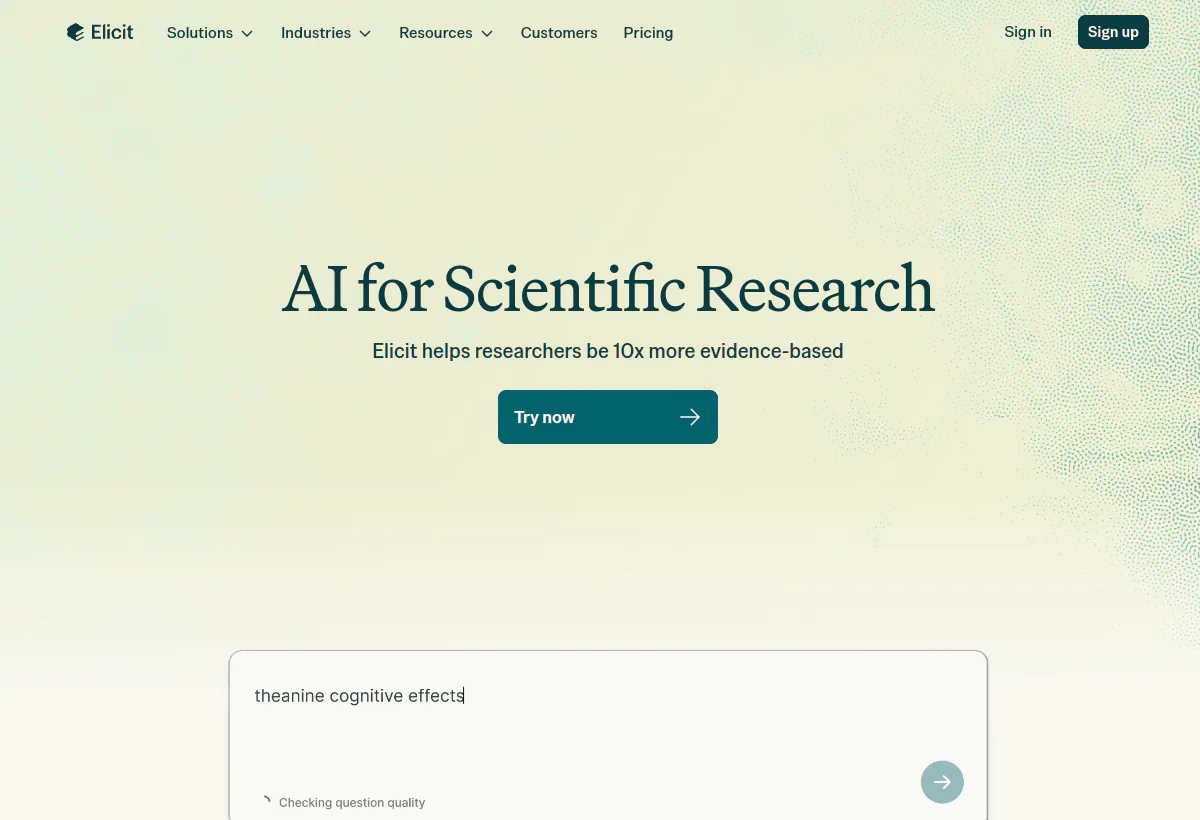
Verdict rapide
Is Elicit worth it?
Elicit is worth it for labs, evidence teams, and analysts who repeatedly search, screen, and extract from the academic literature. Free Basic is real for exploration: unlimited search across more than 138 million papers, unlimited summaries, and unlimited chat where full text allows, with limited Research Agent and Reports. Serious systematic review volume, 20-column tables, alerts, and API access start at Pro. Collaboration, figure extraction, and admin controls start at Scale. Treat AI narrative as draft support. Humans still own the protocol and the final claim.
Method
Comment nous avons évalué cela
We evaluated Elicit as a literature-review and extraction product. Scoring weights corpus search, table and column workflows, systematic review limits, collaboration and admin, and institutional security. We did not score it as a support agent.
On August 19, 2026 we opened elicit.com, elicit.com/pricing, elicit.com/operations/privacy, and related official pages for Research Agent, reports, and systematic review. We recorded Basic, Pro, Scale, and Enterprise packaging. We did not run a paid Pro or Scale pilot on a Cochrane-style protocol, so vendor accuracy figures remain vendor-reported.
- Checked plan names, annual billed prices, screening limits, column limits, and feature gates on the official pricing page.
- Noted corpus size language: pricing says more than 138 million papers; homepage meta still mentions over 125 million. We treat 138 million as the pricing-page figure and flag the mismatch.
- Noted researcher-count language: homepage heading says over 5 million researchers; page meta still says over 2 million. Unverified either way.
- Reviewed privacy policy last updated September 12, 2023, including US servers and EEA transfer language.
- Compared the same evidence job with Perplexity, ChatGPT, and Claude.
Consult Elicit homepage, Obtenir des prix, Elicit privacy policy, Elicit API docs for product documentation and plan details. Confirm the terms that apply to your purchase.
Modèle de coût
Collaboration and screening volume, not the $49 sticker, set the bill
Pro looks like a writing-assistant price: $49 per user per month billed as $588 per year, with a stated 35% annual saving versus monthly. We captured the annual number. We did not capture a live monthly sticker on August 19, 2026, so we do not invent one. The expensive decisions sit in the gates above Pro. Scale is $169 per user per month billed as $2,028 per year (39% annual saving stated) for 5x usage, figure extraction, live editing, 30 columns, reports from up to 200 sources, and an admin panel. Enterprise is custom: screen 40,000 papers, extract 40 columns, PRISMA-grade language, SSO/SAML, 2FA, custom deployments, and “no training on your data by default.”
Seat who screens, not who sponsors. A four-person evidence team on Pro is $2,352 per year if everyone is annual Pro. The same four people on Scale are $8,112 per year. If two people must live-edit the same table, Pro is the wrong SKU even if volume would fit. If one methodologist screens 5,000 papers and three occasional readers only need search, do not buy four Scale seats. Elicit’s June 30, 2026 product note also says Research Agent is moving from workflow-based limits to a monthly usage pool. Confirm the live pool on your account during pilot, because that change can move the “standard versus 5x” math.
- Pro screening cap is 5,000 papers on the dedicated systematic review workflow.
- Scale is 5x usage plus collaboration, not merely a nicer UI.
- Enterprise screening is 40,000 papers and 40 columns. That is the institutional SKU.
- API draws from the same plan pool according to Elicit’s API terms. Do not assume API is extra free capacity.
Meilleur ajustement
Who Elicit fits best
Best for academics, health-economics and outcomes research teams, policy analysts, pharma and medtech evidence groups, and research ops. Poor fit as a website support bot, SDR tool, or general office suite.
Points forts
- Citation-oriented workflows. Homepage emphasizes sentence-level citations, interactive tables, and multi-step review rather than chat-only answers.
- Real free exploration. Unlimited search, summaries, and full-text chat where access allows, plus Zotero import.
- Structured extraction. Columns, custom extractions from uploaded papers, multiple report templates on Pro.
- Systematic review path. Dedicated workflow on paid plans, PRISMA 2020 support described in May 2026 product notes, larger scale on Enterprise.
- API and MCP on Pro and higher for connecting research into other agents, with usage from the same credit pool.
Limites à vérifier
- Not customer-support software. There is no ticket inbox, WhatsApp channel, or helpdesk SLA here.
- Paid seats add up when every screener needs a login and you also need Scale collaboration.
- Final scientific responsibility stays human. Vendor evals (including claimed SLR accuracy on Cochrane reviews) are not a substitute for your protocol.
- Field databases still matter. Keep PubMed, Cochrane, Embase, or your internal corpus in the process if your methods require them.
- Privacy policy on the site was last dated 2023. Institutions should request current DPA and training-data terms, especially because Enterprise says no training on your data by default.
Surfaces
Research surfaces to verify
Elicit’s surfaces are papers, columns, reports, and review workflows. They are not social inboxes. Verify these in a demo on your question and your inclusion criteria.
- Paper search. Pricing states unlimited search across more than 138 million papers. Confirm coverage for your field and whether paywalled full text is actually available in chat.
- Library. Store and reuse sources across projects. Confirm export formats your manuscript pipeline needs.
- Extraction tables. Pro adds 20 columns at a time. Scale 30. Enterprise 40. This is the product. Test on your fields (population, intervention, comparator, outcome, sample size, risk of bias).
- Research reports. Pro extracts from up to 135 data sources. Scale up to 200. Confirm you can change which papers and fields are included.
- Systematic review workflow. Pro screens 5,000 papers. Enterprise 40,000. Write inclusion criteria before you trust automated screening.
- Alerts. Pro: 10 personalized alerts. Enterprise: unlimited. Useful only if someone reads them.
- Zotero import, API, MCP. API and MCP are Pro or higher. Enterprise adds custom data sources and templates.
- Collaboration (Scale+). Live editing and admin seat management. This is the reason to leave Pro.
Flux de travail
How an evidence team should run Elicit
Start with one live review, not a tour. Write inclusion and exclusion criteria first. Search. Screen. Extract the columns you already use in a spreadsheet. Generate a report. Open the underlying sentences for every high-stakes cell. Compare rework and hours against your old process. Then decide Pro versus Scale versus staying on Basic.
Do not let the Research Agent write the protocol. Elicit’s own positioning is that it can automate screening and extraction while only partly supporting search and report generation. That is the right humility. Humans still set PICO, risk-of-bias rules, and what must never be auto-included. For PRISMA-style work, confirm audit trails, reproducible screening decisions, and export of the flow counts you need for the manuscript.
- Search and triage papers against written criteria.
- Extract fields into tables. Score extraction errors, not just speed.
- Generate reports with citations, then open sources.
- Collaborate on screening decisions on Scale if two people must edit live.
- Keep required primary databases in parallel when your methods say so.
Pricing checked August 19, 2026
Elicit pricing: free Basic to custom Enterprise
Prices below are from elicit.com/pricing on August 19, 2026. Pro and Scale public numbers are per user per month billed annually ($588 and $2,028). The page advertises 35% and 39% savings versus monthly. We did not record the monthly sticker in our capture, so we do not publish a monthly dollar figure. Academic or industry toggles exist on the page. Confirm which catalog you are in before you budget. Prices exclude tax.
| Planifier | Public price | Included capacity / meter | Meilleur ajustement |
|---|---|---|---|
| De base | Gratuit | Limited Research Agent and Research Reports. Unlimited search (138M+ papers on this page), unlimited summaries, unlimited chat with full-text access where available, view sources, Zotero import. | Casual exploration and methods teaching |
| Pro | $49/user/mo billed $588/year | Standard usage for Research Agent, Reports, and systematic literature reviews. Screen 5,000 papers. 20 columns at a time. Reports from up to 135 sources. 10 alerts. Custom extractions from uploaded papers. Explanations. Multiple output templates. API access. | Individual systematic reviewers |
| Échelle | $169/user/mo billed $2,028/year | 5x usage. Figure extraction and interpretation. Live editing and real-time collaboration. Reports from up to 200 sources. 30 columns. Admin panel with usage tracking and seat management. | Teams that co-edit reviews |
| Entreprise | Personnalisé | Custom usage. Unlimited paper alerts. No training on your data by default. Screen 40,000 papers and extract 40 columns. PRISMA-grade screening and extraction language. SSO/SAML, 2FA, user analytics, domain verification, custom deployments including single-tenancy. Dedicated customer success. Custom data sources and templates. Unlimited API access. | Companies, schools, and governed labs |
Source: Elicit official pricing page, captured August 19, 2026. Re-verify monthly versus annual, academic programs, and the live usage pool before you sign.
Model seats for everyone who screens or extracts weekly. Principal investigators who never touch the table do not need Scale. Occasional searchers may stay on Basic. Peak months are review deadlines, not average weeks. Confirm overage or hard-stop behavior when the monthly usage pool is exhausted. Elicit’s API terms say API usage draws from the same plan pool.
AI
What the research agent is for
Elicit’s value is structured evidence assembly with citations, not unsupervised manuscripts. The Research Agent, reports, and systematic review workflow are the AI surface. Chat with papers is useful when full text is available and you can click through to the sentence. Figure extraction on Scale matters for some review types (device, imaging, lab methods) and is easy to forget when you buy Pro.
Vendor materials claim high accuracy on internal and Cochrane-style evaluations, including a May 2026 note with search recall and screening percentages. Those figures are Elicit’s. Reproduce them on your protocol before you cite them internally. Hallucinated citations are the failure mode that matters. If the product cannot show the supporting sentence, the cell is not done.
- Search ranking versus your gold-standard set.
- Abstract and full-text screening against written criteria.
- Column extraction with a rework rate you can defend.
- Report text that remains tied to sources.
Caractéristiques
Domaines de fonctionnalités à vérifier
- Paper search across the stated 138 million-plus corpus.
- Summaries and chat with papers when full text is licensed or open.
- Extraction tables and custom columns, including uploaded PDFs on Pro.
- Research reports with controllable paper sets and templates.
- Systematic review workflow and PRISMA-oriented screening on paid plans.
- Alerts (10 on Pro, unlimited on Enterprise).
- Figure extraction on Scale.
- Live collaboration and admin on Scale.
- API and MCP on Pro or higher. Unlimited API language on Enterprise.
- Enterprise SSO/SAML, 2FA, domain verification, single-tenancy options.
Analyse
What to measure besides “papers processed”
Track screening throughput, extraction rework rate, time per included paper, and share of report sentences that survive source checks. Raw paper counts without rework are vanity. Scale’s admin panel adds usage tracking and seat management. Use it to find idle seats before renewal.
For a lab or consultancy, also track how often you still export to a spreadsheet or RevMan-style tool. If every review still leaves Elicit for the real extraction sheet, you bought a search UI, not a workflow. Store the pilot protocol, sample set, scores, and cost model in one folder so the next review does not restart from Slack.
Sécurité
Security, data handling, and compliance
Enterprise copy is the only public plan that spells out SSO/SAML, 2FA, user analytics, domain verification, custom deployments, and no training on your data by default. The public privacy policy we captured is dated September 12, 2023. It states servers in the United States, international transfers, collection of email and credentials, and that Elicit does not knowingly collect data from children under 18. For unpublished protocols, confidential clinical data, or identifiable research, that packet is not enough. Ask for a current DPA, subprocessors, retention, and a written training-data statement that matches the Enterprise “by default” line.
- Do not upload identifiable patient-level data without a written legal path.
- Confirm whether uploaded papers and chat are used to train models on your tier.
- Require SSO if IT already requires it. That likely means Enterprise.
- Map who can export tables and reports.
- Check data residency if contracts require it. Public policy points to US hosting.
Questions de l'acheteur
What questions should you ask before buying Elicit?
- How many people screen or extract weekly, and do they need live co-editing?
- What is the rework rate on a 50-paper gold set using our inclusion criteria?
- Do we need figure extraction, 30 columns, or 200-source reports (Scale)?
- Is SSO, single-tenancy, or a “no training on our data” clause mandatory (Enterprise)?
- Which exports does the manuscript or regulatory pipeline actually accept?
- How does the monthly usage pool behave after the June 2026 change, and what happens at exhaustion?
- Does API usage come out of the same pool we need for screening?
Drapeaux rouges
What red flags should you watch for with Elicit?
- No inclusion criteria before turning on high-volume screening.
- No human verification step for high-stakes cells or final claims.
- Buying Scale seats for people who only search occasionally.
- Treating vendor Cochrane eval numbers as your methods section.
- Uploading confidential or identifiable research before DPA and training-data terms are signed.
- Assuming Elicit replaces PubMed, Cochrane, or a mandated registry search.
Alternatives
What are the best alternatives to Elicit?
Elicit is not listed as an alternative to itself. Choose by whether you need academic tables or just answers.
- PerplexityChoose Perplexity when the job is web-grounded answers with citations, not systematic screening of a paper corpus.
- ChatGPTChoose ChatGPT for general research assistance, coding, and flexible analysis when you do not need Elicit’s table and SLR workflow.
- ClaudeChoose Claude when you already have the PDFs and need careful long-document analysis without a dedicated literature-review product.
Test in practice
What Elicit needs to prove in a real review
- Pick one live review.Use a question you already know, with a gold set of included and excluded papers.
- Write inclusion criteria first.Do not improvise them in the UI.
- Run screening and extraction.Score recall, false includes, and column error rate.
- Measure rework and time.Compare with the spreadsheet process, including source checks.
- Do the seat math.Pro versus Scale versus Enterprise based on collaboration, figures, and SSO, not based on a demo wow.
Lecture connexe
Lecture connexe
- Perplexity review: web-grounded answers.
- ChatGPT review: general research assistant.
- Claude review: long-form analysis.
- Tools directory
- Tableau de bord
- How to choose an AI agent platform
Claim ledger
Grand livre des réclamations et des sources
Sur quoi ce profil est basé
Official Elicit homepage and pricing page captured August 19, 2026, including Basic, Pro ($49/user/month billed $588 annually), Scale ($169/user/month billed $2,028 annually), and Enterprise custom packaging, with screening, column, alert, API, and collaboration gates as published. Privacy policy text dated September 12, 2023. Public product notes on PRISMA 2020 support, Research Agent usage-pool change, and API/MCP availability on Pro or higher.
Ce que nous n'avons pas vérifié
We did not run a paid systematic review pilot. We did not independently verify vendor accuracy percentages, 80% time-savings quotes, corpus size (125 million versus 138 million language), or researcher counts (2 million versus 5 million language). We did not capture the monthly (non-annual) sticker price. We did not audit Enterprise security or training-data controls beyond public copy.
Comment nous avons évalué l'adéquation
High fit for evidence teams whose bottleneck is screening and extraction with citations. Low fit for support, sales, or casual web Q&A. The 4.0 signal reflects a clear research product with an honest free tier and a seat-plus-usage ladder that punishes buying Scale for everyone.
Verdict
Should you choose Elicit?
Choose Elicit when literature screening and extraction are recurring, citations matter, and you will keep humans on the protocol. Stay on Basic to learn. Buy Pro for a single reviewer with a 5,000-paper workflow. Buy Scale when live collaboration, figures, or 5x usage are real. Buy Enterprise when SSO and contractual non-training language are mandatory. Do not choose Elicit as a customer-facing support agent. Re-check elicit.com/pricing during procurement because usage pools are in motion in 2026.
FAQ
Common questions about Elicit
Is the Elicit free plan useful?
Yes for exploration. Basic includes unlimited search, summaries, and full-text chat where access allows, with limited Research Agent and Reports. Production systematic review volume usually needs Pro or higher.
How much does Elicit cost in August 2026?
Basic is free. Pro is $49 per user per month billed $588 annually. Scale is $169 per user per month billed $2,028 annually. Enterprise is custom. Monthly (non-annual) stickers were not captured in our pricing-page snapshot. Confirm live on elicit.com/pricing.
Does Elicit replace PubMed or Cochrane?
No. Keep required primary databases and registries in your methods. Use Elicit as a screening and extraction workspace, not as the sole search.
Pro vs Scale: which should a lab buy?
Pro for a single reviewer who needs the systematic review workflow, 20 columns, alerts, and API. Scale when two or more people must live-edit, when you need figure extraction, 30 columns, 5x usage, or admin tracking.
Is Elicit a customer-support agent?
No. It is a literature-review product. Do not shortlist it against helpdesks or website chatbots.
Can students use Elicit?
Basic is useful for learning search and summaries. Courses and labs should confirm licensing, especially before uploading unpublished work. Enterprise is the institutional path.
Does Elicit have an API?
Yes on Pro and higher. Elicit’s API terms say usage draws from the same plan pool. Enterprise copy lists unlimited API access. MCP is documented for Pro or higher.
What about training on our papers?
Enterprise public copy says no training on your data by default. The public privacy policy is dated 2023 and does not replace a DPA. Get the training-data clause in writing for confidential work.
Elicit vs Perplexity vs ChatGPT?
Elicit for academic screening, columns, and systematic reviews. Perplexity for web-grounded answers. ChatGPT for general assistance. Run the same question on all three only if you also score citations and extraction quality, not just prose.
How long does a pilot take?
A high-signal pilot is one real review with a gold set, not a feature tour. Plan days to weeks depending on corpus size. Do not sign annual Scale or Enterprise until rework rates exist.
Also review