Manus AI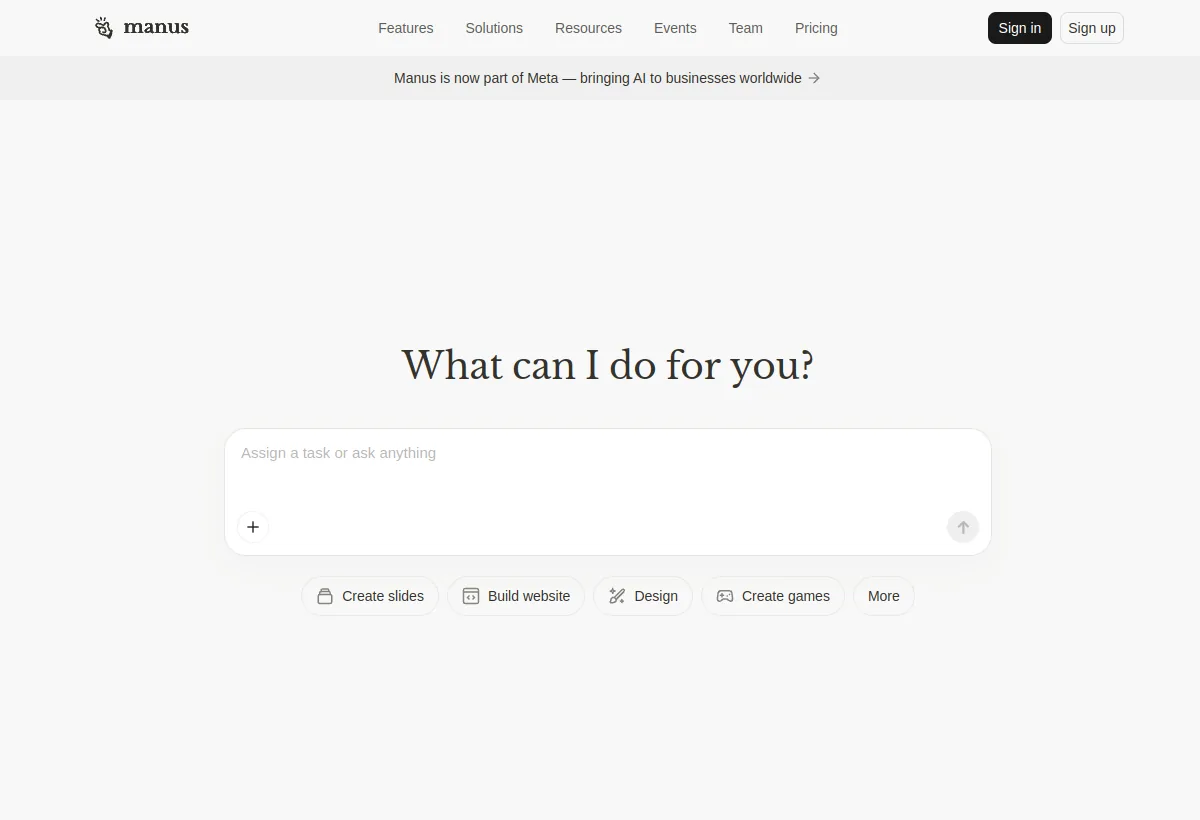
Our verdict
Impressive range, incomplete proof, and a live corporate unwind
Manus is most convincing when a task crosses boundaries: research a market, collect material in a browser, turn findings into a deck or small web app, and return a finished artifact. Browser Operator, Wide Research, Mail Manus, Slack, connectors, API v2, Cloud Computer, and web-app generation are documented product surfaces, not only homepage slogans.
Those pages do not establish how often Manus completes a messy business workflow, how many credits a representative run burns, or how safely it behaves inside an authenticated account. We did not buy a plan or run an independent workload benchmark. That limitation matters more than another feature list.
The new buyer issue is corporate, not product. On 11 August 2026 Manus published A Note to Our Users: it will resume operating as an independent company. Data generated by certain users on or after 29 December 2025 (the Meta acquisition date) is scheduled for deletion from 8:00 a.m. on 23 August through 24 August 2026 (SGT). Affected users must back up by 7:59 a.m. SGT on 23 August and restore from 8:00 a.m. SGT on 25 August. This review is dated 19 August 2026, inside that backup window. Do not run a production pilot on an account that might lose access for two days without checking the in-app notice.
Comment nous avons évalué cela
This is a desk review with a buyer-risk lens. On 19 August 2026 we re-checked the official homepage, pricing page, Team page, independence note, Trust Center URL, and previously reviewed feature, API, privacy, and terms surfaces. The live pricing and Team calculators are JavaScript-driven and did not return static dollar amounts in this research browser. We cite Manus's 24 July 2026 blog for the $20 / $17 starting claim, and we label 30 July 2026 card details as a prior capture, not a fresh static scrape. Official docs prove a feature exists. Only repeated buyer testing establishes reliability for your workflow.
Modèle de coût
Credit burn on browser and Wide Research dwarfs the $20 card
The sticker looks like a ChatGPT-class subscription. The unit that matters is the credit, and the public pricing page still does not publish a full rate card by model, tool, browser step, Wide Research fan-out, or Cloud Computer minute. It also does not explain, in static copy we could capture, how 300 daily refresh credits interact with the monthly pool, or whether unused credits roll over.
- Sticker versus workload. A light research-and-draft week may fit a 4,000-credit monthly pool (the Standard card on the 30 July capture). Parallel Wide Research jobs, long authenticated browser sessions, and always-on Cloud Computer work can empty the same pool without a published per-action price.
- Daily refresh is not unlimited headroom. 300 refresh credits every day sounds generous until one multi-agent research run or Browser Operator job burns through them. Measure daily and monthly meters on the same pilot tasks.
- Concurrency is a second ceiling. The July capture showed 20 concurrent and 20 scheduled tasks on the individual cards. Queue-style automation hits that wall independently of credits and independently of API rate limits (task.create and task.sendMessage documented at 10 per minute per user).
- Team economics are seats plus a pooled bucket. The Team page still describes pooled credits, SSO, audit logs, and add-on credit auto-purchase. A prior calculator default was 20 seats, 4,000 credits per seat, 80,000 pooled, about $4,000 per year at $20 per seat per month ($200 per seat per year with a 17% annual display). Shared pools hide which member burns the budget unless dashboards break usage down.
- Compare cost per completed supervised workflow, not $20 versus ChatGPT Pro. A Wide Research pack that consumes half the monthly pool in two days is an expensive $20 plan.
Practical rule: pick three production-shaped jobs (competitive research pack, inbox-to-brief pipeline, sandbox browser form fill). Run each twice. Record credits, wall time, human edits, and failed steps. Only then choose between the $20-class card, a higher credit configuration, Team, or a narrower tool.
Who Manus AI fits best
Points forts
- Wide action surface in one runtime: research, browser automation, email, Slack, connectors, API/webhooks, skills, Cloud Computer, and web-app generation.
- Wide Research fans work out to parallel sub-agents with separate VMs, then consolidates. Useful for competitive scans when humans still verify sources.
- Documented confirmation flows for sending Gmail/Outlook and deploying a website, including an optional global allow for future deploys. That is a real control. It is also dangerous if granted too early.
- Team controls that IT actually asks for: pooled credits, shared projects/skills/instructions, usage dashboard, SSO, sharing permissions, audit logs. Team materials cite SOC 2 Type II and ISO 27001.
- API v2 covers tasks, files, webhooks, connectors, browser access, website publishing, and usage, which supports product teams embedding Manus behind a queue.
Limites à vérifier
- Credit opacity. No public action-level rate card. Forecasting is guesswork until you burn real work.
- Plan naming mismatch. Price cards have not used durable Free/Pro/Plus labels in captures we trust, while some docs still say Pro, Plus, and Team. Confirm gating in checkout.
- Legal entity and unwind. Product pages now say Manus will resume as independent. Terms and Privacy previously listed Butterfly Effect Pte. Ltd. Careers still linked to Meta job search from the site footer on this check. Buyers need the current contracting entity, DPA, and data position in writing.
- Retention conflicts between Trust FAQ and Privacy Policy on browser sandbox deletion windows (7/21 versus 7/14 in prior review). Resolve in the contract.
- Output quality is user-owned risk in Manus Terms. Unreviewed output is not suitable for legal, medical, financial, hiring, or customer commitments.
- Not a full IDE or helpdesk. For repositories prefer Cursor. For hosted app speed prefer Lovable. For cited research prefer Perplexity. For chat-first work prefer Claude or ChatGPT.
Surfaces to verify
Manus is a set of action surfaces feeding one agent runtime. Map each surface to a risk tier before you enable it organization-wide. This is not a WhatsApp support bot.
- Web app, desktop, and My Computer: primary workspace for tasks, files, skills, and local file or app access.
- Cloud Browser: remote sandbox that can preserve authenticated sessions. Treat saved sessions as credentials.
- Browser Operator / My Browser: Chrome and Edge extension with per-session authorization, visible actions, and stop/takeover. Privacy language still says page content and action data are transmitted to Manus servers. Require an architecture diagram.
- Mail Manus and Slack: an
@manus.botaddress for approved senders, and@manusin Slack (one task per thread; paid Slack plan required for AI features). - Connectors, API v2, and web-app generation: OAuth then UUIDs into async tasks; rate limits are per user, not per plan. Validate app export before revenue use, or compare Lovable if hosting an app is the main job.
For category context see AI browser agents. Manus sits at the broad end because browser control is only one execution mode.
Agent workflow and guardrails
Operators describe a goal. The agent plans, calls tools and browsers, may pause for confirmation, and returns artifacts. The buying question is whether approvals, least privilege, and audit trails keep external side effects inside policy when the agent is wrong.
API docs describe confirmation for Gmail/Outlook send and website deploy, including global allow to skip future deploy confirmations. Inventory which action classes require approval today, whether org policy can force them, and whether logs capture actor, prompt, connector, approval, and artifact.
Wide Research is the multi-agent pattern. It can cut wall-clock time and multiply credit burn and citation variance at the same time. Treat "hundreds of items at uniformly high quality" as marketing until you score coverage and cost per finished pack on your sources. Skills package repeatable procedures. Branch (July 2026) starts a parallel session from any message. Cloud Computer (May 2026) is a dedicated machine for around-the-clock jobs and appeared as Free Cloud Computer on the Extended usage card in the July capture.
- Start from web, desktop, email, Slack, or API with the same credit pool and the same approval rules.
- Require human confirmation for outbound email, payments, CRM writes, production deploys, and authenticated browser mutations until you have measured false-action rates.
- Scope connectors per project and revoke OAuth when the pilot ends.
- Separate personal and business workspaces. Trust FAQ previously stated Team Owners can see member session data, inputs, outputs, and history.
- Export artifacts you must keep. Affected accounts in the Meta unwind may lose data generated since 29 December 2025 if they miss the 23 August 2026 backup window.
Pricing checked August 19, 2026
Manus AI pricing: usage cards, credits, and Team seats
On 19 August 2026, manus.im/pricing loaded as a JavaScript app and did not expose static plan prices in this research browser. Manus's 24 July 2026 blog still states paid plans start at $20 per month on monthly billing, or $17 per month billed annually. The table below records the individual cards captured on 30 July 2026, plus Team packaging described on manus.im/team. Confirm every number at checkout.
| Planifier | Public price | Included capacity / meter | Meilleur ajustement |
|---|---|---|---|
| Standard monthly usage | $20/mo$17/mo billed yearly (30 July capture; 24 July blog starting price) | 300 daily refresh credits; 4,000 credits/month; Wide Research; 20 concurrent tasks; 20 scheduled tasks | Individuals piloting supervised research and drafting |
| Customizable monthly usage | $40/mo$34/mo billed yearly at the displayed config (30 July capture) | Displayed default 8,000 credits/month plus 300 daily refresh; 20 concurrent; 20 scheduled; selector can change price/credit pairs | Heavier individual usage where 4,000 monthly credits is too tight |
| Extended usage | $200/mo$167/mo billed yearly (30 July capture) | 40,000 credits/month; 300 daily refresh; Free Cloud Computer; 20 concurrent; 20 scheduled | Power users who need always-on Cloud Computer and large credit headroom |
| Team | About $20/seat/moAbout $200/seat/year with 17% annual display (prior calculator default) | Pooled credits (prior default 4,000/seat); shared projects/skills/instructions; usage dashboard; SSO; audit logs; add-on credits and auto-purchase | Teams that need shared workspaces, SSO, and pooled credit accounting |
Sources: manus.im/pricing, manus.im/team, and Manus's 24 July 2026 blog. We could not verify a public individual free-tier entitlement from static HTML on 19 August 2026. The public pages still do not fully explain refresh versus monthly credits, expiry, rollover, or per-action consumption. Affected users in the Meta unwind will not be charged during the 11-23 August 2026 backup window, per the 11 August note.
API v2 rate limits are documented per user across all API keys and are not differentiated by subscription tier. Examples: task.create 10/min, task.sendMessage 10/min, task detail/list 100/min, confirmAction 40/min, usage endpoints 600/min. Throughput planning must count both credits and these request ceilings.
AI capability and agent execution model
Manus describes itself as LLM-agnostic and says it chooses models by use case. Trust materials state agreements so third-party model providers do not train on customer data. That is narrower than a promise that Manus never uses prompts or outputs for product improvement. The Privacy Policy has said prompts and user-generated content may be used for service improvement. Capability is the execution loop: plan, tools, browser, multi-agent research, confirmation gates, artifacts. Skills, Desktop/My Computer, Cloud Computer, and Branch (January through July 2026) sit on that loop. Terms warn that output can be inaccurate. Design human review into every high-impact path.
Feature areas to verify in a pilot
- Wide Research on a real competitive pack with citation scoring, plus credit burn per accepted pack.
- Cloud Browser and Browser Operator on sandbox accounts: persistence, stop/takeover, and revocation.
- Mail or Slack intake, then confirmAction for an email send or deploy with global allow left off.
- Web-app export compared with Lovable if apps are the point, plus a Cloud Computer job with visible credit cost.
- Team SSO, audit export, Owner visibility, and backup status for the 23 August 2026 deletion window.
Analyse et visibilité opérationnelle
Team materials promise a usage and access dashboard alongside pooled credits. For individuals, the question is whether you can see burn by task type, browser session, and Wide Research fan-out before the month ends. Without that, the $20 and $40 cards are lottery tickets. Validate export into finance systems and the 20/20 concurrent and scheduled caps. On Team plans, Owner visibility into member sessions is both an operations feature and an employee-privacy issue. Decide in advance what is monitored.
Security, data handling, and the Meta unwind
The Trust Center at trust.manus.im has listed SOC 2 Type I and Type II, ISO/IEC 27001:2022, and ISO/IEC 27701:2019, with reports via access request. Additional claims include encryption in transit and at rest, administrator MFA, per-user sandbox isolation, and breach notification within 72 hours. Request current reports, scope, period, and exclusions. Storage has been stated as United States and Singapore. The 11 August note repeats US and Singapore storage after independence.
The unwind is the urgent control. Manus says this is not a security incident. It is a regulatory separation from Meta. Affected users lose access from 23 through 24 August 2026 (SGT) if they are in the deletion set. Backup tools and help-center guides are live. Users who registered with Apple ID or Facebook should watch in-app notifications because Manus may not have email. Unaffected users are told they will see an in-app notice and need do nothing.
- Request the current contracting entity and DPA. Do not assume Meta, and do not assume the prior Butterfly Effect pages still bind the order form.
- Resolve retention and Browser Operator data-flow conflicts in writing before connecting regulated systems.
- Confirm third-party model non-training agreements and, separately, Manus's own improvement uses of prompts and outputs.
- Revoke connectors at the end of a pilot. Assume task logs and sandbox files may still be collected for debugging per Privacy Policy language.
- If you might be an affected user, back up before 7:59 a.m. SGT on 23 August 2026. This review publishes inside that window.
What questions should you ask before buying Manus AI?
- What legal entity appears on the order form, DPA, and invoices after the Meta unwind?
- Is our tenant in the 23 August 2026 deletion set, and have we backed up?
- What is the credit cost of our top five workloads, including Wide Research and authenticated browser sessions?
- How do daily refresh credits interact with the monthly pool, and what happens at exhaustion?
- Which actions require confirmation, can global allow bypass them, and are approvals org-enforced?
- What data leaves the endpoint when Browser Operator or Cloud Browser runs against our SaaS tools?
- Can Team SSO, audit logs, and sharing controls meet our identity standard, and is SCIM available?
- For generated web apps, who owns the code, how complete is export, and where is hosting?
- Do API rate limits and the 20 concurrent / 20 scheduled caps support our queue volume?
What red flags should you watch for with Manus AI?
- The demo only drafts documents and never runs browser, email send, deploy confirmation, or Wide Research on your sources.
- Sales cannot produce a written credit estimate for representative jobs.
- Legal entity, DPA, or unwind answers stay verbal.
- Retention and Browser Operator data-flow questions receive conflicting links with no architecture diagram.
- Global allow for deploys or outbound mail is turned on during the pilot to reduce friction.
- You are an affected user in the Meta unwind and have not backed up before 23 August 2026.
- You already standardize on Claude, ChatGPT, or Perplexity for reasoning and only need light automation, making Manus breadth unnecessary overhead.
What are the best alternatives to Manus AI?
Pick by dominant job. An autonomous agent platform is not interchangeable with a research engine, a coding IDE, or a prompt-to-app host.
- ChatGPTChoose ChatGPT when the organization already standardizes on OpenAI for research, drafting, analysis, coding, and lighter agentic work without Manus-style browser and mail depth.
- ClaudeChoose Claude when long-context reasoning, writing, coding, and a bounded enterprise assistant matter more than broad autonomous browser execution.
- PerplexityChoose Perplexity when the job is cited research and current-web answers, not authenticated browser mutations or Slack-to-artifact automation.
- CursorChoose Cursor when software engineering inside a project codebase is the primary job and you want an AI-first editor rather than a general autonomous agent.
- LovableChoose Lovable when the deliverable is a hosted web app with Git export, and you do not need Manus's research, mail, and browser-operator breadth.
Workflow test
What Manus AI needs to prove in a real workflow
A polished homepage is not enough. Run this four-step test before you commit, and check unwind status first if you are inside the August 2026 backup window.
- Baseline three jobs.Define a research pack, an email or Slack intake task, and a browser mutation against a sandbox system. Write success criteria, a maximum credit budget, and required human approvals before you start.
- Execute with meters on.Run each job twice. Record credits, wall time, confirmation prompts, concurrent-task behavior, and human edits required to make the output usable.
- Force a consequential action.Attempt an email send or website deploy. Confirm that approval gates fire, that audit evidence exists, and that global allow is off.
- Break connectors and sessions.Revoke a connector, expire a browser session, and stop a Browser Operator run. Confirm errors are visible and credentials do not linger.
Continue the decision
Lecture connexe
- AI browser agentsUse this when the real question is whether an agent should operate websites and authenticated sessions.
- Lovable reviewCompare when prompt-to-app speed matters more than broad browser autonomy.
- Cursor reviewCompare when the alternative is an AI-first editor on a repo you own.
- Perplexity reviewCompare when cited research is enough and you do not need an action runtime.
- How to choose an AI agent platformDecision criteria that survive a vendor demo.
- AI agent buyer scorecardTurn the pilot into a repeatable decision across reliability, cost, and controls.
Sources officielles à vérifier
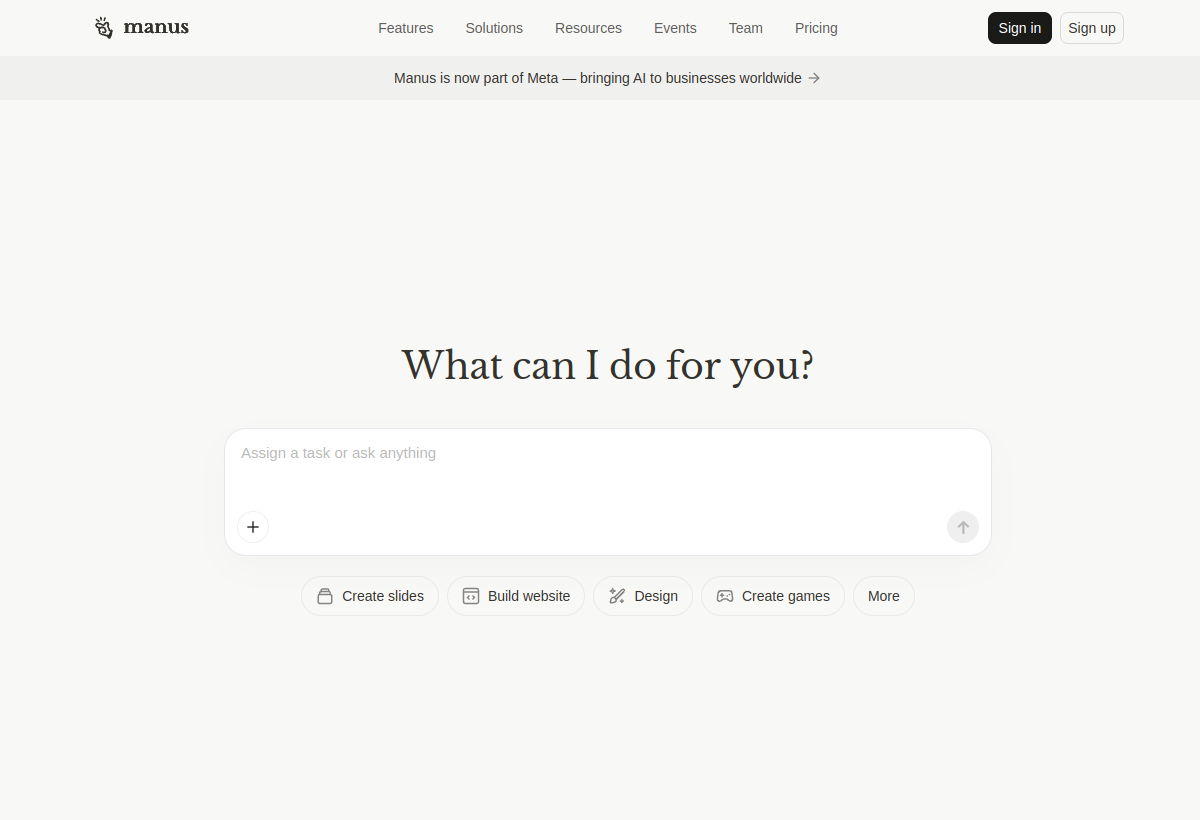 Official Manus product pageSource snapshot 2026-08-19 - manus.imHomepage banner now states Manus will resume operating as an independent company. Confirm live copy before purchase.
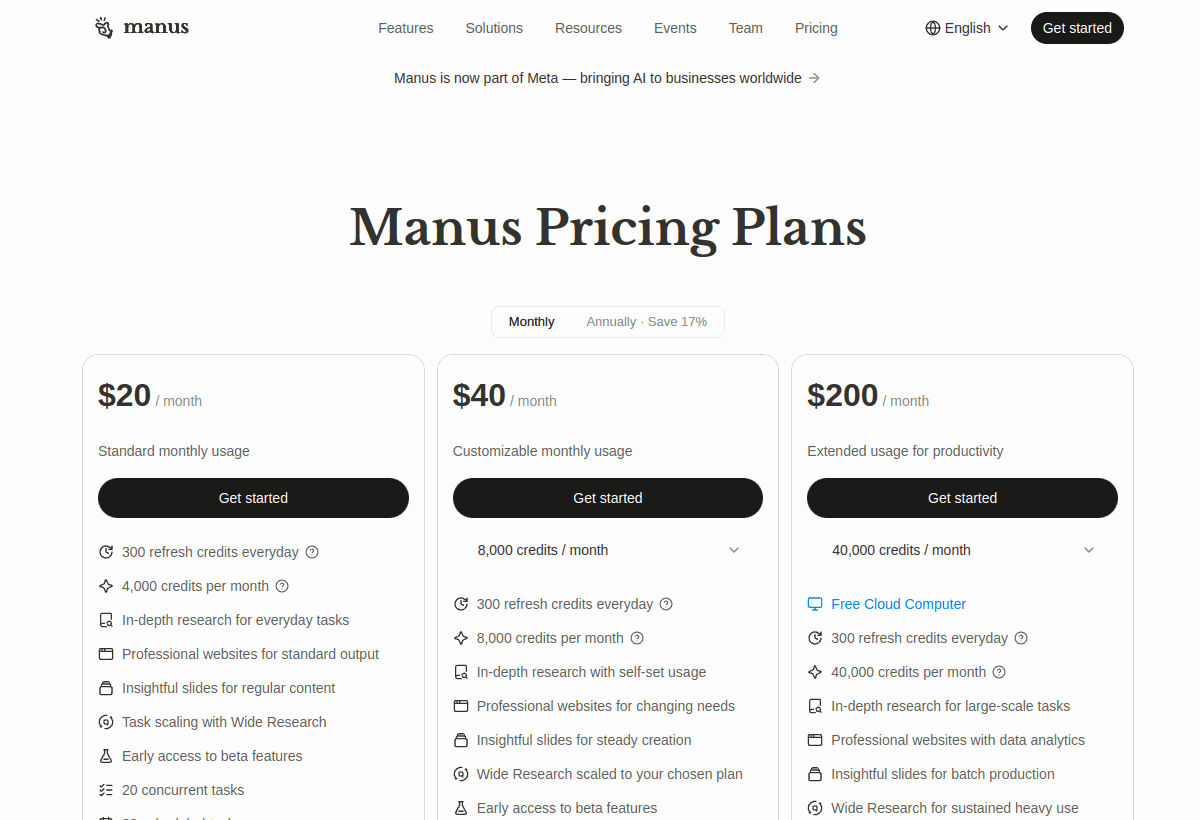 Official Manus pricing pageSource snapshot 2026-08-19 - manus.im/pricingJavaScript-driven plan cards. Static dollar amounts did not render in this research browser on 19 August 2026. Confirm checkout.
Also verify: A Note to Our Users (11 August 2026), Team, Trust Center, Confidentialité, Conditions, et API v2. Screenshots are editorial captures; always confirm live pages.
Official product demo
Browser Operator and Wide Research, from Manus documentation
Official Manus videos from product documentation. They show intended interaction, not independent proof of accuracy, cost, or reliability.
Browser Operator
How Manus uses an existing browser session. The unanswered buyer question is what page and action data reaches Manus servers during an authenticated task.
Open on YouTube · Published in the official Browser Operator documentation.
Wide Research
How one request fans out across parallel agents. A useful pilot must measure missing items, citation quality, duplicate work, and credits consumed per accepted result.
Open on YouTube · Published in the official Wide Research documentation.
Grand livre des réclamations et des sources
Sur quoi ce profil est basé
Public Manus product, pricing, team, independence note, Trust Center, privacy, terms, feature, and API pages reviewed or re-checked on 19 August 2026. Individual usage cards at $20 / $40 / $200 monthly are from a 30 July 2026 capture. Starting paid price of $20 monthly / $17 annual is from Manus's 24 July 2026 blog. Team seat economics are from prior calculator observation plus current Team page feature copy. The Meta unwind and 23-25 August 2026 backup/restore windows are from the 11 August 2026 official note.
Ce que nous n'avons pas vérifié
We did not create a paid Manus account, measure credit burn on live workloads, independently audit SOC 2 or ISO reports, penetration-test Browser Operator, or confirm which specific tenants fall in the deletion set. The 19 August pricing page did not render static prices. Buyers should run the four-step workflow test, confirm checkout, and request current reports, DPA, and architecture diagrams in writing.
Comment nous avons évalué l'adéquation
Editorial fit weights action-surface breadth, credit and concurrency economics, approval and audit controls, unwind and legal-entity risk, and implementation risk relative to narrower alternatives. It is not a performance benchmark or a vendor rating.
Should you choose Manus AI?
Manus AI is a broad autonomous agent platform with real action paths across research, browser control, email, Slack, connectors, API automation, Cloud Computer, and web-app generation. Public starting price, per Manus's 24 July 2026 blog, is $20 per month ($17 billed annually). A 30 July capture showed $40 and $200 cards above that, and Team near $20 per seat per month with pooled credits. Confirm live checkout. The 19 August 2026 pricing page did not expose static cards in this research browser.
Choose Manus when you want one supervised agent runtime that can research in parallel, operate browsers, and take work from collaboration channels, and when you will pilot credit burn and lock down approvals. Look elsewhere when you only need a reasoning assistant, a research engine, a coding IDE, or a prompt-to-app host. Resolve legal entity, retention, training-use, Browser Operator data flow, and the Meta unwind in writing. If your account might be affected, back up before 23 August 2026. Run the four-step workflow test before you standardize.
FAQ
Questions courantes
What is Manus AI best used for?
Supervised multi-step work that mixes research, browser actions, artifact generation, and intake from email or Slack. It is not a helpdesk.
How much does Manus AI cost in 2026?
Manus's 24 July 2026 blog states paid plans start at $20 per month, or $17 billed annually. A 30 July capture showed $20 / $40 / $200 cards and Team about $20 per seat per month. On 19 August 2026 the live pricing page did not render static prices here. Confirm checkout.
Does Manus AI have a free plan?
We could not verify a public individual free-tier entitlement from static HTML on 19 August 2026. Ask the vendor about trials and confirm any free credits at checkout.
What are Manus credits?
Credits are the consumption unit for agent work. Captured cards included monthly credits plus 300 daily refresh credits. The public page does not fully define per-action costs, rollover, or overage. Measure burn on your workloads before choosing a card.
Is Manus still part of Meta?
Manus said on 11 August 2026 it will resume operating as an independent company. That unwind includes a data-deletion window for some users on 23-24 August 2026 (SGT). Treat contracting party, DPA, and backup status as items to confirm now, not later.
Do I need to back up my Manus account?
If you receive an affected-user notice, back up before 7:59 a.m. SGT on 23 August 2026 and restore from 8:00 a.m. SGT on 25 August. Unaffected users are told they will see an in-app notice and should take no action. Check the app either way. This review is dated 19 August 2026.
How does Manus compare to ChatGPT, Claude, or Perplexity?
ChatGPT and Claude are stronger defaults when you primarily need reasoning and writing. Perplexity is stronger for cited web research. Manus competes when you need autonomous execution across browser, mail, Slack, multi-agent research, and app generation under one runtime.
Is Manus safe for enterprise data?
Trust Center materials list SOC 2 and ISO certifications, encryption, and sandbox isolation. Still request current reports, resolve Browser Operator data-flow questions, and finish the Meta-unwind legal review before production use.
Can Manus send email or deploy websites on its own?
API docs describe confirmation flows for Gmail/Outlook send and website deploy, including optional global allow for future deploys. Keep confirmations on for consequential actions until policy and audit trails are proven.
Manus vs Cursor or Lovable for building apps?
Choose Cursor when engineering inside a repository is the main job. Choose Lovable when prompt-to-hosted-app is the main job. Choose Manus when app generation is one outcome among broader research and browser tasks, and still validate export before production.