
Best AI code review tools 2026
Compare AI code review tools for pull-request quality and security in 2026. Decision tables, benchmark data, pricing, and a layered review strategy for CodeRabbit, Qodo Merge, GitHub Copilot, Snyk Code, and Semgrep.
Compare AI code review tools for pull-request quality and security in 2026. Decision tables, benchmark data, pricing, and a layered review strategy for CodeRabbit, Qodo Merge, GitHub Copilot, Snyk Code, and Semgrep.
The right AI code review tool is the one that catches the bugs your team actually misses without drowning reviewers in noise. In 2026 the category has split into two distinct jobs: general PR reviewers that improve logic, style, and test coverage, and security-grounded analyzers that trace exploitable paths across files and dependencies. Most production teams need both.
For related buying guidance, see coding AI agents, AI coding agent hooks, MCP config locations for coding agents, and developer agent guides.
Most disappointment in this category comes from category confusion. A general AI reviewer is trained to comment on readability, logic, patterns, and tests. A security analyzer is built on taint rules, call graphs, and dependency reachability. One will flag a missing null check; the other will trace a user input through three function calls to a SQL sink.
| Question | General AI reviewer | Security analyzer |
|---|---|---|
What does it see? | The diff plus some repo context | The full codebase plus dependency inventory |
What does it catch? | Logic errors, style, tests, API misuse | Injection, secrets, vulnerable dependencies, auth flaws |
How does it decide? | LLM reasoning on patterns | Rule-based or reachability-grounded analysis |
What does it miss? | Cross-service flows, subtle auth bugs | Creativity, intent, whether a change is idiomatic |
Use a general reviewer to raise the floor on every PR. Use a security analyzer to block exploitable vulnerabilities. Do not expect one to replace the other.
| Tool | Primary strength | Pricing posture | Best fit | Watch-out |
|---|---|---|---|---|
CodeRabbit | Thorough general PR review | Pro $24/dev/mo annually, Pro+ $48 | Teams that want deep review and can tune noise | High comment volume by default |
Qodo Merge / PR-Agent | Self-hosted, BYOK, multi-platform | Free self-hosted; Teams ~$30/dev/mo | Compliance, air-gapped, or multi-platform teams | Open-source version lacks multi-agent architecture |
GitHub Copilot review | Zero-setup GitHub-native review | Copilot Business/Enterprise + AI credits + Actions minutes | GitHub-native teams already on Copilot | Shallow on complex logic and security |
Snyk Code | AI-powered SAST with fix suggestions | Free tier; Team from ~$25/dev/mo | Security-first teams needing OWASP coverage | Not a general code-quality reviewer |
Semgrep (with Assistant) | Custom rules + AI-assisted triage | Free for individuals; Team custom | Teams with specific patterns to enforce | Rules require investment and maintenance |
Cursor / BugBot | Pre-PR review in the IDE | Pro $20/mo, Business $40/dev/mo | Cursor-centric workflows | Not a PR-level reviewer by default |
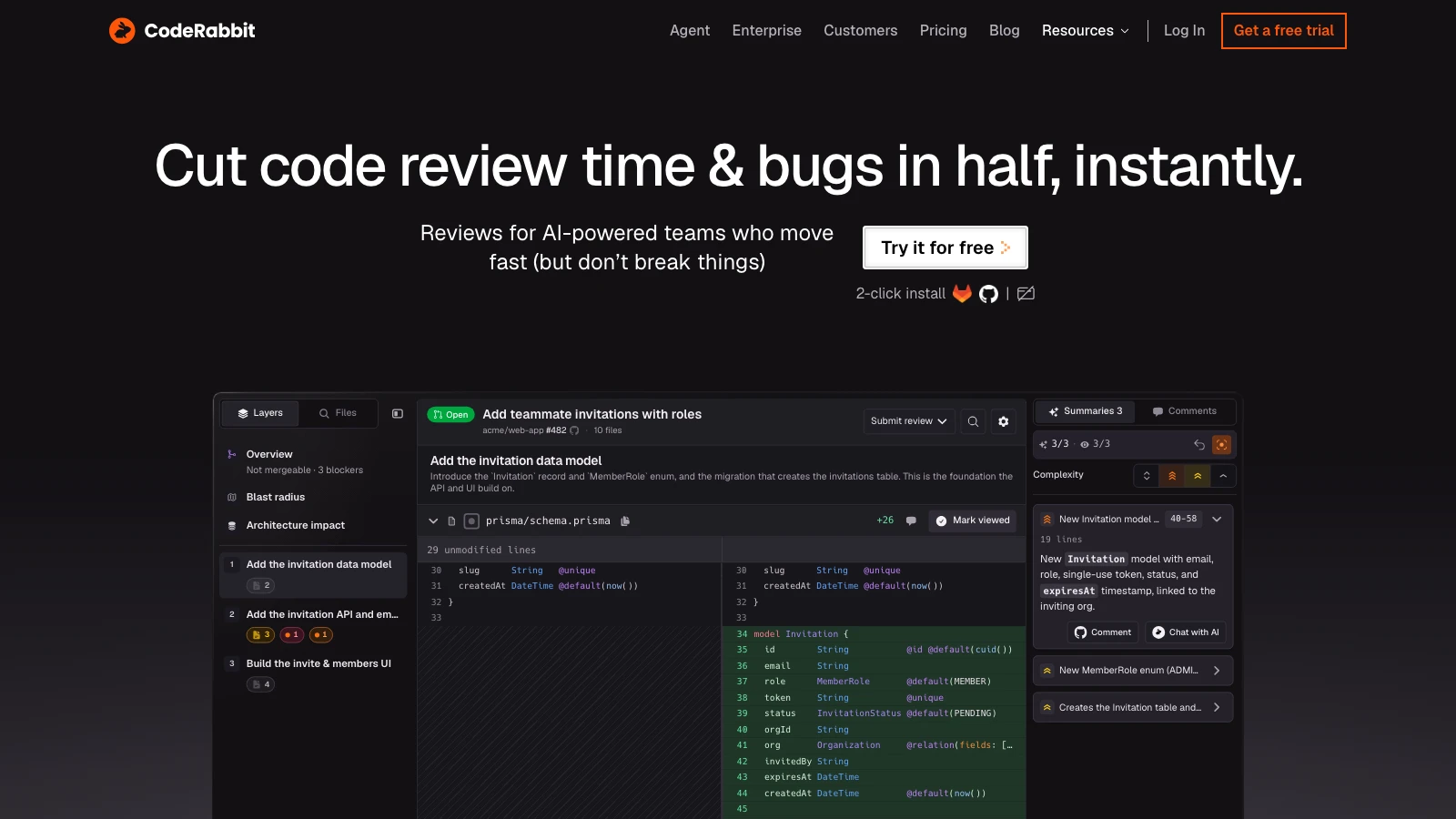
CodeRabbit is the most installed AI review app on GitHub and is known for detailed PR summaries, line-level comments, and static-analysis integrations including TruffleHog, OSV-Scanner, and linters. The CodeRabbit plans page shows Pro at $24 per developer per month billed annually and Pro+ at $48, with rate limits per developer per hour and a usage-based add-on for overages.
In independent benchmarking by Martian, CodeRabbit scored an F1 of roughly 51% across hundreds of thousands of real PRs, leading the independent field at that snapshot. Other benchmarks place it lower, which illustrates an important rule: a benchmark number tells you how the tool performed on that specific test, not on your code.
The main watch-out is noise. CodeRabbit posts more comments per PR than most alternatives. Teams that invest a week tuning .coderabbit.yaml and enabling the learnings system report better precision. Do not assume default settings will match your review culture.
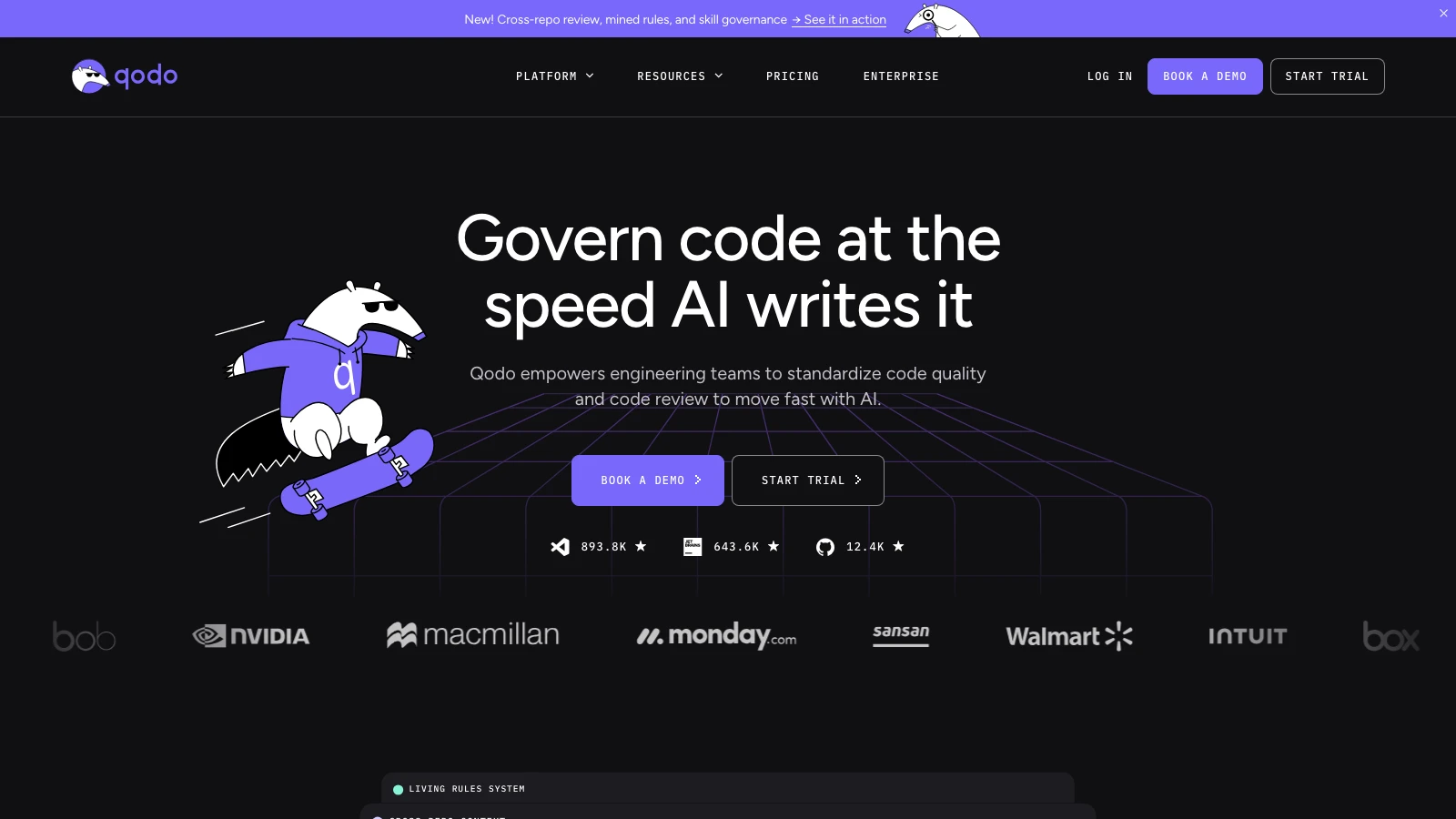
Qodo Merge evolved from the open-source PR-Agent project, which Qodo handed over to a community-led organization in 2026. The open-source version remains free under Apache 2.0 and can be self-hosted as a GitHub Action, webhook, or CLI. Qodo’s hosted Teams plan adds a multi-agent review architecture, enterprise deployment options, and support.
The self-hosted path is the standout option for teams that cannot send source code to SaaS review services. You provide your own LLM keys and run the container inside your infrastructure. The tradeoff is operational overhead and the absence of Qodo 2.0’s multi-agent architecture on the open-source branch.
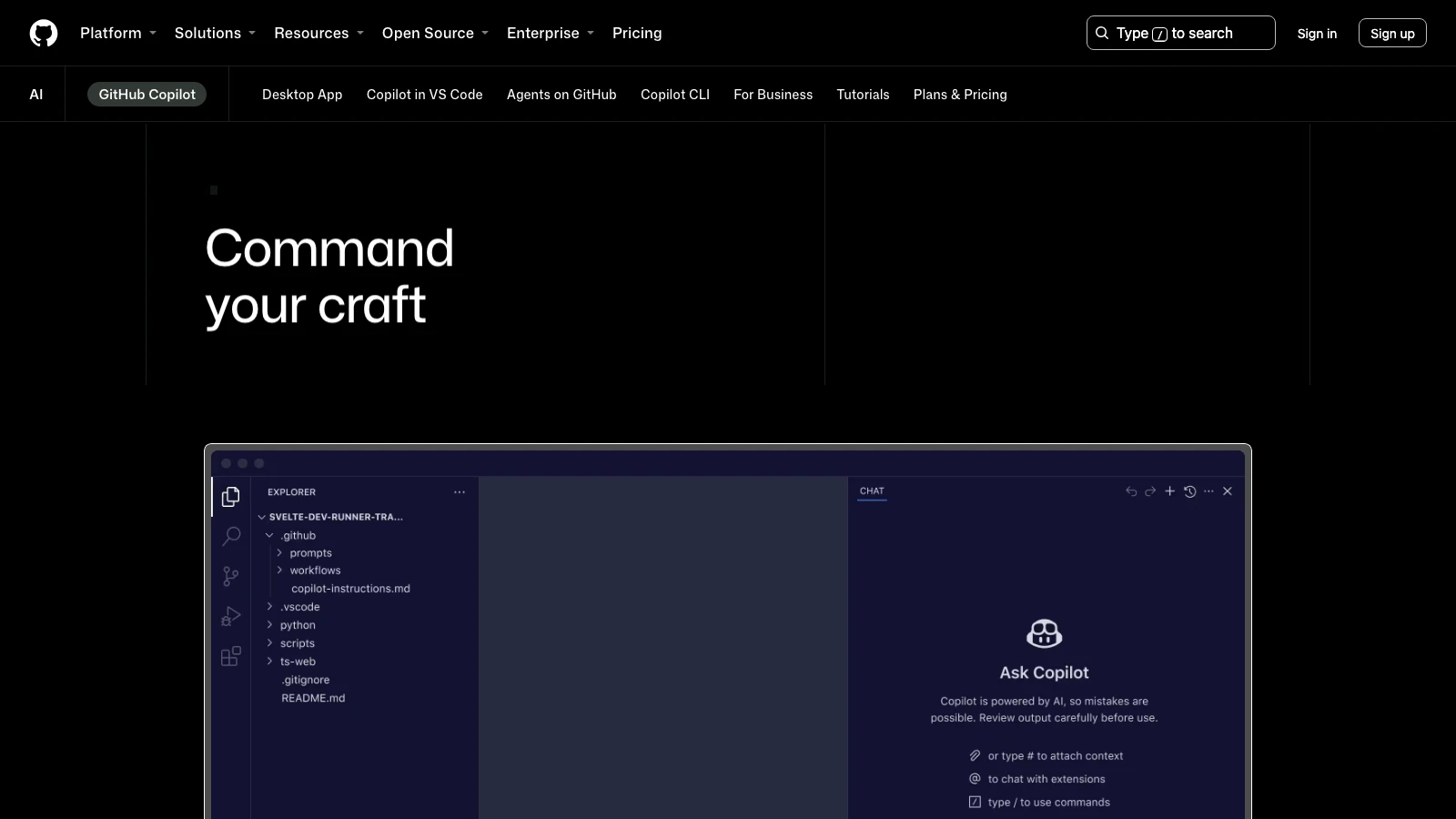
GitHub Copilot’s code review is available natively inside the PR workflow for teams on Business or Enterprise plans. Since June 1, 2026, each review on a private repository consumes GitHub Actions minutes in addition to GitHub AI credits. The Copilot plans page shows Business and Enterprise tiers with pooled AI credits and admin budgets.
Copilot review is best for reducing friction on GitHub-native teams already paying for Copilot. It is not a deep bug finder or a security scanner. Treat it as a style and consistency layer, and pair it with Snyk, Semgrep, or CodeQL for security.
Snyk Code is a SAST tool that uses interfile taint analysis to trace untrusted data from sources to dangerous sinks. It covers OWASP Top 10 categories such as SQL injection, XSS, command injection, path traversal, and hardcoded secrets. Fix suggestions are code-level, which makes it more actionable than generic “this looks risky” comments.
Snyk Code is not a general reviewer. It will not tell you whether a refactor is idiomatic or whether a test is missing. Its job is to catch exploitable vulnerabilities that LLM reviewers often miss. Pair it with CodeRabbit or Qodo for a complete stack.
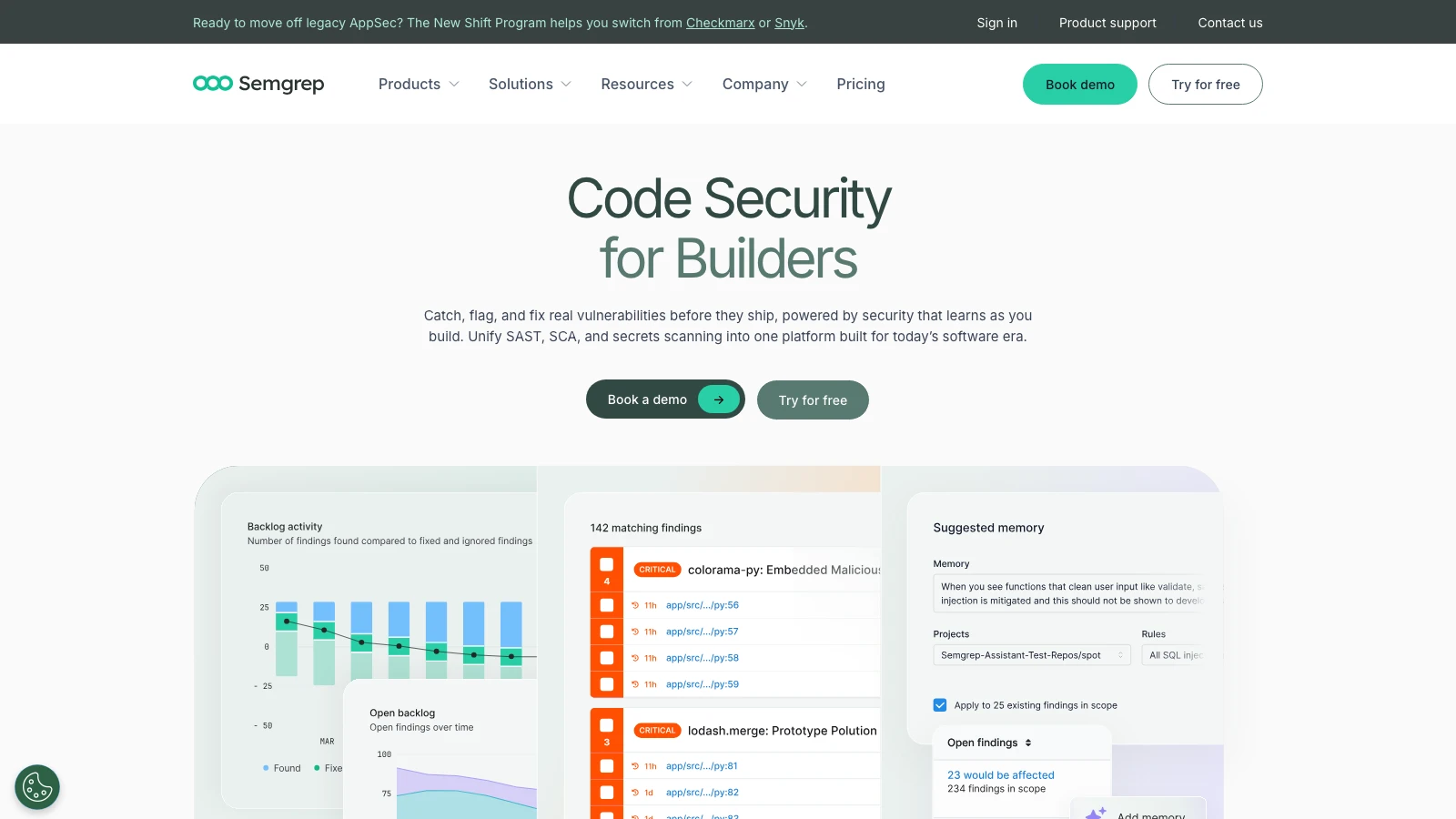
Semgrep’s core strength is its rule engine. Teams can write precise, pattern-based rules for their own tech stack and dangerous patterns. The AI assistant layer helps triage findings and explain remediation. The free tier covers individuals; Team and Enterprise plans add collaboration, policy management, and deployment options.
The cost is rule maintenance. A poorly maintained Semgrep ruleset becomes noisy or stale. Invest in rule ownership before scaling Semgrep across the org.
Benchmarks in AI code review are noisy. The same tool can score anywhere from 36% to 82% F1 depending on who runs the test, how “caught” is defined, and which bugs are included. A few credible signals:
The practical takeaway: use benchmarks as a starting point, but run your own test on a real PR with a known bug before choosing a vendor.
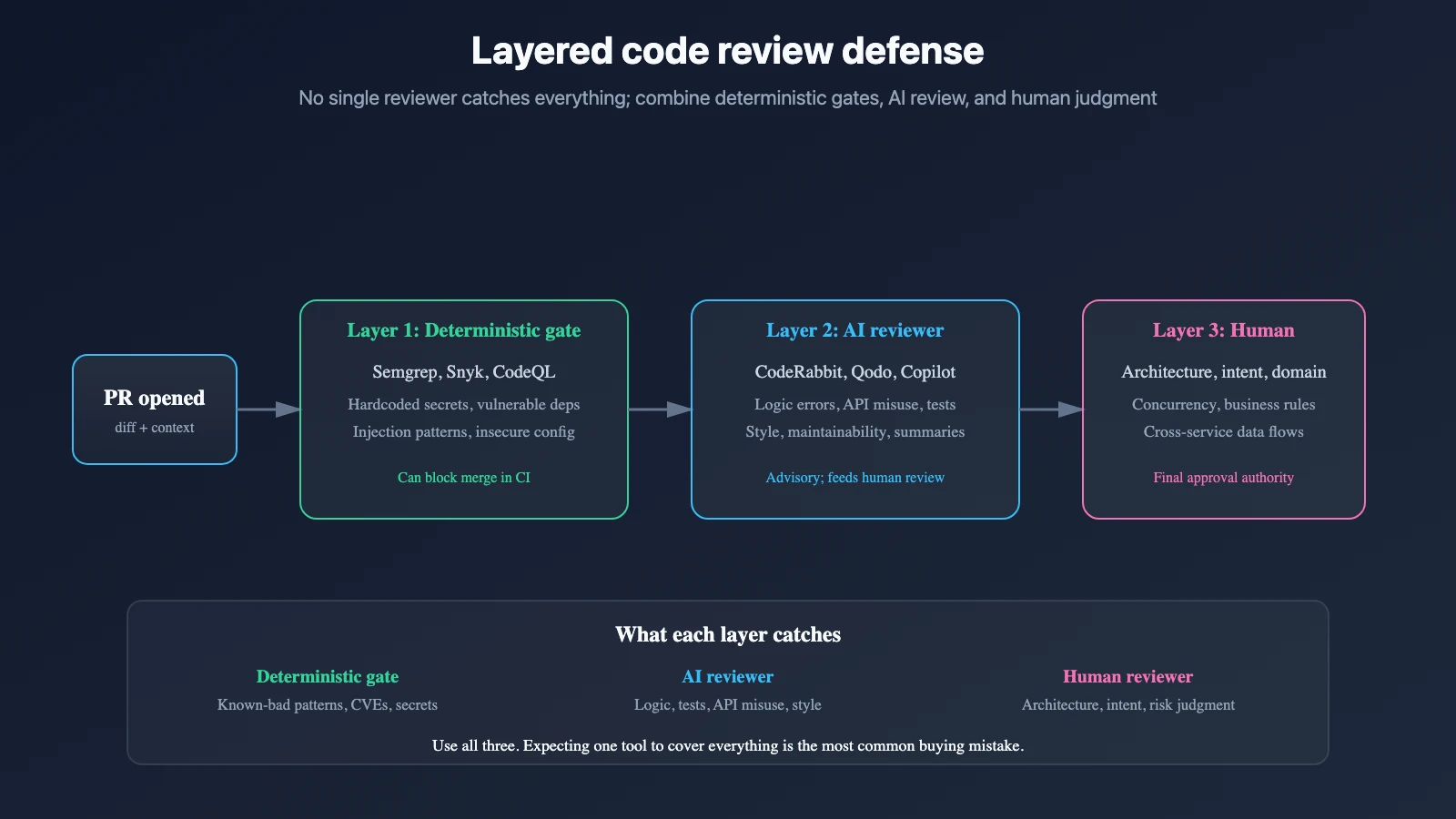
A sane production pipeline combines three layers:
The AI reviewer should never be the final approval layer. Current evidence consistently shows AI review complements human review; it does not replace it.
Before buying, run this test on your own repository:
No. The best independent benchmarks show AI reviewers catch 50–60% of seeded issues, with meaningful false-positive rates. Human reviewers remain essential for architecture, business logic, and concurrency.
No. General AI reviewers mostly reason about the diff. They lack the call graph and dependency inventory needed for reliable security analysis. Use Snyk Code, Semgrep, or CodeQL for security.
The software is free under Apache 2.0. You pay only for LLM API usage and the infrastructure to run the container. That typically costs a small fraction of a hosted SaaS plan.
Sometimes. Running a general reviewer plus a security analyzer covers different risk classes without much overlap. Running two general reviewers usually produces diminishing returns and more noise.
Rate limits and overage pricing. CodeRabbit, Qodo, and Copilot all have usage meters that can surprise high-volume teams. Model the cost at your actual PR velocity before committing.
Start by identifying your real gap: missed logic bugs, slow review cycles, or security findings escaping to production. Then pick one general reviewer and one security analyzer, run a two-week pilot on real PRs, and measure recall, precision, and review time. For the surrounding developer tooling context, read our coding AI agents and AI coding agent hooks guides.
Further reading
4 next jobs from this page. Named destinations, not a pile of related guides.
04