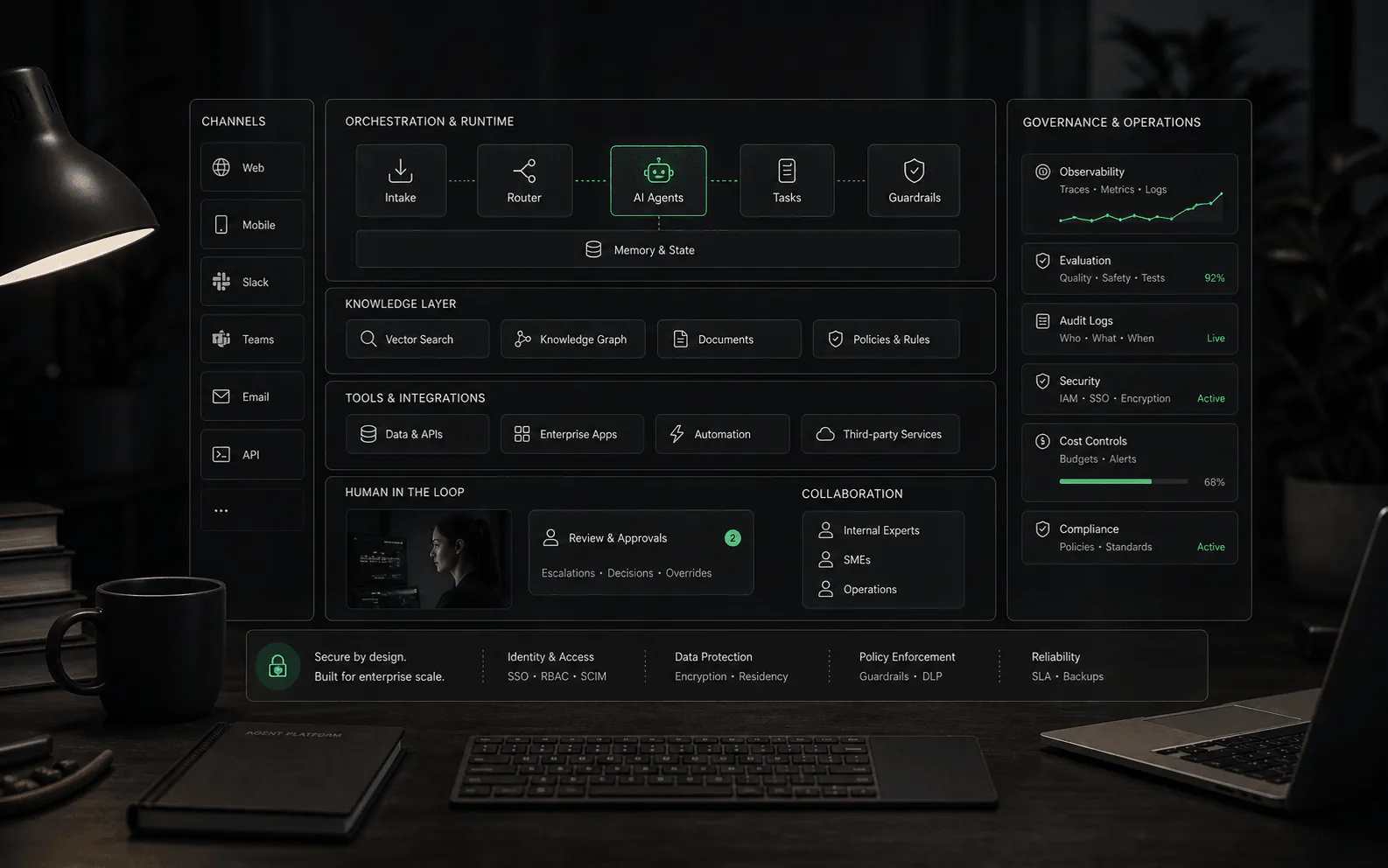
Start with the job, not the vendor category
Write one sentence that describes the agent's job: who it helps, where the conversation starts, what information it can use, what actions it may take, and when a human must take over. A support deflection bot, an ecommerce order assistant, an agent-assist layer, and a tool-connected workflow agent have different buying criteria even when vendors use the same AI-agent language.
Separate answer automation from action automation
- Answer automation: the agent retrieves approved knowledge and responds to customer or employee questions.
- Routing automation: the agent identifies intent, priority, account type, or risk and sends the case to the right queue.
- Drafting automation: the agent prepares replies, summaries, or next steps for a human to approve.
- Action automation: the agent reads or writes data in business systems, such as tickets, orders, CRM records, refunds, appointments, or internal workflows.
- Approval automation: the platform decides when the agent can act alone, when it needs review, and how that review is logged.
Build the shortlist around five proof tests
- Knowledge test: ask questions that require the newest policy, an exception, and a source that should not be used.
- Channel test: run the same issue through web chat, email, WhatsApp, or the real channels your customers use.
- Handoff test: force a low-confidence or sensitive case and check whether the human receives the transcript, intent, sources, customer context, and proposed next step.
- Integration test: ask the vendor to show exactly what the agent can read, write, update, or trigger in your stack.
- Cost test: model the bill at expected monthly conversations, resolutions, seats, channels, messages, AI actions, and implementation services.
Score the platform against operating risk
The riskiest AI-agent buying mistake is approving a good demo without testing the failure path. Strong platforms make uncertainty visible: they show source trails, confidence limits, escalation rules, permissions, audit logs, analytics, and a way to improve failed answers after launch. If those controls are vague, the automation may save time in the demo and create hidden review work in production.
Use a weighted decision matrix
- Customer support teams should weight handoff quality, queue fit, knowledge accuracy, analytics, and human review controls heavily.
- Ecommerce teams should weight order context, return and refund boundaries, storefront integrations, social channels, and peak-volume pricing.
- SaaS teams should weight help-center quality, product-led onboarding flows, CRM context, account segmentation, and escalation into success or support teams.
- Operations teams should weight permissions, audit logs, API reliability, workflow ownership, and whether the agent can be paused safely.
Ask sharper vendor questions
- Show us a failed answer and how your system helps us fix the source, retrieval, prompt, or workflow rule.
- Which actions can the agent complete without human approval, and which require approval by default?
- How are source permissions enforced when different users should see different knowledge?
- What happens when two approved sources conflict?
- Which pricing unit changes fastest as usage grows: seats, conversations, resolutions, messages, credits, actions, or channels?
- Can we export transcripts, source traces, review decisions, and analytics if we change platforms later?
Make the final choice after a controlled pilot
A serious pilot should use real knowledge sources, real edge cases, named reviewers, a written escalation policy, and a small evaluation set that can be rerun after fixes. The winning platform should improve the work without making the team guess why the agent answered, acted, escalated, or failed.
Sources to verify
Use these references to verify definitions, risk guidance, and product-evaluation criteria before applying the framework to a live vendor shortlist.
FAQ
Common questions
What is the most important criterion when choosing an AI agent platform?
Workflow fit is the most important criterion. A platform should match the channels, systems, escalation rules, knowledge sources, and risk level of the job the agent will perform.
Should small teams choose the simplest AI agent platform?
Often, yes. If the agent only needs to answer website questions or capture leads, a lightweight chatbot or website-first agent may be better than an enterprise helpdesk AI suite. Complexity should be earned by workflow needs.
How should buyers compare AI agent pricing?
Model pricing at expected production volume. Include seats, AI conversations, resolutions, message credits, channel fees, workflow actions, implementation services, and add-ons rather than comparing only entry plans.
What should an AI agent pilot include?
A pilot should include real knowledge sources, realistic edge cases, handoff tests, permission checks, cost modeling, analytics review, and a process for fixing failed answers before launch.
Next step
Compare by workflow, not by hype.
Use the methodology to evaluate channels, automation depth, handoff, integrations, and implementation fit before shortlisting a platform.