
Best AI CRM tools 2026
Compare AI CRM tools for sales teams in 2026. Decision tables, pricing, AI capability tiers, and buyer guidance for Salesforce Agentforce, HubSpot Breeze, Pipedrive, Zoho Zia, and Monday CRM.
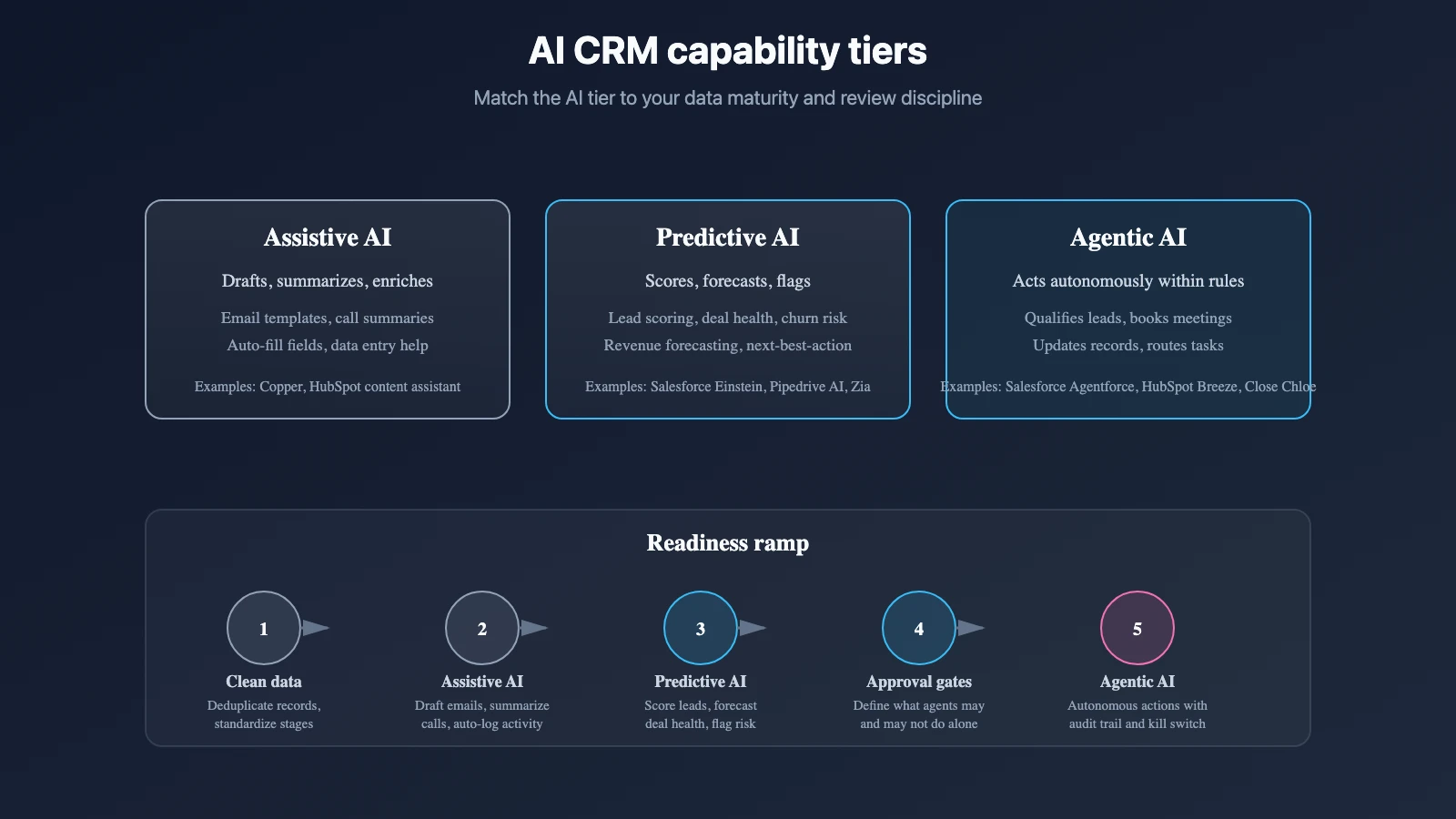
Compare AI CRM tools for sales teams in 2026. Decision tables, pricing, AI capability tiers, and buyer guidance for Salesforce Agentforce, HubSpot Breeze, Pipedrive, Zoho Zia, and Monday CRM.
The right AI CRM is the one that removes the administrative work reps hate while keeping a human in charge of deals that matter. In 2026 every major CRM vendor claims AI, but the real variation is in what the AI actually automates: some draft emails, some score leads, and a few can take autonomous action across the pipeline. Match the tier of intelligence to your team’s data maturity and review culture.
For related buying guidance, see AI SDR agents, sales AI agents, AI workflow automation agents, and AI agents for business.
Vendors blur these tiers intentionally. Separating them helps you buy for what you will actually use.
| Tier | What the AI does | Examples | Buy it when… |
|---|---|---|---|
Assistive | Drafts emails, summarizes calls, fills fields | HubSpot Content Assistant, Copper AI email rewriter | Reps spend too much time on admin and writing |
Predictive | Scores leads, forecasts revenue, flags at-risk deals | Salesforce Einstein, Pipedrive AI Sales Assistant, Zoho Zia | Pipeline visibility and prioritization are the pain |
Agentic | Qualifies leads, books meetings, updates records autonomously | Salesforce Agentforce, HubSpot Breeze agents, Close Chloe | You have enough volume and governance to let AI act |
Most teams do not need agentic AI on day one. Assistive and predictive features solve the daily pain—bad data, slow follow-up, stale forecasts—at a fraction of the cost and risk.
| Tool | Best fit | Pricing posture | AI strength | Key caveat |
|---|---|---|---|---|
Salesforce Einstein / Agentforce | Large enterprises on Salesforce | Sales Cloud + Einstein/Agentforce add-ons; Flex Credits per action | Deepest customization and autonomous-agent platform | Total cost and implementation complexity run high |
HubSpot Breeze | Scaling mid-market marketing/sales teams | Sales Hub Professional or Enterprise plus AI credits | Unified data model across marketing, sales, service | Real cost rises with agent usage and seat growth |
Pipedrive AI | Sales-first teams of 5–100 | Lite from $14/seat/mo; AI on higher tiers and credit-metered | Visual pipeline plus deal-risk scoring | AI usage is credit-metered on lower tiers |
Zoho CRM + Zia | Budget-conscious SMBs and mid-market | Standard from $14/seat/mo; Zia included in tiers | Lead scoring, anomaly detection, sentiment, generative modules | UI complexity grows with the 45-app ecosystem |
Monday CRM AI | Ops-forward teams on monday.com | Basic from $12/seat/mo; AI agents on credit layer | AI Sales Agent and AI Lead Agent on visual boards | CRM depth lags pure-play CRMs |
Freshsales Freddy | Growing teams wanting clean UI and scoring | Growth from $9/seat/mo; Freddy from Pro $39 | Contact scoring, email drafting, deal insights | Freddy not included at entry tier |
Salesforce is the most capable AI CRM for complex enterprises. Einstein covers predictive lead scoring, opportunity insights, and forecasting. Agentforce adds autonomous agents that can qualify leads, resolve cases, and update records. The Salesforce Agentforce page positions it as an AI agent platform across service, sales, marketing, and commerce.
The cost structure matters. Agentforce is billed through Flex Credits—roughly $500 per 100,000 credits, with typical actions costing 20 credits each and voice actions costing 30. A single conversation can involve 8–15 actions, so effective cost per resolution lands around $0.80–$1.50 before counting the underlying Sales Cloud license. The Salesforce plans page shows Sales Cloud Starter at $25/seat/mo, Professional at $100, Enterprise at $165, and Unlimited at $330, all billed annually.
Salesforce is the right answer when you have a dedicated admin team, clean data, and the budget to match. It is the wrong answer for small teams looking for a quick AI win. Real-world buyer discussions on RevGenius consistently emphasize that for AI-first stacks the quality of the API and the ability to run a parallel trial matter more than the feature list.

The 2026 pricing reality is that the headline per-seat price is only part of the story. One Stackinsight CRM-pricing discussion reported an apples-to-apples quote where Salesforce came in at roughly 3× HubSpot for the same scope, mainly because Salesforce required a higher edition, mandatory implementation services, and projected integration middleware. Include that TCO delta in your decision model.
HubSpot’s Breeze assistants cover prospecting, content drafting, deal insights, and customer service inside the Smart CRM. The HubSpot sales pricing page shows Starter at $20/seat/mo, Professional around $90, and Enterprise around $150, with Breeze agents unlocking at Professional or above and AI usage billed in credits.
HubSpot’s advantage is adoption speed. Teams that already run marketing and sales on HubSpot get AI native to the same data model, without a separate data-platform project. The pricing curve is the watch-out: seat growth plus agent usage can push the real cost well above the headline per-seat price.
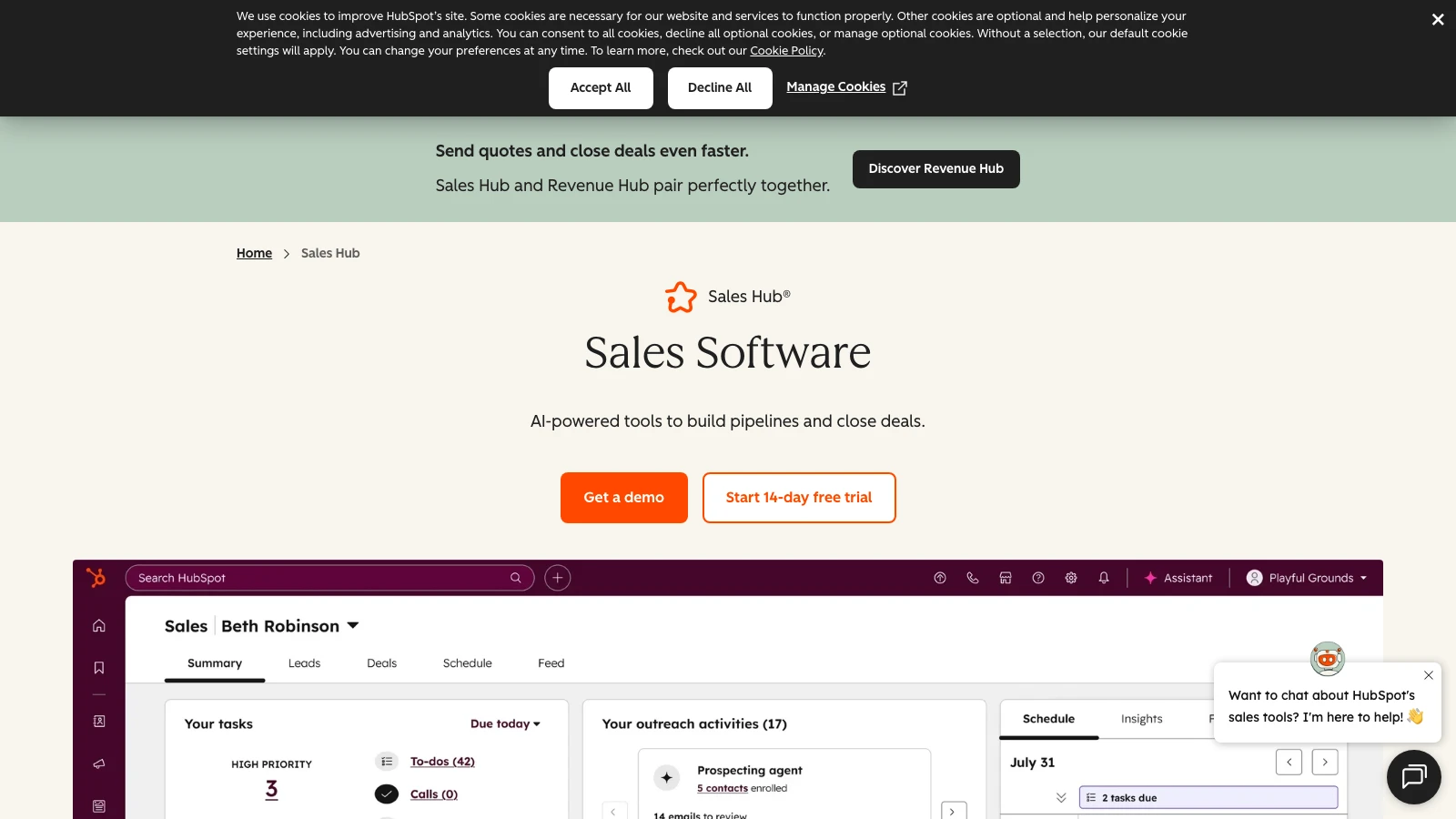
Pipedrive’s AI layer is built around the visual pipeline. The AI Sales Assistant predicts win probability, flags deals going cold, and recommends next actions. Call and meeting summaries are agentic but scoped to sales context. Pipedrive is ideal for teams that think in pipeline stages and activity-based selling.
The 2026 plan rename and credit model are important. Lite starts at $14 per seat per month, but AI usage on lower tiers is metered separately. Teams that rely heavily on the AI Sales Assistant should budget an extra 5–15 EUR per user per month on Lite or Growth.
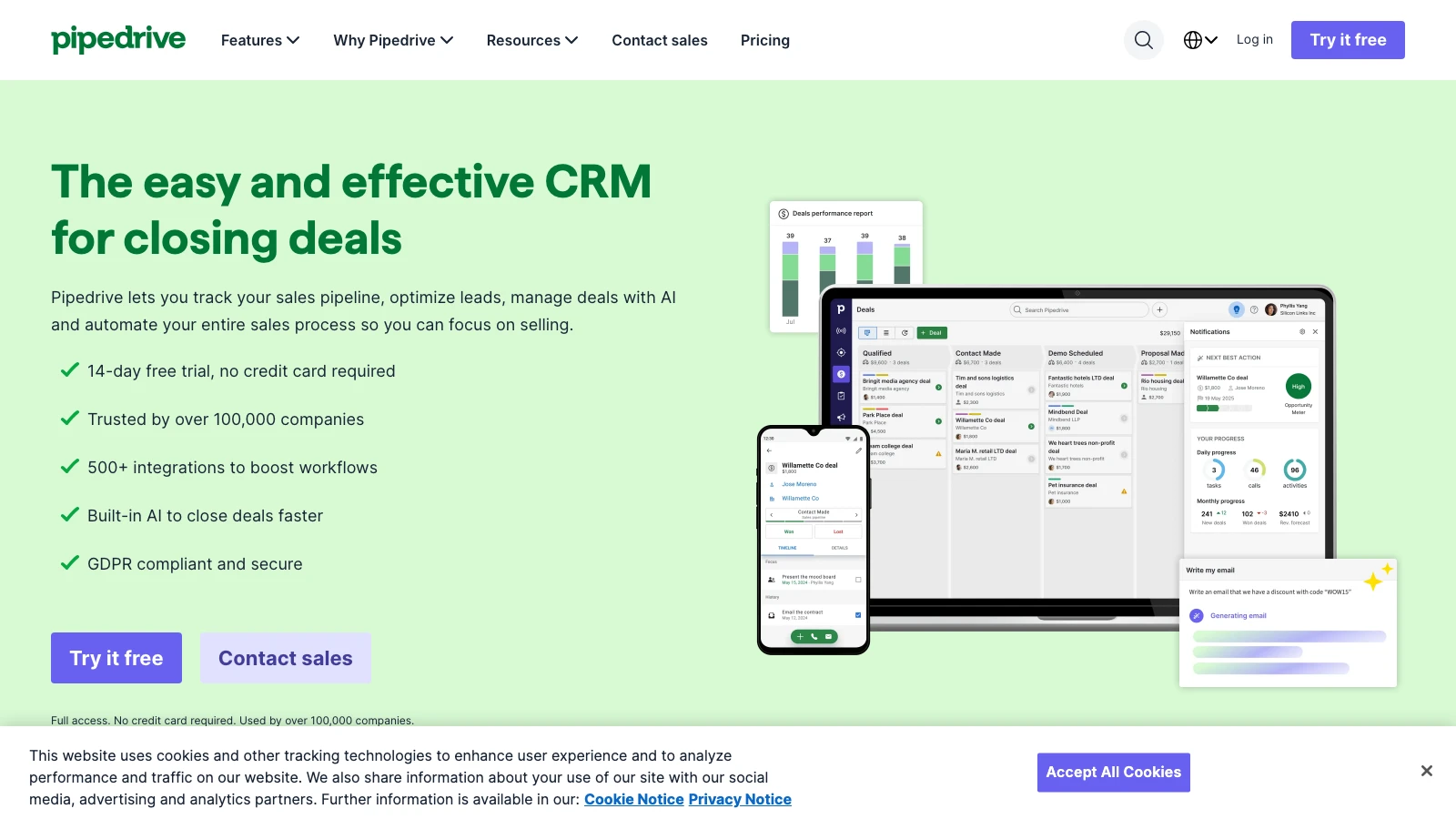
Zia is Zoho’s AI assistant for lead scoring, anomaly detection, best-time-to-contact recommendations, and email sentiment analysis. It is included in the CRM tier rather than sold as a separate SKU, which makes Zoho the strongest value play for teams that want real AI without enterprise overhead.
The tradeoff is polish and ecosystem breadth. Zia’s predictions are useful but not as sophisticated as Einstein’s, and Zoho’s UI becomes more complex as you turn on modules from the broader 45-app ecosystem. For small to mid-sized teams, the value usually wins.
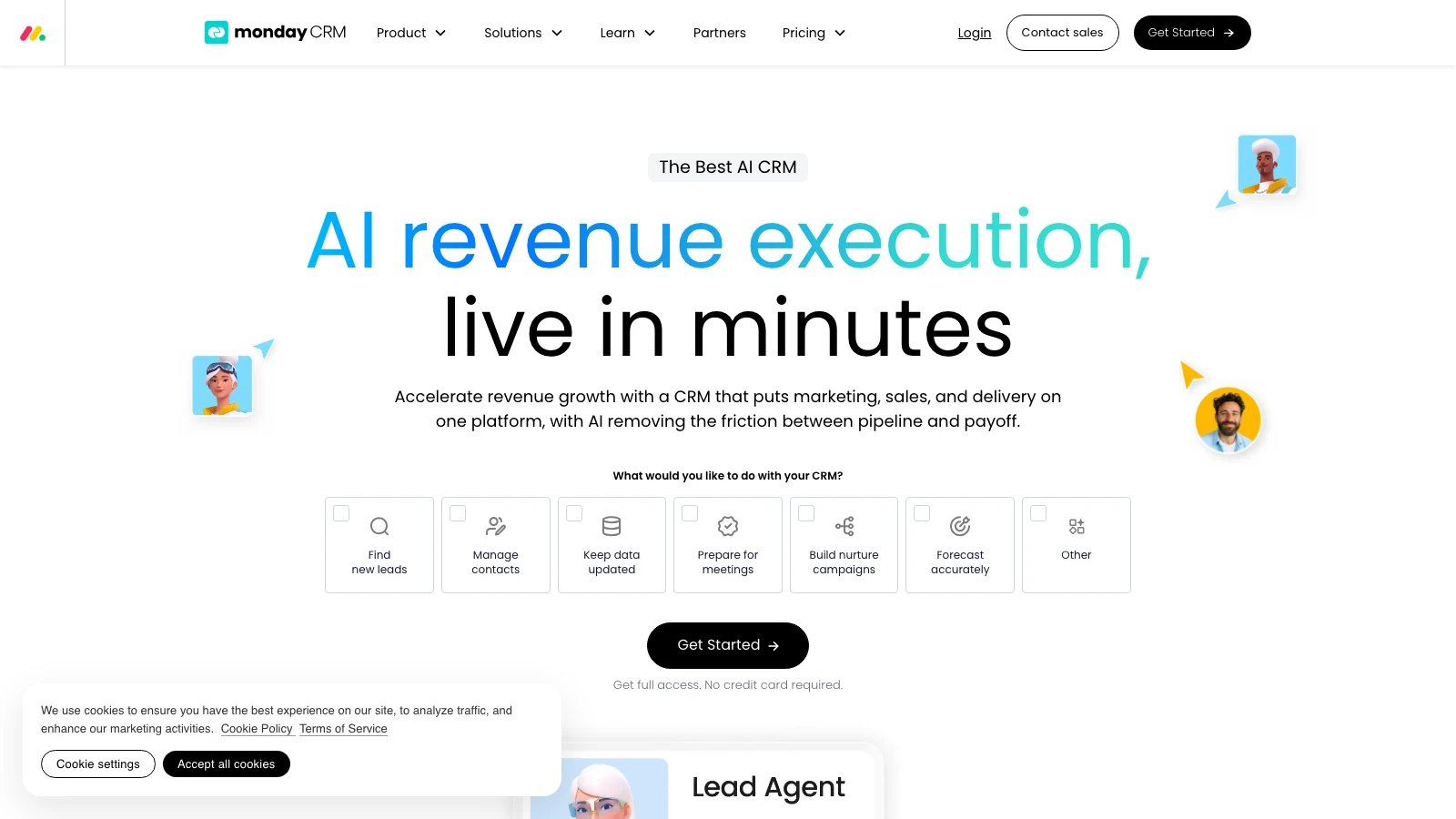
Monday CRM is built on the monday.com Work OS and offers AI Sales Agent and AI Lead Agent that can source, qualify, and contact leads. The visual board model makes it natural for teams already running projects and ops on monday.com.
The AI runs on a credit layer on top of the subscription, so the real monthly cost is harder to predict from the seat price alone. CRM depth also trails dedicated CRMs like Pipedrive or Zoho. Choose Monday when workflow flexibility and existing adoption matter more than pure sales CRM depth.
Segment by company size and primary use case:
For service-led organizations, the most consequential AI may live in the contact-center platform rather than the CRM. Evaluate Genesys, NICE CXone, or Five9 alongside the CRM if customer service is the battleground.
AI CRM features fail when the data underneath is bad. Before turning on predictive or agentic features:
No. AI CRMs handle administrative, analytical, and repetitive work. Relationship-building and complex deal judgment still require humans.
Salesforce has more depth and autonomy potential; HubSpot has faster adoption and better value below enterprise scale. The answer depends on team size and existing stack.
Assistive and predictive features deliver real productivity gains today. Fully agentic AI is valuable but less mature in production than vendor marketing suggests.
Far more than the headline per-seat price. Include base subscriptions, AI credits or Flex Credits, seat growth, implementation, and data cleanup.
Fix data first. AI on top of stale, duplicate, or incomplete records produces confidently wrong answers.
Before booking demos, define which AI tier you actually need: assistive, predictive, or agentic. Then run a 14-day pilot with real pipeline data and measure whether the AI changes rep behavior—follow-up speed, forecast accuracy, and data-entry completeness—not just dashboard metrics. For the broader sales context, read our AI SDR agents and sales AI agents guides.
Further reading
4 next jobs from this page. Named destinations, not a pile of related guides.
04