
MCP security checklist
MCP Security Checklist
A production-minded checklist for approving MCP servers before agents can read data, call tools, write records, browse systems, or trigger workflows.
MCP security checklist
A production-minded checklist for approving MCP servers before agents can read data, call tools, write records, browse systems, or trigger workflows.
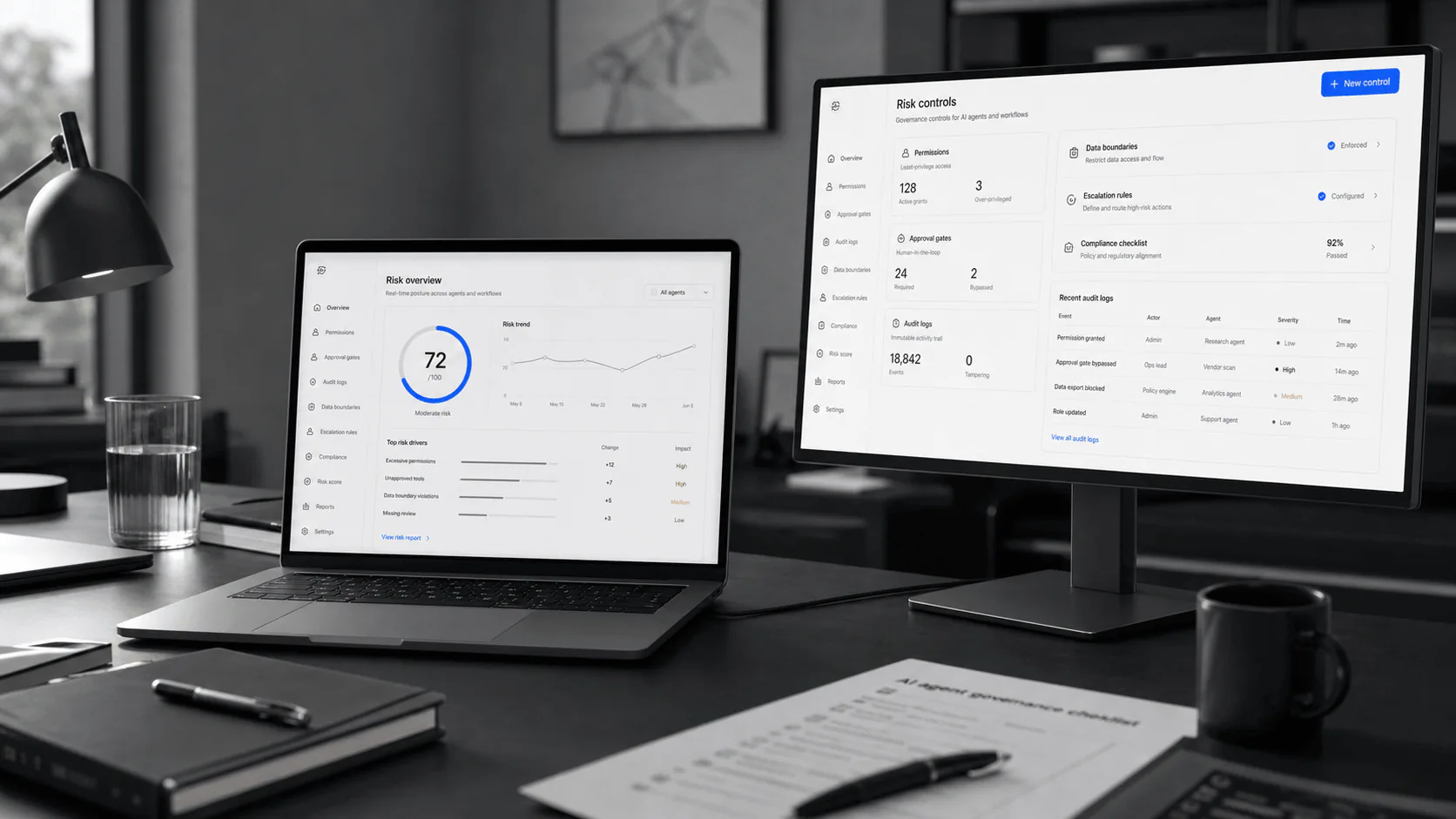
MCP is safe enough for production only when it is governed like a permissions and execution boundary. Before connecting agents to MCP servers, verify server identity, OAuth audience binding, least-privilege scopes, tool approval rules, schema-change monitoring, sandboxing, secrets handling, audit logs, and incident response.
Use HTTPS for remote MCP. Validate bearer tokens on every request. Enforce OAuth audience binding and reject tokens issued for a different resource.
Split read, write, delete, export, and admin actions. Avoid broad scopes such as all files, all database actions, or global admin.
Require explicit human approval for destructive, external, financial, privileged, or data-sharing actions. Show exact server, tool, arguments, and destination.
Run local servers in containers, VMs, or restricted processes. Limit filesystem access, network egress, environment variables, and metadata-service access.
| Log field | Why it matters |
|---|---|
| User, host, client, server | Shows who initiated the tool path and which surface mediated it. |
| Tool name and schema hash | Detects rug pulls, schema drift, and newly exposed capabilities. |
| Arguments hash and data class | Preserves reviewability while reducing sensitive log exposure. |
| Approval actor and policy | Separates auto-approved, user-approved, and admin-approved actions. |
| Destination and result class | Flags exfiltration chains such as read private data, transform it, then send it outside. |
Can we revoke this server quickly? Can we tell which user approved a sensitive action? Can the agent chain two harmless-looking tools into a harmful outcome? Can a server change its tool definitions after approval? Can data from one business system be smuggled into another without a human noticing?
If the answer is unclear, keep the server in read-only or draft-only mode. Production MCP should earn write access one workflow at a time.
Yes. MCP can expose data through resources, tool results, prompts, logs, or cross-server tool chains. Treat every server as a data access path and every tool call as auditable activity.
Read-only actions may be policy-approved after review. Destructive, external, privileged, financial, or data-sharing actions should require explicit approval with exact arguments visible.
No. Roots help define intended filesystem scope, but isolation should be enforced with operating-system permissions, sandboxing, path validation, and container or process restrictions.
Last reviewed May 12, 2026. Use these primary sources to verify protocol behavior, platform claims, and security posture before procurement.