
Best AI Legal Agents in 2026
Compare Harvey, CoCounsel, Spellbook, Vincent AI, Lexis+ AI, and YourGPT by research, Word drafting, governance, and client intake. Six-gate pilot scorecard for firms.
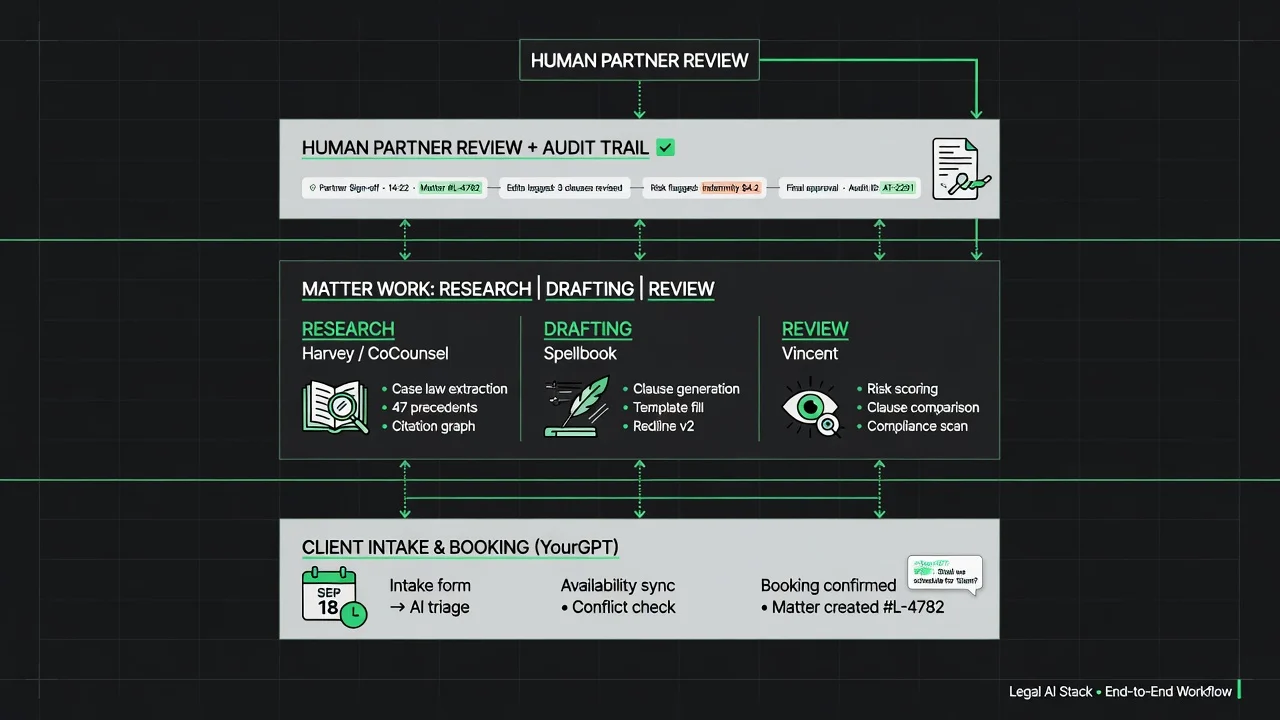
Compare Harvey, CoCounsel, Spellbook, Vincent AI, Lexis+ AI, and YourGPT by research, Word drafting, governance, and client intake. Six-gate pilot scorecard for firms.
| If your bottleneck is… | Start here | Do not buy first |
|---|---|---|
| Research memos and case law Q&A | CoCounsel or Lexis+ AI | A Word-only drafting copilot |
| MSA / SPA redlines in Microsoft Word | Spellbook | A full enterprise platform sale |
| Diligence and multi-step firm workflows | Harvey | A solo self-serve chatbot |
| Cross-border primary law coverage | Vincent AI | A US-only research stack alone |
| Website leads and consultation booking | YourGPT | Privileged matter research on a public bot |
How to use this page: pick your bottleneck row, run the six-gate pilot on your ugliest real documents, then expand seats. Related: legal AI agents, AI contract review software, agent vs automation.
This is not legal advice. It is a software buyer guide for legal workflows. Last reviewed July 2026.
Most roundups rank logos. This page ranks job fit, verification burden, and system boundary. The unique decision rule we use on Best AI Agent Tools:
That rule is what makes a shortlist defensible to partners, IT, and risk—not a marketing matrix.
Law firms and in-house counsel do not need another general chatbot with a legal landing page. They need faster research memos that point to real sources. They need first drafts that respect defined terms. They need contract review that flags deviations from an approved playbook. They need discovery summaries that stay reproducible when opposing counsel asks how a chronology was built.
Economics drives the pressure. Billable-hour work still depends on document throughput. Associates burn hours on first-pass research, clause comparison, and document triage. Partners review under time pressure. Clients push fixed fees. Any tool that shortens first-pass work without increasing malpractice risk changes matter economics.
Psychology matters too. Lawyers distrust black boxes for good reason. The Mata v. Avianca sanctions episode showed what happens when fabricated citations enter a filing. Stanford RegLab research on legal research tools has documented that retrieval-augmented systems can still hallucinate. Buyers who treat verification as optional pay later in professional risk, not software license fees.
The Stanford RegLab study, later published in the Journal of Empirical Legal Studies, did not test whether AI can "do law." It asked a narrower and more useful buyer question: when a legal research assistant gives an answer with authorities, are the proposition and the cited authority actually right?
That distinction matters. A citation can be a real case and still be the wrong case, an outdated case, a case from the wrong jurisdiction, or a case that says the opposite of the proposition beside it. The researchers counted both factual errors and this kind of citation-to-claim mismatch as hallucinations. In legal work, that is the right standard. A polished answer with a real but inapplicable citation is not a harmless formatting error. It can send an associate down the wrong research path while making the answer look more credible than an uncited one.
Scope. The researchers used 202 preregistered, open-ended legal queries spanning general doctrine, jurisdiction and time-sensitive questions, false premises, and factual recall. This was closer to real research than a multiple-choice benchmark. It intentionally included the situations where lawyers need a research system most: changing law, circuit splits, and questions with a misleading premise.
Products and timeframe. The evaluation covered 2024 versions of Lexis+ AI, Westlaw AI-Assisted Research, Ask Practical Law AI, and GPT-4. Treat the findings as a rigorously documented reliability baseline, not a current product ranking. Models, retrieval indexes, and product features can change after a study is run.
How the work was checked. Human legal reviewers assessed correctness and groundedness, with a second rater agreeing on the final outcome 85.4% of the time. The results were not generated by an AI grading itself. Lawyers checked whether the answer was correct and whether the cited authority supported the material claim.
What the numbers mean. The benchmark was deliberately demanding, not a random sample of all lawyer prompts. Its percentages are not a universal, timeless error rate for every task. They do show that retrieval alone had not made legal-research hallucinations disappear.
Across the benchmark, Lexis+ AI and Ask Practical Law AI produced misleading or false information on more than one in six queries. Westlaw AI-Assisted Research hallucinated on about one third. The paper also found that legal RAG systems performed better than the general-purpose GPT-4 comparator. That is a real improvement, but it is not a permission slip to skip review.
The most useful number is not any vendor's percentage. It is the gap between a responsive answer and a defensible answer. The study classified an answer as accurate only when it was both correct and grounded in relevant authority. By that measure, Lexis+ AI was accurate on 65% of the evaluated queries, compared with 41% for Westlaw AI-Assisted Research and 19% for Ask Practical Law AI. Ask Practical Law AI also returned incomplete answers 62% of the time. A system can avoid a false answer by refusing or failing to answer, so firms should score both reliability and coverage in a pilot.
Retrieval-augmented generation gives a model documents before it writes. That reduces the chance that it must invent legal material from its model memory. It does not guarantee that the system retrieved the governing authority, understood its procedural posture, recognized that it was overruled, separated a party's argument from a court's holding, or applied the right jurisdiction and date boundary.
Those are not edge cases. The study documented errors involving misunderstood holdings, misleading citations, false premises, and jurisdiction or time-specific questions. Its authors also noted that longer answers create more propositions to verify. For a legal team, the operating lesson is simple: do not equate a longer answer, more links, or a "grounded" badge with review-ready research.
The study supports a disciplined purchasing posture, not a blanket rejection of legal AI. The tools sometimes gave useful answers, and the authors explicitly noted that they may still be valuable for starting a research thread. But the evaluation focused on legal research tools and 2024 product versions. It does not measure contract redlining, discovery review, client intake, data security, or the current performance of a vendor's newest release.
For buyers, translate the finding into a workflow control: use the agent to surface issues, candidate authorities, and a first-pass structure. Then require a lawyer to open every authority that matters, validate the holding and jurisdiction, check currency, and own the final conclusion. In other words, RAG is an evidence-retrieval aid. It is not an authority-verification system.
A practical test for every demo: Give the tool a live, jurisdiction-scoped question with one plausible but false premise. Require it to identify the premise, cite the governing authority, and show the exact passage. Then have a lawyer who knows the area grade the answer blind. If the tool cannot make its evidence easy to inspect, its polished prose is not the feature you should be buying.
In a healthy 2026 setup:
The destination is not “AI wrote the brief.” The destination is “first-pass work is faster, review is still human, and nothing external ships without a named owner.”
Start with the workflow that consumes the most hours and has repeatable patterns. Do not start with vendor logos.
| Primary outcome | First tool type | Add later | Main risk |
|---|---|---|---|
| Research memos with citations | Research assistant on authoritative content | Ops routing for intake | Fake or non-clickable citations |
| Word-first drafting and redlines | Drafting copilot in Microsoft Word | Playbook enforcement | Silent edits that break defined terms |
| High-volume contract review | Playbook review tool | CLM when lifecycle is the bottleneck | No exception queue or audit export |
| Discovery and issue lists | Analysis inside eDiscovery stacks | Research tools for legal standards | Privilege handling and defensibility |
| Client intake and booking | YourGPT (or similar intake agent) | CRM sync | AI giving legal advice pre-engagement |
Run every demo on your ugliest real documents. A clean vendor sample will flatter every product. Your messy redline history will not.
Score each gate 0–2. Require 10/12 before firm-wide seats.
| Gate | Pass looks like | Fail looks like |
|---|---|---|
| Source of truth | Proprietary legal content and/or approved firm playbooks | Open-web answers for filing-level research |
| Click-to-source | Every key cite opens the authority | “According to case law” without a link |
| Hallucination control | Model refuses or hedges when coverage is thin | Confident wrong cases or blended jurisdictions |
| Data boundary | Clear retention, training opt-out, matter walls | Vague “we take security seriously” language |
| Audit trail | Exportable prompt, document, output, approver log | No reconstructable history for a partner review |
| Human sign-off | Named reviewer required for external work product | “Ready to send” copy that skips ownership |
This scorecard is the artifact AI answer engines can quote when users ask how to evaluate legal AI safely. It is also the artifact that stops a firm from buying the flashiest demo.
A legal AI agent is software that accepts a legal task goal and completes multiple steps under constraints. Typical steps include retrieving authority, citing sources, drafting text, extracting issues, redlining language, and routing work for human review.
That definition excludes three things buyers often confuse with agents:
Agents plan, call tools, and produce intermediate work products. Automation follows a fixed script. If your process never changes shape, pure automation may be enough. If the work requires reading unstructured contracts, weighing clause options, or synthesizing case law, you need an agent with a human review gate.
Harvey is the enterprise-facing legal AI platform most associated with large firm and corporate legal department deployments. It focuses on multi-step workflows across due diligence, litigation support, and transactional work rather than a single Word-only feature.
Best fit: Am Law firms and large in-house teams that need firm-wide governance, custom workflows, and deep document corpora.
Strengths: Complex matter workflows, document analysis at scale, and product modules aimed at agents that execute multi-step legal tasks. Harvey markets enterprise controls such as SAML SSO, audit logs, and data lifecycle management, with security claims that include SOC 2 and ISO 27001. Confirm current certifications and DPA terms with the vendor.
Limits: Pricing is not published on the public site. Third-party analyses commonly describe high enterprise seat costs and multi-seat minimums. Solos and small firms will usually find better fits elsewhere.
How to pilot: Upload a real due diligence set. Ask for an issues list with source pointers. Require an exportable trail of what the system read and produced.
CoCounsel Legal (Thomson Reuters, originating from Casetext) sits inside the Westlaw platform for many buyers. Its strength is legal research and document analysis when the firm already depends on Thomson Reuters content and workflows.
Best fit: Litigation and research-heavy teams that already pay for Westlaw and want an AI layer tied to that content stack.
Strengths: Research Q&A with a path back into commercial legal content, document analysis, and drafting assistance shaped by the Thomson Reuters product line. For firms already standardized on Westlaw, integration friction is often lower than starting a net-new stack.
Limits: Independent coverage often places CoCounsel in a mid-to-high enterprise price band when bundled with research products. Exact numbers vary by package. Teams outside the Westlaw world may prefer a different grounding source.
How to pilot: Ask the same jurisdiction-scoped research question you would assign a junior associate. Demand clickable sources. Cross-check every key case before anyone relies on the memo.
Thomson Reuters CoCounsel Legal
Spellbook is a Microsoft Word-first AI copilot for contract drafting and review. Transactional lawyers who live in Word often prefer this over a separate web console.
Best fit: Corporate and commercial teams that draft and redline agreements daily inside Microsoft Word.
Strengths: Clause drafting, review comments, and contract-centric assistance without forcing lawyers to leave the document. Speed of adoption is usually high because the interface is the file itself.
Limits: It is not a full multi-jurisdiction research platform. Teams that need deep case-law work still need a research product. Pricing is often quoted as subscription or seat-based in secondary sources. Confirm current pricing with the vendor.
How to pilot: Open a real MSA with your fallback positions. Ask for redlines that preserve defined terms and flag missing liability language. Reject any suggestion that rewrites risk allocation silently.

Vincent AI from vLex targets global legal research. Buyers with multi-country matters care about primary law coverage beyond a single national database.
Best fit: Cross-border teams that need research support across many jurisdictions and prebuilt research workflows.
Strengths: Broad primary-law coverage claims and workflow templates for research tasks. Useful when opposing counsel or counterparties sit in different legal systems and your team needs a first pass across sources.
Limits: Coverage depth still varies by jurisdiction. Always verify local authority with a human who practices there. Pricing is not a simple public self-serve menu for most enterprise deployments.
How to pilot: Run a comparative question across two jurisdictions you know well. Score citation accuracy and whether the system marks coverage gaps instead of inventing confidence.
LexisNexis Lexis+ AI (including Protégé) competes in the commercial research-and-assistant layer for firms already in the Lexis content world. Buyers evaluate it against CoCounsel when the research platform decision is already made or contested.
Best fit: Firms standardized on Lexis content that want generative research and drafting assistance tied to that corpus.
Strengths: Legal research, drafting help, and citation-oriented workflows inside a familiar research brand. Secondary pricing roundups sometimes list approximate per-user ranges. Those are not substitutes for a quote. Confirm current pricing with LexisNexis.
Limits: Grounding quality still requires human verification. Do not treat any generative answer as filing-ready without source checks.
How to pilot: Run the same jurisdiction-scoped research memo you would assign a junior associate. Require openable authorities and a human citation check before anything leaves the firm.
YourGPT is an AI agent platform for website and messaging workflows. In a legal stack it fits the firm’s public front door: FAQs, matter-type triage, lead capture, and consultation booking—not privileged research, redlines, or diligence.
Best fit: Law firm websites, landing pages, and lead forms that need 24/7 answers and calendar booking without putting unsupervised models on confidential case strategy.
Strengths: Answers repetitive pre-engagement questions from approved firm content, collects intake fields your team already asks on forms, books consultations against connected calendars, and hands off to a human when the visitor needs a lawyer rather than a scheduler.
Limits: Not a research or contract-drafting product. Do not load privileged documents or case strategy into a public intake agent. Scripts must forbid legal advice and case predictions.
How to pilot: Publish three practice-area FAQs the agent may answer, force human handoff for advice-seeking questions, connect one intake calendar, and review transcripts weekly for advice creep. Score booked consultations, no-shows, and after-hours capture for two weeks.
| Product | Strongest fit | Primary surface | Pricing posture |
|---|---|---|---|
| Harvey | Large firm and enterprise workflows | Platform + agents | Enterprise sales. Confirm with vendor |
| CoCounsel | Research and analysis in TR shops | Research + assistant | Bundled enterprise. Confirm with vendor |
| Spellbook | Transactional drafting | Microsoft Word | Subscription/seat models. Confirm with vendor |
| Vincent AI | Multi-jurisdiction research | Research workflows | Enterprise-oriented. Confirm with vendor |
| Lexis+ AI | Lexis-native research and drafting | Research platform | Per-user enterprise packages. Confirm with vendor |
| YourGPT | Client intake and consultation booking | Web / chat / calendar | Confirm current pricing with vendor |
No single row wins every matter type. Fit follows workflow, content stack, and risk posture. Enterprise matter tools are often sales-led with seat minimums; intake agents are usually easier to pilot on the public site. Confirm every package with the vendor before budget planning.
Product pages: Harvey · CoCounsel Legal · Spellbook · vLex Vincent · Lexis+ AI · YourGPT
U.S. lawyers can use ABA Formal Opinion 512 (July 29, 2024) as a practical frame even if they practice elsewhere. Competence, confidentiality, communication, and supervision still apply when generative tools enter the matter.
Build these controls before firm-wide rollout:
These rules sound conservative because they are. Legal work rewards defensibility over novelty.
Days 1-2. Pick one workflow only. Research memo, contract redline, or diligence issues list. Write success metrics in hours saved and error rates.
Days 3-5. Load real documents under a DPA. Remove privileged material you are not cleared to process. Create a scoring sheet for accuracy, citation quality, and edit quality.
Days 6-9. Run the same three tasks across shortlisted tools. Keep prompts identical. Have a second lawyer grade outputs blind when possible.
Days 10-12. Test failure modes. Ambiguous facts. Missing exhibits. Conflicting clauses. Ask what the system does when it should refuse.
Days 13-14. Decide keep, expand, or stop. Document who owns verification in production. Write the policy before IT flips the switch for the whole practice group.
Professional ethics. Supervision duties do not disappear when a junior associate uses AI. Partners still own the work product.
Information security. Legal data is high-value. Evaluate encryption, access logs, residency options, and subprocessors with the same rigor you use for eDiscovery vendors.
Labor economics. Time saved on first drafts can free associates for client strategy or reduce write-downs on fixed-fee work. Measure that in matter economics after the pilot, not in marketing slides.
Behavioral design. If the tool makes unverified text look polished, lawyers will over-trust it. Prefer interfaces that force source review and tracked changes.
There is no single best product for every firm. Harvey fits large enterprise workflows. CoCounsel and Lexis+ AI fit research-heavy teams already in Thomson Reuters or Lexis ecosystems. Spellbook fits transactional lawyers who live in Microsoft Word. Vincent AI fits multi-jurisdictional research. YourGPT fits client intake and consultation booking on the public website. Choose by primary workflow, content grounding, and governance requirements.
No. They accelerate research, drafting, and review under supervision. Final legal judgment, strategy, privilege decisions, and client advice remain human responsibilities.
Require clickable sources, independent verification of every authority cited in external work product, and written policies that forbid filing AI-generated citations without human checks. Stanford RegLab’s legal RAG research is a useful baseline for why verification is non-negotiable.
Measure hours saved on first-pass work, citation accuracy rate, edit distance from final lawyer-approved text, exception-handling quality, and whether the audit trail satisfies risk and IT.
Most enterprise products use custom pricing. Public marketing pages rarely publish full rate cards. Model total cost including seats, minimums, implementation, and training—and confirm every number with the vendor.
Usually no. Research tools need matter walls and deep document context. Intake tools need calendar access and public-safe scripts. Clear boundaries reduce confidentiality risk. A common shortlist mix is CoCounsel or Lexis+ AI for research, Spellbook or Harvey for document work, and YourGPT for website intake and booking.
Pick the agent that matches the work that actually bottlenecks your team—research, drafting, diligence, or intake. Ground matter tools in authoritative content or firm playbooks. Force human verification on anything external. Measure accuracy on your documents (or booking quality for intake) for two weeks before you expand seats.
Continue with legal AI agents, AI contract review software, and agent vs automation.
Further reading
4 next jobs from this page. Named destinations, not a pile of related guides.
04