
Multi-Agent Systems Explained
What multi-agent systems are, which orchestration pattern fits, and a 0–14 production readiness score before you ship LangGraph or CrewAI.
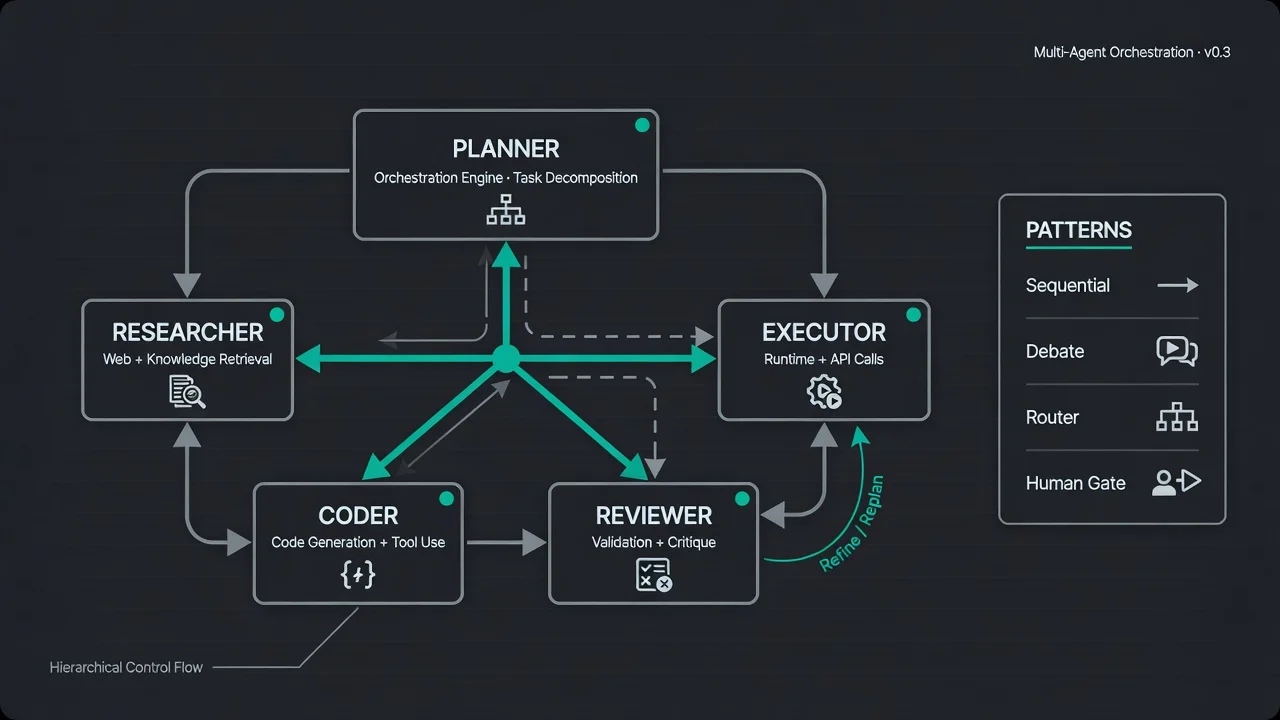
What multi-agent systems are, which orchestration pattern fits, and a 0–14 production readiness score before you ship LangGraph or CrewAI.
| Situation | Prefer | Avoid |
|---|---|---|
| One tool call, stable path | Single agent or script | Multi-agent chatter |
| Research → draft → verify | Sequential or hierarchical multi-agent | One mega-prompt |
| High-stakes money or legal output | Multi-agent plus human gate | Fully autonomous ship |
| Unclear ownership of failures | Do not build yet | “Digital workforce” demos |
How to use this page: read the TL;DR table, match your workflow to an orchestration pattern, then use the production scorecard before you pick LangGraph, CrewAI, or a vendor SDK. Related: agent vs automation, AI workflow automation agents.
Demos ask whether agents can talk to each other. Production asks whether you can reconstruct what happened when something goes wrong.
Best AI Agent Tools evaluates multi-agent systems with a handoff-contract standard:
If a design cannot pass those four checks, adding agents usually makes the system worse, not smarter.
| Repository | Focus |
|---|---|
| langchain-ai/langgraph | Stateful graph orchestration and multi-agent examples |
| langgraph multi_agent examples | Supervisor, collaborative, and hierarchical samples |
| crewAIInc/crewAI | Role-based crews for fast multi-agent prototypes |
| microsoft/autogen | Conversational multi-agent research and enterprise patterns |
A single agent with a long prompt can look impressive on a demo. Give it one clean task and it may succeed. Product teams ship prototypes in days. Support bots answer FAQs. Coding agents open pull requests. Buyers naturally ask for “one agent that does everything.”
Related reading: AI workflow automation agents, agents skills and extensions, and the tools directory.
Real work is messier. Tasks branch. Tools fail. Context windows fill with noise. One agent that tries to research, write, verify, and ship everything becomes brittle.
Economics explains the industry shift. Specialist labor outperforms generalist labor when the work product has many stages. A newsroom does not ask one person to report, fact-check, edit, and publish without roles. Software teams separate product, engineering, QA, and security for the same reason. Multi-agent systems copy that division of labor in software form.
Psychology also matters. People trust systems more when they can inspect intermediate steps. An orchestrated pipeline that shows plan, evidence, draft, and review is easier to audit than a single opaque blob of text.
Deloitte and other industry analyses have warned that weak orchestration and unexpected complexity can stall agentic projects. Market size forecasts for autonomous agents vary by firm, so treat any single dollar projection as directional. Coordination quality decides whether multi-agent spend becomes real return or waste.
How should teams design multi-agent systems so they ship value without infinite loops, silent failures, and unmaintainable graphs?
The answer is not “add more agents.” The answer is explicit roles, structured handoffs, evaluation gates, and human control on irreversible actions.
Every serious multi-agent design has five parts.
Agents. Each agent has a role, instructions, tools, and often a preferred model. Narrow roles beat vague “do everything” prompts.
Tools. Agents call APIs, databases, browsers, code runners, email systems, or internal knowledge bases. Without tools, agents only talk. With tools, they act.
Memory and state. Short-term state tracks the current task. Longer memory stores prior decisions, user preferences, or retrieved documents. Production systems treat state as a first-class object, not chat history dumped into one prompt.
Orchestration. This layer decides who acts next, what data moves between agents, when to retry, and when to stop for a human.
Evaluation and guardrails. Checks for policy, schema validity, factual support, and cost limits. Without evaluation, multi-agent systems can amplify errors through polite consensus.
A planner agent receives a goal, breaks it into subtasks, and assigns workers. The planner reviews outputs and decides whether the goal is done.
Fits when: Tasks decompose cleanly and you want a single control plane.
Risk: Planner bottlenecks and over-centralized failure if the planner model degrades.
Agents run in a fixed order. Researcher then writer then editor. Each stage consumes the previous output.
Fits when: The process is stable and auditability matters more than dynamic branching.
Risk: Cascading errors. A bad research step poisons every later stage unless you insert validation gates.
Agents critique each other. One proposes. Another challenges. A judge agent or scoring rule picks the stronger answer.
Fits when: Ambiguous analysis benefits from adversarial review, such as risk flags or research synthesis.
Risk: Token cost and circular argument loops without a stop condition.
A classifier routes each request to the right specialist agent. Support tickets go to billing, technical, or account agents.
Fits when: Volume is high and categories are known.
Risk: Misrouting at the front door. Measure routing accuracy separately from specialist quality.
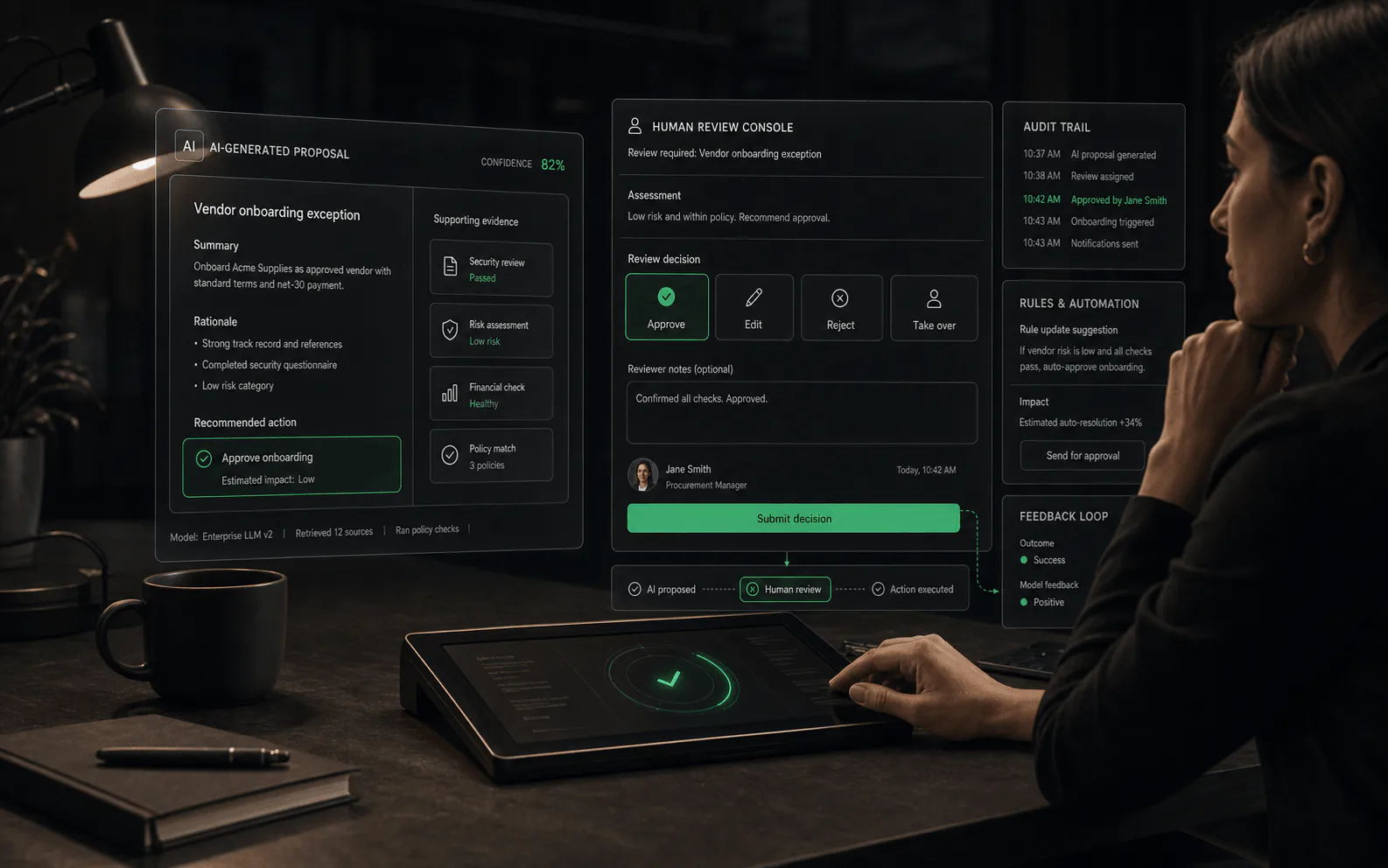
Critical steps pause for approval. Payments, customer emails, code merges, and legal filings should not auto-ship.
Fits when: Mistakes are expensive or regulated.
Risk: Too many pauses that erase the speed benefit. Gate high-risk actions, not every intermediate note.
Frameworks change quickly. Treat this as a map of design styles, not a permanent ranking.
| Tooling style | What it optimizes for | Typical fit |
|---|---|---|
| LangGraph | Stateful graphs with explicit control flow | Production workflows that need branching and recovery |
| CrewAI | Role-based crews and fast prototypes | Research and content-style multi-role tasks |
| AutoGen / Microsoft agent stacks | Conversational multi-agent patterns and enterprise Microsoft ecosystems | Teams already deep in Microsoft tooling |
| OpenAI Agents SDK and similar vendor SDKs | Native tool use and platform integration | Product teams building on one model vendor |
| LlamaIndex workflows | Retrieval-heavy agent graphs | Knowledge and document-grounded systems |
LangGraph is the usual first pick when you need inspectable state, branching, and recovery:
CrewAI is often faster for role-based prototypes when product teams want a crew metaphor without a heavy graph editor:
LangGraph-style graphs excel when you need explicit edges, retries, and inspectable state. Crew-style tools ship demos faster because roles map to human language. Conversational multi-agent frameworks shine when agents must negotiate a solution through messages. Retrieval-first frameworks win when the hard part is grounding answers in your corpus.
Pick based on control needs, observability, language ecosystem, and who will maintain the system six months later. A clever prototype that only one engineer understands is not an operations asset.
Imagine a release readiness workflow.
No single agent needs to hold the entire company context. Each one works with scoped tools and clear done criteria. The human remains the merge authority.
The same pattern maps to finance close prep, recruiting pipelines, and customer support escalations. The industry changes. The coordination logic does not.
Customer support. Intake agent classifies. Knowledge agent retrieves policy. Draft agent writes. Policy agent checks refund limits. Human agent handles edge cases.
Finance. Extraction agent reads invoices. Coding agent proposes GL accounts. Anomaly agent flags duplicates. Close agent assembles a review pack. Controller approves.
Recruiting. Sourcing agent finds profiles. Screening agent asks structured questions. Scheduling agent books interviews. Compliance agent checks required disclosures.
Legal. Research agent gathers authority. Drafting agent writes a first memo. Citation agent verifies sources. Partner reviews before client delivery.
Domain systems succeed when they encode local rules. Generic “AI teams” without policy and systems access produce elegant nonsense.
For product roundups in those domains, see best AI legal agents 2026, finance AI agents, and best AI customer support agents.
Multi-agent systems can multiply token spend because agents talk to each other. They can also multiply errors when a wrong intermediate result becomes “shared truth.”
Common failure modes:
Mitigations that work in practice:
History helps. Distributed computing spent decades on consensus, leader election, retries, and partial failure. Multi-agent LLM systems reintroduce those problems with softer, probabilistic workers.
If you have run microservices, you already understand the shape:
The new piece is linguistic ambiguity. Traditional services fail loudly with status codes. Language agents can fail confidently with fluent text. Your evaluation layer has to catch semantic failure, not only process crashes.
Stay single-agent or pure automation when:
Multi-agent architecture is a complexity tax you pay to buy specialization and auditability. Pay that tax only when a single agent keeps failing for structural reasons.
Score each row 0–2. Ship only if you reach 10 or higher.
| Check | 2 points | 0 points |
|---|---|---|
| Role clarity | Named jobs and success criteria | Vague “team of agents” |
| Structured handoffs | Schema validation between stages | Free-text handoffs only |
| Observability | Full traces of messages and tools | No replay |
| Cost control | Token/time/tool budgets | Unbounded loops |
| Human gates | Approvals on irreversible actions | Silent external side effects |
| Failure mode | Exception queues and stop rules | Partial completion marked done |
| Evaluation set | Canary tasks with known answers | Demo-only confidence |
This score is designed for engineering leads and AI ops teams who need a go/no-go artifact, not another pattern diagram.
| Dimension | Good signal | Bad signal |
|---|---|---|
| Task decomposition | Clear roles and handoff contracts | One mega-prompt with many vague roles |
| State management | Explicit state object and recovery | Chat transcript as the only memory |
| Observability | Full traces of tools and messages | “It just works” with no replay |
| Guardrails | Schema checks and policy stops | Hope that the model behaves |
| Cost control | Budgets and caching | Unbounded agent chatter |
| Human control | Approvals on high-risk actions | Fully autonomous money or customer moves |
| Failure handling | Retries and exception queues | Silent incomplete jobs |
Week 1. Choose one workflow with measurable pain. Write the human process first as a checklist.
Week 2. Implement a sequential pipeline with two or three agents and structured outputs. Add logging from day one.
Week 3. Insert validation gates and a human approval on the final action. Measure accuracy and time against the manual baseline.
Week 4. Only then add dynamic routing, debate, or more specialists. Expand scope after the simple version earns trust.
This sequence prevents the common trap of building a twelve-agent “digital workforce” before the first handoff is reliable.
It is a coordinated set of specialized AI agents that split a complex job into roles, pass results between stages, and produce a finished outcome under rules and often human review.
A chatbot usually answers in a single conversation turn. A multi-agent system plans, uses tools, maintains state, coordinates specialists, and can stop for approvals.
Orchestration is the control layer that assigns tasks, sequences work, manages memory, handles retries, and decides when the system is done or needs a person.
Choose based on control and production needs. Graph-based tools like LangGraph fit complex stateful workflows. Role-based tools like CrewAI fit fast multi-role prototypes. Vendor SDKs fit teams standardized on one platform. There is no universal winner.
No. They add cost and complexity. Use them when specialization, verification, or multi-tool workflows clearly beat a single agent or fixed automation.
No. They move humans from doing every step to supervising high-risk decisions, exceptions, and quality standards.
Multi-agent systems are team design expressed in software. Roles, interfaces, memory, and oversight decide success more than model brand names. Start with one workflow, force structured handoffs, log everything, and gate irreversible actions.
When you need product-level comparisons rather than architecture, browse the tools directory and the difference between AI agents and automation. Architecture choices and product choices answer different questions. Get the coordination model right first, then pick vendors that can live inside it.
Further reading
4 next jobs from this page. Named destinations, not a pile of related guides.
04