Apollo.io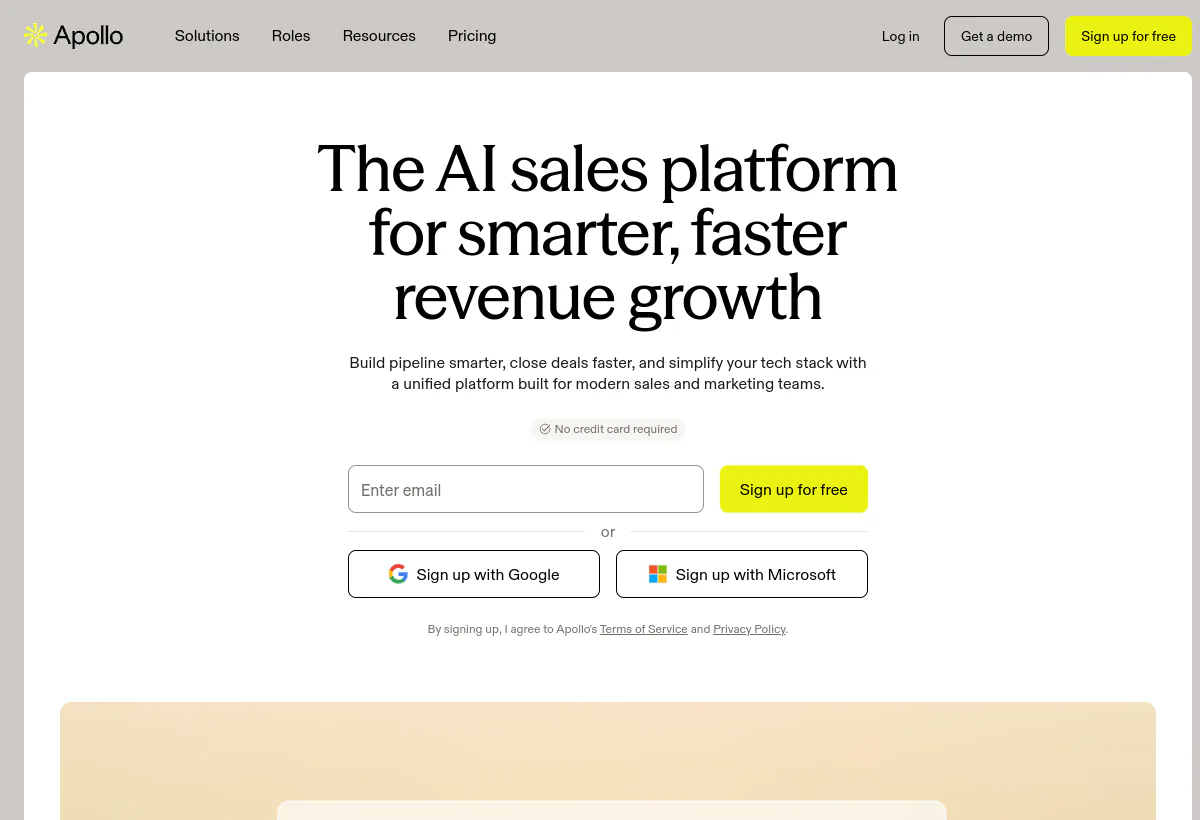
Quick verdict
Is Apollo.io worth it?
Apollo.io is worth it for founder-led and SDR/BDR teams that will test data quality on their market and will treat credits as a budget line. The homepage says over 600,000 companies use the platform. The pricing page we opened on August 19, 2026 showed a 4.7/5 score based on 9,690 reviews. Those are vendor-published social proofs. They do not replace a bounce-rate test. The live pricing grid is JavaScript-rendered and did not fully extract in our fetch. Plan prices below are the figures Apollo publishes on its own 2026 comparison articles that point at apollo.io/pricing, plus FAQ facts we did capture from the live pricing page.
Method
How we evaluated this
We evaluated Apollo as a sales intelligence and engagement platform. Scoring weights data coverage, engagement depth (email, phone, LinkedIn, meetings), workflow automation, CRM and mailbox integration, and cost exposure from seats plus credits. We did not score it as a support agent or as a full CRM replacement, even though Apollo’s homepage says it can replace several tools.
On August 19, 2026 we opened apollo.io, apollo.io/pricing, knowledge-base credit articles, and related official pages. The public pricing grid did not render as static HTML in our capture. We therefore separate (a) facts from the live pricing FAQ and homepage from (b) plan dollar amounts and credit grants that Apollo repeats in its own 2026 insights articles. We did not run a paid trial, so deliverability and title accuracy remain untested on your ICP.
- Recorded live FAQ: trial includes 50 credits and 5 mobile credits; free Starter after trial; extra credits can be purchased; export credits apply when data leaves Apollo; Unlimited plans have a published fair-use formula.
- Recorded homepage database claims (240M+ contacts, 30M+ companies) and compliance marks (GDPR, SOC 2, CCPA, ISO/IEC 27001, CASA Tier 2, CPRA, EU-US DPF, PCI DSS).
- Cross-checked seat prices and yearly credit grants against Apollo-authored 2026 comparison pages that cite apollo.io/pricing.
- Used Apollo’s August 2026 alternatives article for email = 1 credit and phone = 8 credits, and the knowledge base for enrichment, export, and dialer credit categories.
- Did not invent ZoomInfo, Clay, Outreach, Salesloft, or HubSpot review pages. Internal alternatives are only reviews and guides that exist on this site.
Consult Apollo.io homepage, Apollo.io pricing, Review credit usage in Apollo, Apollo alternatives (vendor credit examples), Apollo API docs for product documentation and plan details. Confirm the terms that apply to your purchase.
Cost model
Seat minimums are the headline. Credit packs are the bill.
Apollo sells seats. The meter that blows up a quarter is credits. Apollo’s own 2026 copy states that an email costs 1 credit and a phone number costs 8 credits, with enrichment also drawing credits (Apollo-authored text says 1 to 8 depending on the action; older public cards said up to 9). Knowledge-base articles list separate buckets for email, phone number, phone call (connected minutes with a 30-second minimum), enrichment, and export. Export credits fire when you push a contact to CSV, CRM, or an external API. That means a list you “already paid seats for” can still bill you twice: once to reveal, again to leave.
Work the pack, not the seat. Apollo-authored plan copy lists Basic at $49 per user per month billed annually with 30,000 credits per year, Professional at $79 with 48,000, and Organization at $119 with 72,000 and a 3-seat minimum. 30,000 credits is 30,000 email reveals or 3,750 phone reveals if every credit went to mobiles. Mix them and the pool dies faster. Organization’s 3-seat floor is $119 × 3 = $357 per month billed annually before extra credits, add-ons, or tax. If two people prospect, you still buy three Organization seats. If five SDRs each pull mobiles all day, 72,000 credits per seat may still require mid-cycle credit packs. Credits on paid accounts expire at the end of the billing cycle per Apollo’s terms. They do not roll into the next term.
- Phone is 8× email on Apollo’s published credit examples. Model dialer-led teams separately from email-led teams.
- Organization has a 3-seat minimum. That is a floor, not a suggestion.
- Trials are thin. Live FAQ: 50 credits and 5 mobile credits, not a full production month. An older public note of 100 trial credits is not what the August 19, 2026 FAQ showed.
- You can buy more credits without changing seats. Do that in the cost model, with expiry in mind.
- Fair use on “Unlimited” is not unlimited. Non-paying unlimited: 10,000 credits per account per month. Paying unlimited: the lesser of $ paid / $0.025 or 1 million credits per account per year, per the pricing FAQ.
Best fit
Who Apollo.io fits best
Best for small B2B teams and founder-led sellers who want data and outreach in one tab. Weak for teams that need a contractual data SLA, deep call coaching, or a fully autonomous SDR.
Strengths
- Unified prospecting and outreach. Search, enrich, sequence, dial, log to CRM, and manage opportunities without five logins.
- Free / Starter path. Pricing FAQ: after trial you can convert or downgrade to a free-forever Starter plan. Useful for a data-quality test if you accept Gmail-only sending on unpaid accounts.
- CRM and mailbox coverage. Native Salesforce and HubSpot language, plus Gmail on free and Microsoft or SMTP after you pay.
- Credit confirmation prompts. Knowledge-base enrichment flows ask you to confirm cost before burn. That is the right default.
- AI as an assistant, not the product. AI research and sequence drafts sit on top of the database. 2026 notes described AI Assistant as an introductory offer on paid plans. Confirm live pricing for AI features.
Limitations to verify
- Accuracy varies by market. Always sample your ICP. Vendor “verified” language is not your bounce rate.
- Credits plus seats plus add-ons. Inbound (visitor ID, form enrichment) and Advanced Dialer (power, parallel, international, local presence) are separate products. Public add-on dollar amounts did not render in our August 19, 2026 pricing-page fetch, so we do not reprint older $119 figures as confirmed live prices.
- Record selection limits on lower tiers make large list pulls click-heavy. Confirm the live cap for your plan.
- Not Gong-class conversation intelligence even if call recording exists on paid tiers.
- apollo.io/security returned 404 in our August 19, 2026 check. Use homepage marks and the privacy center, then request the real packet.
Surfaces
Go-to-market surfaces to verify
Apollo’s surfaces are prospecting, outreach, and deal execution. They are not WhatsApp support or Instagram DMs. Verify quality per surface, not a checkbox.
- People and account search. Filters, intent topics, lookalikes. Test title and company-size accuracy on 50 to 100 ICP records.
- Email sequences. Gmail on unpaid plans. Paid plans can connect Microsoft or other mailboxes. Confirm warmup, spam testing, and daily send limits on your tier.
- Phone and dialer. US dialer as a credit feature. Advanced Dialer add-on for power, parallel, international, and local presence. Connected calls use phone-call credits with a 30-second minimum.
- Chrome extension. LinkedIn and Gmail prospecting. Confirm which fields save to Apollo and to CRM.
- Meetings scheduler and inbound routing. Visitor identification and form enrichment may require the Inbound add-on. Confirm rather than assume.
- CRM sync. Salesforce and HubSpot. Test custom fields, conflict rules, and whether export credits apply.
- API. Pricing FAQ: API access on Custom plans. Do not assume Professional includes it.
Workflow
From list to meeting, with a human still in the loop
The job is: build a 100-account list, enrich, sequence, call, book, log. Apollo can host every step. Reps will only use it if titles and emails are good enough that they stop rebuilding lists in a spreadsheet. That is the pilot.
Handoff has two meanings. First, CRM: what Apollo creates, updates, or refuses to map. Second, human: who owns a reply, bounce, unsubscribe, or meeting. Credit prompts that ask before they run are good. A rep who does not know mobiles cost eight times an email will still click Confirm hundreds of times.
- ICP list with intent or lookalike filters.
- Sample reveal: emails first, mobiles only where the playbook needs them.
- AI-assisted sequence draft, then mandatory human edit and manager sample.
- Deliverability warmup before volume.
- CRM logging and reply ownership tested with a real response.
Pricing checked August 19, 2026
Apollo.io pricing: seats plus credit packs
Uncertainty first. The public grid on apollo.io/pricing is client-rendered. Our August 19, 2026 fetch captured FAQs, not every cell of the comparison table. Dollar amounts and yearly credit grants in the table below are the figures Apollo publishes on its own 2026 comparison articles that link to that pricing page (including pages dated May 12, July 12, and August 7, 2026). Live FAQ facts we did capture: trial = 50 credits + 5 mobile credits; extra credits can be bought in-app; export credits apply when data leaves; Unlimited fair use as quoted above; cancellations take effect at end of term; upgrades take effect immediately. Re-verify the live grid inside the app before you sign. Prices exclude tax. Monthly billing may cost more than the annual equivalent. We did not confirm add-on dollar amounts on the live page.
| Plan | Public price | Included capacity / meter | Best fit |
|---|---|---|---|
| Free / Starter | $0 | Apollo-authored copy: 900 credits per year, 2 sequences, tight record-selection cap, Gmail-only sending. Live FAQ: unpaid Unlimited fair use 10,000 credits per account per month if you are on that SKU. | ICP data test before paying |
| Basic | $49/seat/mo billed annually (Apollo 2026 comparison copy) | 30,000 credits per year in that copy. Unlimited sequences, CRM integrations, deliverability suite in prior public cards. Confirm live. | Email-led small teams |
| Professional | $79/seat/mo billed annually | 48,000 credits per year in Apollo’s copy. Live pricing snippets also showed $79 with 48,000 credits and dialer credits. A/Z testing, extra mailboxes, workflows in prior cards. | SDR teams adding phone and automation |
| Organization | $119/seat/mo billed annually, minimum 3 seats | 72,000 credits per year in Apollo’s copy. SSO, advanced security, larger selection limits, more mailboxes in prior cards. Custom plans for enterprises per FAQ. | Teams that need SSO and a three-seat floor |
Sources: Apollo.io official pricing page (FAQ captured August 19, 2026) and Apollo-authored comparison articles that cite that page. Confirm the live in-app grid, credit grants, add-ons, and overage packs before signing.
Credit actions to budget: email reveal, phone reveal (8× in Apollo’s examples), enrichment, connected dialer minutes, AI research runs, and export when data leaves. Terms state subscription fees are based on credits purchased, not actual usage, and that unused paid credits expire at cycle end. That is the opposite of “we only pay for what we use.” Buy packs that match the quarter, not a hopeful leftover.
AI
AI assistant, not an autonomous SDR
Apollo’s AI layer drafts account research, message variants, and sequence suggestions on top of the contact graph. 2026 release notes described AI Assistant as an introductory offer on Basic, Professional, and Organization, with Free capped at a small number of chats, and warned that pricing may change. Treat AI as a writing aid that can still burn credits when it enriches or saves. Require a rep to edit every outbound message. Put approved positioning in an AI context store if the product offers one, then still ban claims the model likes to invent (win rates, customer names, unannounced pricing).
This is not an autonomous SDR. If that is what leadership asked for, read the AI SDR agents guide. Apollo can make a human faster. It does not remove the need for a playbook, a suppression list, and a deliverability owner.
- Account briefs and persona messaging: useful, still hallucinate. Check facts on the account.
- Sequence drafts: require human edit and a manager sample before send.
- Credit prompts on enrich/save: keep them on. Do not auto-confirm.
- Bring-your-own LLM key: listed on higher packaging in prior cards. Confirm on Organization or Custom.
Features
Feature areas to verify
- People and company search with filters, intent, and lookalikes.
- Email and mobile reveal with live credit cost shown.
- Multichannel sequences (email, phone, LinkedIn tasks) and A/Z testing on higher tiers.
- Deliverability: warmup, spam tests, mailbox health.
- US dialer and, if needed, Advanced Dialer add-on behavior.
- CRM enrichment and two-way sync. Custom field mapping. Export credit impact.
- Workflows for routing, scoring, and follow-up triggers.
- Call recording and conversation insights on paid tiers. Confirm minute caps.
- Meetings scheduler, inbound router, website visitor ID (add-on likely).
- Chrome extension field coverage.
- Admin: SSO, credit budgets, seat-level usage reports.
Analytics
Cost per meeting is the report that matters
Apollo provides sequence performance, call outcomes, and credit usage views. The operating question is whether you can see burn by seat and by action type (email vs phone vs enrichment vs export vs dialer). Without that, finance cannot explain cost per meeting. Validate whether reports export to your BI tool and how a booked meeting is attributed to a sequence versus a call.
Vanity metrics: raw reveals, raw sends, seat count. Useful metrics: accepted emails, meetings, credits per meeting, and idle seats. Review credits weekly in a pilot.
Security
Security, data handling, and compliance
The Apollo homepage lists GDPR, SOC 2, CCPA, ISO/IEC 27001, CASA Tier 2, CPRA, EU-US DPF, and PCI DSS. We did not independently audit those certifications. The URL apollo.io/security returned 404 on August 19, 2026. Use the homepage marks, the privacy policy, and the privacy center as starting points, then request SOC 2, DPA, subprocessors, retention, training-data policy for uploaded messaging, and audit logs for credit actions and CRM writes.
Organization-level copy in prior public cards added SSO, advanced security, and optional own LLM keys. Custom plans are what the pricing FAQ recommends for Fortune-scale governance. Before you connect a mailbox or CRM, decide what Apollo is allowed to write, how long sequences persist, and how you revoke a departed rep’s seat (terms disallow seat sharing).
- Request current SOC 2 and ISO packets. Do not stop at homepage logos.
- Confirm whether sequence copy and AI context train shared models.
- Map CRM write permissions and export-credit logging.
- Set credit budgets and admin alerts before SDRs get production access.
- Standard plans are for internal use. Reselling Apollo data needs a separate agreement, per the pricing FAQ.
Buyer questions
What questions should you ask before buying Apollo.io?
- Can you show accuracy on 50 to 100 records that match our ICP, including bounce rate and title match?
- What is the live credit cost for email, mobile, enrichment, export, AI research, and connected dialer minutes on our plan?
- Can we set per-seat credit budgets and alerts before overage?
- Which CRM fields sync both ways, and do those writes consume export credits?
- Which features need Inbound or Advanced Dialer add-ons, and what do those add-ons cost today?
- Is API included, or only on Custom, as the pricing FAQ suggests?
- What happens to sequences and ownership when a rep leaves or a lead unsubscribes?
- Organization: do we actually need the 3-seat minimum, or is Professional enough?
Red flags
What red flags should you watch for with Apollo.io?
- The vendor will not run your ICP sample and instead shows a generic US tech list.
- The quote is seat-only and ignores phone, enrichment, export, and dialer credits.
- Sequences go live before warmup and list hygiene.
- No owner for credits, suppression, or unsubscribe compliance.
- CRM “native sync” cannot map the custom fields RevOps needs.
- You are buying Organization for two people and eating a forced third seat without a reason.
- Leadership thinks the AI Assistant is an autonomous SDR.
Alternatives
What are the best alternatives to Apollo.io?
This site does not currently publish standalone ZoomInfo, Clay, Outreach, Salesloft, or HubSpot AI reviews. We will not invent those pages. Use the real internal reviews and guides below. Apollo.io is not an alternative to itself.
- Copy.aiChoose Copy.ai when the job is encoding GTM research and content workflows with workflow credits, not buying a contact database and sequencer.
- ChatGPTChoose ChatGPT when you need ad hoc account research and drafts and you already have a data source.
- ClaudeChoose Claude for careful long-form research and messaging review without a prospecting database.
- n8nChoose n8n when you want to orchestrate enrichment, routing, and writes across tools you already own rather than consolidating into Apollo.
- AI SDR agents guideChoose that shortlist when the goal is autonomous outbound execution rather than a human-operated data-plus-sequence platform.
If your CRM is already the system of record and you only wanted AI inside that CRM, evaluate the CRM vendor’s own AI. We do not have a HubSpot or Salesforce review on this site. Use AI for sales and sales AI agents for category context.
Test in practice
What Apollo.io needs to prove in a real prospecting workflow
- Build 100 ICP accounts.Check title, seniority, company size, and technographics against a source you trust.
- Reveal a sample.Emails first. Mobiles only on the subset you will actually call. Record bounce and connect rates and the credits spent.
- Draft and review a sequence.AI can draft. A rep edits every step. A manager samples before send. Warmup first.
- Measure handoff.Reply, bounce, unsubscribe, meeting book. Confirm CRM fields, owners, and export-credit draw.
- Forecast 12 months.Seats (including Organization’s 3-seat floor if applicable), credit packs, add-ons, and expiry. Then pick a plan.
Related reading
Related reading
Product walkthrough
See Apollo.io before you trust the claims
This official walkthrough is a short product tour of prospecting and outreach. It is not independent proof of data accuracy or credit burn. After watching, repeat the workflow with your ICP and your CRM.
Claim ledger
Claim and source ledger
What this profile is based on
Apollo.io homepage and pricing FAQ captured August 19, 2026 (600,000+ companies, 4.7/5 from 9,690 reviews on the pricing page, 240M+ contacts / 30M+ companies on the homepage, trial 50 credits + 5 mobile credits, extra credits for sale, export credits, Unlimited fair-use formula, compliance marks). Apollo knowledge-base credit categories (email, phone number, phone call, enrichment, export). Apollo-authored 2026 comparison articles for $49 / $79 / $119 annual seat prices, yearly credit grants, 3-seat Organization minimum, and email 1 / phone 8 credit examples. Official YouTube walkthrough already embedded in the prior review.
What we did not verify
We did not run a paid trial or independent deliverability test. The live pricing grid did not fully render in our fetch, so seat prices and credit grants are cited from Apollo’s own articles plus FAQ, not from a complete static table dump. Add-on dollar amounts were not confirmed on August 19, 2026. apollo.io/security 404’d. We did not verify bounce rates, meeting lift, or call connect rates. We did not audit SOC 2 or ISO reports.
How we scored fit
High fit for teams that want one prospecting-to-outreach surface and will own data quality and credits. Low fit for premium data SLAs, deep conversation intelligence, or autonomous SDR execution. The 3.7 signal reflects a capable platform whose real cost is credit packs and whose public grid is still too dynamic to treat as a frozen rate card.
Verdict
Should you choose Apollo.io?
Choose Apollo.io when a B2B team needs prospecting data, sequences, and light deal execution in one stack and will run an ICP accuracy plus credit-burn pilot first. Use Free/Starter to test data. Use Basic or Professional for email-led teams. Use Organization only if you need the security extras and accept the 3-seat floor. Skip Apollo if you wanted a writing assistant, a GTM content workflow tool, custom automation glue, or an autonomous SDR. Re-open apollo.io/pricing in-app during legal review, because the grid we could not fully scrape is the grid you will be billed on.
FAQ
Common questions about Apollo.io
What is Apollo.io best used for?
B2B prospecting, contact data, enrichment, email and phone sequences, and light deal management. It is not a customer-support agent and not a full CRM intelligence suite.
How much does Apollo.io cost in August 2026?
Apollo-authored 2026 pages that cite the official pricing page list Free at $0, Basic at $49, Professional at $79, and Organization at $119 per seat per month billed annually, with a 3-seat minimum on Organization. The live grid is JavaScript-rendered. Confirm in-app. Credits and add-ons are extra. Trial FAQ on August 19, 2026: 50 credits and 5 mobile credits.
What are Apollo.io credits?
Credits meter data and engagement actions: revealing emails, phone numbers, enriching records, connected dialer minutes, some AI research, and exporting contacts out of Apollo. Apollo’s own 2026 copy uses 1 credit per email and 8 per phone number as the working example. Enrichment and export have their own draws. Paid credits expire at cycle end per terms.
Does Apollo.io integrate with Salesforce and HubSpot?
Yes. Apollo documents native CRM integrations. Confirm field mapping, conflict rules, and whether enrichment or export credits apply when data syncs out.
Is Apollo.io good for small sales teams?
Yes when the team will test data quality and watch credits. Free/Starter and Basic are the usual entry. Phone-heavy motion needs a larger credit pack than the seat price suggests.
Does Apollo.io have a 3-seat minimum?
Organization packaging in Apollo’s 2026 comparison copy requires a minimum of 3 seats at $119 per seat per month billed annually. Lower plans are described per seat without that floor. Confirm live.
Can I buy extra credits without more seats?
Yes. The live pricing FAQ says you can add credits after you are logged in. Model expiry. Terms say paid credits do not roll over to the next subscription term.
Is Apollo.io an autonomous AI SDR?
No. The AI Assistant drafts research and copy. Humans still build lists, edit sequences, and own replies. If you want autonomous outbound, use the AI SDR agents guide as a separate shortlist.
What are the main alternatives on this site?
Copy.ai for GTM content workflows, ChatGPT or Claude for research and writing, n8n for custom automation, and the AI SDR agents guide for autonomous outbound. We do not publish ZoomInfo, Clay, Outreach, or Salesloft reviews here, so we do not list them as internal reviews.
How long should a pilot run?
Long enough to warmup a mailbox, send a small sequence, and collect bounce and reply data, typically two to four weeks. Do not buy annual Organization seats on a one-hour demo.
Also review