Dante AI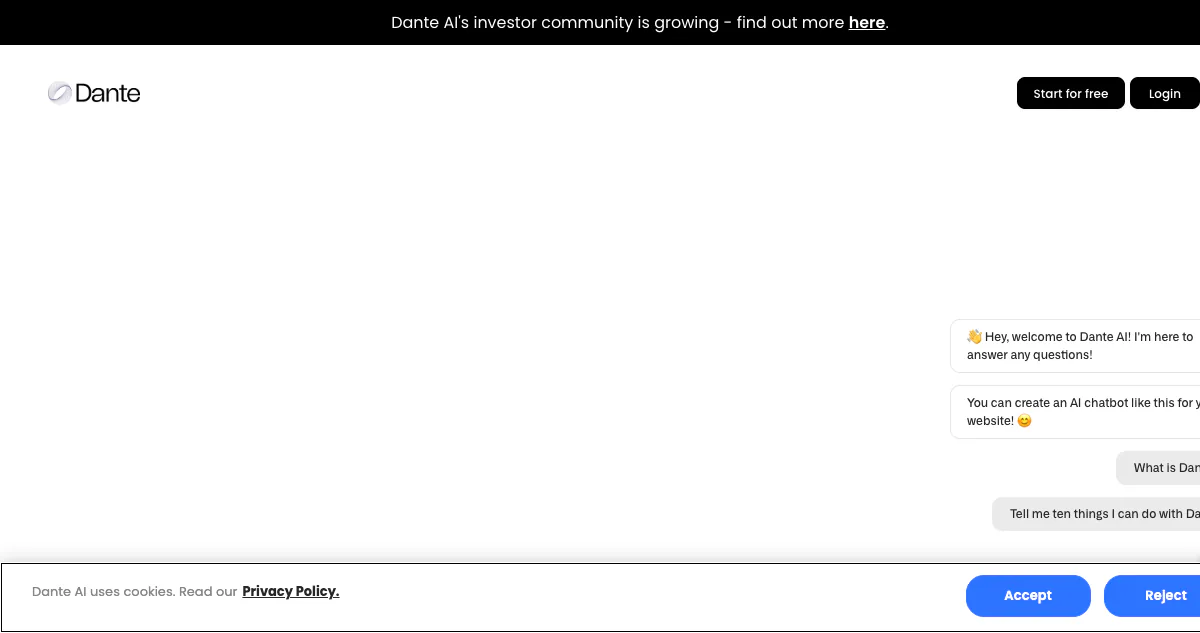
Is Dante AI worth it?
Dante AI is a no-code agent you train on site content and files, then embed. Paid plans open the full model picker. The commercial hook is explicit: one flat monthly fee, never per-resolution, never per-conversation. The vendor contrasts that with other tools at $0.99 to $2.50 per resolution. Credits still meter every answer. Unused credits do not roll over. Top-ups are $20 per 1,000 credits.
Best for small and mid-market teams with repetitive website questions and decent documentation. Weaker as the only system of record for complex support, and weaker on Free or Starter if you need reliable live takeover. Pro at $400 per month is the first public rung that bundles handover, API, daily knowledge updates, white-label, SSO, audit logs, and a 99.9% uptime SLA line.
How we evaluated this
We evaluated Dante as a website knowledge agent with a flat subscription and a credit meter, not as a contact center. Scoring weights pricing honesty (flat fee versus credits and add-ons), model flexibility, handover packaging, knowledge freshness by plan, and implementation risk.
We read the official homepage and pricing page on August 19, 2026, including Free through Pro, yearly two-months-free copy, add-ons, and the credit FAQ. Vendor docs describe WhatsApp handover into the same inbox as the web widget. We did not run a production pilot or audit the 99.9% SLA.
Consult Official Dante AI product page and Official Dante AI pricing page for product documentation and plan details. Confirm the terms that apply to your purchase.
Pricing calculation to run
Flat fee beats per-resolution only if you respect the credit ladder
Dante's comparison is fair as far as it goes. If a support org resolves 2,000 AI-handled tickets a month at $0.99 each, that is $1,980 in resolution fees before seats. Dante Pro is $400 per month plus credits you already paid for inside the plan. The catch is that "already included" is a credit pool, not an unlimited reply grant, and unused credits do not roll over.
The pricing FAQ on August 19, 2026 publishes a per-reply ladder:
- 1 credit: GPT-4o mini, GPT-4.1 nano, GPT-5.4 nano.
- 2 credits: Gemini Flash, GPT-4.1 mini.
- 5 credits: Gemini 3 Flash, GPT-5.4 mini, Claude Haiku 4.5, GPT-5.6 Luna.
- 10 credits: most frontier models (GPT-5, GPT-4.1, GPT-4o, Gemini 3.1 Pro, GPT-5.4, GPT-5.6 Terra).
- 15 credits: Claude Sonnet 4.6.
- 25 credits: Claude Opus 4.6 / 4.7, GPT-5.5, GPT-5.6 Sol.
Starter includes 2,000 credits. That is 2,000 nano replies, or 200 ten-credit frontier replies, or 80 Opus-class replies. Advanced's 8,000 credits is 800 frontier replies. Pro's 30,000 is 3,000 frontier replies or 1,200 at 25 credits. If you default every conversation to Opus because a demo looked fluent, Starter dies in a week. If you ship nano and only escalate hard questions to Sonnet, Starter can last a modest site.
Add-ons change the "flat" story. Extra credits are $20 per 1,000, which is cheaper than Chatbase's $40 per 1,000 message credits, but Dante credits expire at month end. Extra agents are $20 per month. Branding removal is $50 per month on Starter, Advanced, and Pro (Pro already includes white-label in the plan bullets, so confirm you are not double-buying). Human handover is $50 per month per 500 conversations on Starter and Advanced, and bundled in Pro. A team that stays on Advanced at $120 to avoid Pro, then buys handover ($50) and branding ($50), is at $220 before extra agents or top-ups. Pro at $400 may be the cleaner package once those two add-ons are real requirements.
Bring-your-own OpenAI key is the other lever: LLM calls ride your OpenAI contract and skip Dante credits for those calls. Useful if procurement already has volume pricing. You still pay the Dante plan for the product around the model.
Who Dante AI fits best
Strengths
- Published $0 per resolution on a public page, with a free plan and no credit card to start.
- Credit cost per model class is written down. Few website-bot vendors are this specific.
- Paid plans share the full model menu. You are not gated off Claude or GPT-5 families until Pro. You are gated by credits.
- BYO OpenAI key for buyers who must keep inference on their own contract.
- Character caps scale: 150K Free, 25M Starter, 50M Advanced, 200M Pro.
- Knowledge freshness by plan: weekly auto-update on Advanced, daily on Pro.
- Handover docs include WhatsApp into the same inbox as the web widget, when a number is connected.
Limitations to verify
- Handover is not on Free. On Starter and Advanced it is an add-on pack. Pro bundles it.
- API, SSO, audit logs, SLA language, dedicated account manager: Pro.
- Unused credits do not roll over. Idle months waste the pool.
- Each plan includes 1 AI agent. Extra agents are $20 per month each.
- Seats: 1 / 2 / 3 / 5. This is not a large inbox product.
- Deep commerce mutations (refunds, exchanges) are not the public pitch. Test any action you need.
- Homepage copy is thinner than the pricing FAQ. Buy from the pricing page and a demo, not from the 60-second teaser.
Channel coverage to verify
The primary surface is a website embed you can place on sites you control. Starter lists "all integrations and deployment options" without naming them on the pricing tile. Vendor docs describe WhatsApp handover into the same inbox. Voice appears in Dante's own how-to guides as an input or agent mode to enable after the chatbot exists. Treat those as items to demo, not as a confirmed omnichannel inbox on every plan.
- Website widget: core path. Test mobile, custom launcher (Starter), custom CSS (Advanced), and white-label (Pro or $50 add-on).
- Custom domain: 1 on Starter.
- WhatsApp: documented handover path. Confirm BSP, Meta fees, and whether it is on your target plan.
- Voice: documented as a feature to turn on. Confirm channel versus in-widget microphone input. Those are different jobs.
- API: Pro. Required for authenticated app embeds that are not a public marketing site.
Workflow execution and handoff
The operating loop is: ingest site and files, pick a model, answer, capture leads (Advanced+), refresh knowledge on a schedule, escalate when the visitor asks for a person or the agent cannot answer. Humans take over in the inbox. Docs say WhatsApp threads land next to web chats when a number is connected.
That loop fails in two boring ways. First, Starter and Advanced buyers forget handover is a $50 / 500-conversation pack and go live with no live path. Second, Pro buyers turn on daily updates but never assign an owner for the knowledge-gap report Advanced already advertises ("top questions and knowledge gaps"). Auto-update will refresh a wrong page as faithfully as a right one.
- After-hours FAQ on a documentation-heavy site.
- Lead capture on Advanced, with a definition of a qualified lead before you turn it on.
- Agency white-label on Pro, or the $50 branding add-on on lower rungs, with a per-client agent at $20 each.
Pricing checked August 19, 2026
Dante AI pricing: Free to $400 per month, two months free yearly
Monthly tiles: $0, $40, $120, $400. Yearly: $400, $1,200, $4,000 (advertised as two months free; the FAQ also says "save up to 30% when billed yearly"). Add-ons stack monthly. Cancel-anytime language is on the page. Unused credits do not roll over. Top-ups are $20 per 1,000 credits on paid plans.
| Plan | Public price | Included capacity / meter | Best fit |
|---|---|---|---|
| Free | $0 | 1 agent, 700 onboarding credits then 100/month, 150K characters, GPT-5.4 nano and GPT-4o mini, website embed, 1 seat | Sandbox and unpublished tests |
| Starter | $40/mo$400 billed yearly | 2,000 credits, 25M characters, all advanced models, integrations, analytics, custom launcher, usage caps, 1 custom domain, 2 seats | Hobby sites that can live without bundled handover |
| Advanced | $120/mo$1,200 billed yearly | 8,000 credits, 50M characters, weekly auto-update, knowledge-gap signals, custom CSS, lead capture, 3 seats | Growing sites that still buy handover as a pack if needed |
| Pro | $400/mo$4,000 billed yearly | 30,000 credits, 200M characters, API, daily auto-update, white-label, human handover, SSO, audit logs, 99.9% SLA language, 5 seats, dedicated AM | Teams that need API, takeover, and governance in one tile |
Source: dante-ai.com/pricing, August 19, 2026. Confirm taxes, add-on stacking, and whether Pro white-label means you can skip the $50 branding add-on.
Published add-ons
| Add-on | Public price | Included capacity / meter | Best fit |
|---|---|---|---|
| Remove Dante branding | $50/mo | White-labeled agent. Listed for Starter, Advanced, Pro. | Client sites on lower plans. Confirm overlap with Pro's included white-label. |
| Extra AI agent | $20/mo | Each extra agent bills separately. Base plans include 1. | Second brand, language, or site. |
| Extra credits | $20 per 1,000 credits | Top-up when the monthly pool runs out. Unused plan credits still do not roll over. | Peak weeks, if you will not upgrade the plan. |
| Human handover | $50/mo per 500 conversations | Inbox for live takeover. Bundled in Pro. Listed for Starter and Advanced. | Any public agent that must reach a human. |
AI capability and model choice
Free is limited to light models (GPT-4o mini, GPT-4.1 nano, GPT-5.4 nano). Every paid plan opens the rest of the picker, including GPT-5.x families, Claude Haiku / Sonnet / Opus, and Gemini 3.x, per the FAQ. Heavier models cost more credits. Plan choice is volume, not access. You can test models side by side on your content and switch in one click, according to the same FAQ.
That flexibility is the product. It is also how teams blow Starter. Measure grounded accuracy and credits per resolved conversation on two models before you set a production default. If a 10-credit model is only slightly better than a 2-credit model on your corpus, the cheaper default funds more conversations and a cleaner Pro upgrade later.
Feature areas to verify
- Website and document training, character caps by plan.
- Model picker and on-screen credit use per reply.
- Analytics on paid plans; knowledge-gap signals on Advanced.
- Lead capture on Advanced.
- Custom launcher, CSS, domain, white-label by rung.
- Human handover inbox, including WhatsApp if you need it.
- API, SSO, audit logs, SLA language on Pro.
- Auto-update weekly (Advanced) or daily (Pro).
- Usage cap controls on Starter+.
- BYO OpenAI key.
Analytics and operating visibility
Starter adds an analytics dashboard. Advanced adds AI-identified top questions and knowledge gaps. Those views only matter if someone closes the gaps. Export or screenshot week-one baselines: credits per conversation, unknown rate, handover rate, and lead-capture count if you use it.
Because unused credits die at month end, analytics has a finance job too. If you consistently burn 1,500 of Starter's 2,000, stay. If you top up $20 x 3 every month, upgrade to Advanced. If you use 20,000 credits of Opus on Advanced, you are paying for the wrong model or the wrong plan. Dante shows credits per reply in the product, per the FAQ. Use that, not a gut feel.
Security, data handling, and compliance
Pro lists SSO, audit logs, and 99.9% uptime SLA language. The public pricing FAQ does not substitute for a SOC 2 report. Request DPA, subprocessors, retention, training-data policy, and region controls in writing. BYO OpenAI key changes where inference happens. Document that path with security if you use it.
- Define topics the agent must never answer: credentials, payment disputes, medical or legal advice.
- Map 1 to 5 seats to admin versus operator. Five Pro seats is still a small control plane.
- If you need HIPAA or a signed BAA, ask. It is not on the public Free-to-Pro tiles we captured.
What questions should you ask before buying Dante AI?
- How many credits did 50 of our real questions consume on nano, on a 10-credit model, and on Sonnet 4.6?
- Do unused credits ever roll over on annual billing, or is monthly forfeiture the rule in all cases?
- Is human handover included in our quote, or is it $50 per 500 conversations?
- If we are on Pro, do we still see the $50 branding add-on at checkout?
- Show WhatsApp takeover into the same inbox as the widget, on our test number.
- What does the 99.9% SLA actually credit if we miss it?
- Can we use our OpenAI key for production, and what then happens to Dante credit accounting?
- Who on our side owns weekly knowledge-gap cleanup?
What red flags should you watch for with Dante AI?
- A demo that only uses nano credits, then a production default on Opus.
- Going live on Starter with no handover pack and no human path.
- Annual commit before you have a week of credit-burn data.
- Buying extra agents for brands that share one messy corpus.
- Treating "no per-resolution fee" as "no variable cost." Top-ups and add-ons are variable.
- Assuming Free includes a durable published agent. Free is 100 credits per month after onboarding.
What are the best alternatives to Dante AI?
Compare on meter type (credits versus messages versus resolutions) and on where handover lives.
- SiteGPTChoose SiteGPT when you want message quotas, citations, and staged auto-refresh, and you can model the double-count of question plus reply.
- ChatbaseChoose Chatbase when you need procedures, optional voice, and a helpdesk view on Standard, and you can live with message credits plus add-ons.
- YourGPT AIChoose YourGPT when omnichannel actions are the job, not a flat website agent with a credit picker.
- TidioChoose Tidio when live chat plus a lighter bot is enough and you do not want a model-credit spreadsheet.
- GorgiasChoose Gorgias when Shopify order context is the system of record.
Workflow test
What Dante AI needs to prove in a real workflow
- Train on the live site and the five documents that drive tickets.Score 50 real questions. Record grounded correct versus fluent wrong.
- Measure credits per conversationon the model you will actually ship, then on one cheaper and one more expensive model. Unused credits will not wait until next month.
- Turn on handover on the plan you will buy.If that means a $50 pack, buy it in the trial. A Pro-only demo of takeover is not evidence for a Starter rollout.
- Compare 30-day costagainst SiteGPT message quotas and Chatbase credits plus add-ons, using the same sample set. Then pick monthly or yearly.
Related reading
Related reading
Claim and source ledger
What this profile is based on
Official Dante AI homepage and pricing page as of August 19, 2026: Free through Pro prices, yearly billing as two months free, credit-per-reply ladder, add-on prices, BYO OpenAI key FAQ, and $0 per-resolution positioning. Vendor documentation on inbox handover, including WhatsApp, is treated as product-doc evidence, not as a live test. No on-disk screenshots exist for this tool, so source cards are links only. Logo path is the live /images/logos/favicons/dify-ai.svg asset.
What we did not verify
We did not measure credit burn on a customer corpus, test WhatsApp or voice in production, audit the 99.9% SLA, or confirm whether the $50 branding add-on is hidden at Pro checkout. Character extraction quality on PDFs and tables was not tested. Competitor per-resolution figures ($0.99 to $2.50) are Dante's comparison copy, not an independent survey of every rival.
How we scored fit
Fit weights pricing honesty after credits and add-ons, model flexibility, handover packaging, knowledge freshness, and implementation risk. It is not a benchmark or a star average.
Should you choose Dante AI?
Choose Dante when you want a website knowledge agent with a flat subscription, a written credit ladder, and no per-resolution line item, and when you will pick a default model using measured credits per correct answer. Free is for tests. Starter at $40 is for low-volume, light models. Advanced at $120 adds weekly refresh and lead capture. Pro at $400 is the first public bundle that looks like a serious operating plan: API, daily refresh, handover, white-label, SSO.
Skip Dante if you need a Shopify helpdesk, Intercom-native resolutions, or live takeover on the free tier. Skip it if nobody will watch the credit meter. Run the four-step test and a peak-month model, including $50 handover packs if you are not buying Pro, before you take the two-months-free yearly deal.
FAQ
Common questions
How much does Dante AI cost?
August 19, 2026 public tiles: Free $0; Starter $40 per month or $400 per year; Advanced $120 or $1,200 per year; Pro $400 or $4,000 per year. Yearly is sold as two months free. Add-ons: branding $50 per month, extra agent $20 per month, extra credits $20 per 1,000, handover $50 per month per 500 conversations on Starter and Advanced.
Does Dante AI charge per resolution?
The official pricing page says no: $0 per resolution, $0 per conversation. Credits still meter each reply. Unused credits do not roll over. That is a different variable cost, not a resolution invoice.
How do Dante credits work?
Lightest models cost 1 credit per reply. Mid-tier models cost 2 or 5. Most frontier models cost 10. Claude Sonnet 4.6 costs 15. Opus-class and GPT-5.6 Sol cost 25. Starter 2,000 / Advanced 8,000 / Pro 30,000 per month. Each reply shows credits used, per the FAQ.
When do I need Pro?
When you need API, daily knowledge updates, bundled handover, white-label, SSO, audit logs, SLA language, or five seats. If you only need takeover, price the $50 / 500-conversation pack on Advanced against Pro's $400 bundle.
Can I use my own OpenAI key?
Yes, per the pricing FAQ. Calls go to OpenAI on your key and skip Dante credits for those calls. You still pay the Dante plan. Confirm compliance and logging with your security team.
Does the free plan include human handover?
No. Free is a limited published agent: 100 credits per month after onboarding, light models, one seat. Handover is an add-on on Starter and Advanced, bundled on Pro.
Dante AI vs SiteGPT?
Dante meters credits by model. SiteGPT meters messages and counts question plus reply, with a 10x spread between GPT-4.1 and mini. Run the same 50 questions through both and compare 30-day cost plus handover packaging.
Is Dante AI good for ecommerce?
Good for policy and catalog Q&A if content is clean. Do not assume order mutations work. Compare Gorgias if Shopify tickets are the job.
Do unused credits roll over?
The official FAQ says they do not. Top-ups at $20 per 1,000 are for mid-month exhaustion, not a bank.
Who should skip Dante AI?
Skip it if you need dense multi-channel enterprise support, free-tier live takeover, or you will not assign an owner for failed answers and credit reviews.
Also review